One of the first things people tell you about Indonesian grammar is that it's "simple." No verb conjugations, no gendered nouns, no tenses in the way English handles them. And that's true, mostly. But then you try to build a sentence and realize that while Indonesian might not care about verb conjugations, it definitely cares about where you put things.
I spent my first month in Indonesia constructing perfectly logical sentences that technically had all the right words in them. The problem was I'd built them using English word order rules, and Indonesians would pause for half a second before figuring out what I meant. That pause is the linguistic equivalent of someone tilting their head at you like a confused dog. Not ideal.
Here's what I wish someone had explained up front about how Indonesian sentences actually work.
The basic pattern (which you'll use constantly)
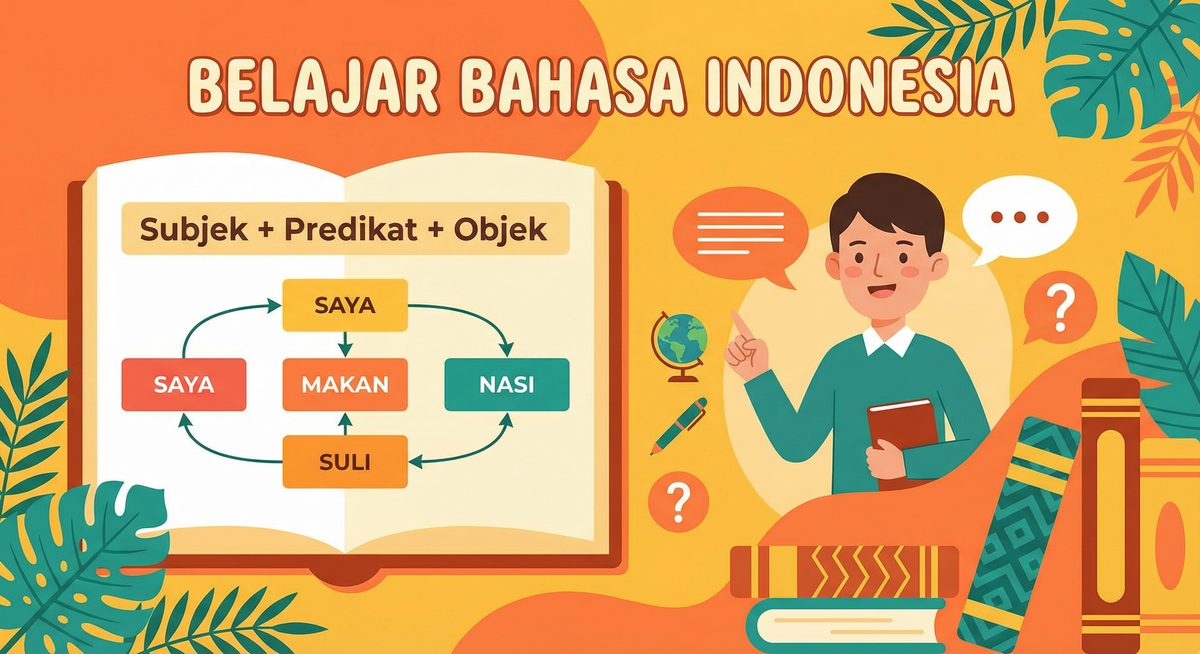
Indonesian follows Subject-Verb-Object order, same as English. Saya makan nasi (I eat rice). Subject: saya (I). Verb: makan (eat). Object: nasi (rice). Straightforward.
This works for most simple statements. Dia membaca buku (She reads a book). Mereka minum kopi (They drink coffee). Once you've got pronouns down, you can build a lot of basic sentences just by following English word order.
The thing English speakers need to unlearn is the urge to stick modifiers everywhere. In English we wedge adjectives and adverbs into sentences whenever we feel like it. Indonesian is pickier about placement.
Adjectives go after nouns (not before)
This one trips up everyone coming from English. In Indonesian, adjectives follow the noun they modify. Rumah besar (house big) means "big house." Mobil merah (car red) means "red car."
Your brain will want to say besar rumah because that's English word order flipped into Indonesian vocabulary. Don't. It sounds wrong. Indonesians will probably understand you because they're used to foreigners mangling this, but it'll mark you as someone who hasn't internalized the pattern yet.
Multiple adjectives stack in the same order. Rumah besar merah (house big red) is "big red house." It reads a bit like Yoda-speak to English ears, but you get used to it fast.
The one exception is numbers, which go before the noun. Dua kucing (two cats). Lima buku (five books). Numbers have their own rules, and they don't follow the adjective pattern. I have no idea why. That's just how it is.
Possession: whose thing is whose
Possession works similarly. The possessor comes after the thing possessed. Buku saya (book I) means "my book." Mobil dia (car he/she) means "his/her car."
English speakers want to say saya buku because we say "my book" with the possessive first. You'll get corrected on this approximately a hundred times before it sticks. I still catch myself starting to do it wrong occasionally, especially when I'm tired.
The word punya (to have/own) gives you another option. Buku punya saya (book owned-by I) also means "my book," but it's more formal and a bit wordier. For casual conversation, just stick with buku saya.
Questions: intonation vs question words
Indonesian has two ways to form questions, and they're structurally quite different.
For yes/no questions, you don't change the word order at all. You just add -kah to the verb (formal) or raise your intonation at the end (casual). Kamu makan nasi (You eat rice) becomes Kamu makan nasi? with rising intonation. Same sentence. Different punctuation. That's it.
Alternatively: Apakah kamu makan nasi? uses the question particle apakah at the start. More formal, but common in writing.
For information questions (who/what/where/when/why), you use question words. The full breakdown is in the question words guide, but the short version is that question words usually replace the thing you're asking about, in the same position.
Kamu makan apa? (You eat what?) means "What are you eating?" The question word apa (what) sits where the object would normally go.
Siapa yang makan nasi? (Who that eats rice?) means "Who is eating rice?" The question word siapa (who) takes the subject position, and you add yang as a relative marker.
This is where Indonesian word order starts feeling genuinely different from English, because English moves question words to the front of the sentence. Indonesian mostly doesn't. The question word stays in the position of the thing it's asking about.
Negation: where "tidak" and "bukan" go
Negation in Indonesian uses tidak (for verbs and adjectives) or bukan (for nouns). Where you put them matters.
Tidak goes right before the verb or adjective. Saya tidak makan (I not eat) means "I don't eat" or "I'm not eating." Ini tidak besar (This not big) means "This is not big."
Bukan goes before nouns. Ini bukan buku (This not book) means "This is not a book."
English speakers want to insert "do not" or "is not" in here somewhere because we use auxiliary verbs for negation. Indonesian doesn't have that concept. You just stick the negation word directly in front of what you're negating. No extra machinery.
The one that gets people is negating "have," because Indonesian doesn't have a direct equivalent to "have" as a verb. You use punya or you use ada (to exist). Saya tidak punya mobil (I not have car) means "I don't have a car." Tidak ada makanan (not exist food) means "There is no food."
Time expressions: front or back, your choice
Time words can go at the beginning or end of a sentence, depending on what you're emphasizing. Besok saya pergi (Tomorrow I go) and Saya pergi besok (I go tomorrow) both mean "I'm going tomorrow." The first version emphasizes the time. The second version is more neutral.
Indonesian time expressions are flexible in a way that English isn't. You can front-load them for emphasis or tuck them at the end for flow. Neither is wrong. It's just a style choice.
What you can't do is wedge them into the middle of the sentence randomly. Saya besok pergi sounds broken. Time expressions belong at one end or the other, not floating around in the middle.
Particles: the chaos layer
Here's where Indonesian sentence structure stops being "simple" and starts being "you'll figure this out after living here for six months."
Indonesian has a bunch of particles (lah, dong, sih, kok, and others) that modify the tone or emphasis of a sentence. They mostly go at the end, but their placement can shift meaning in subtle ways. I wrote an entire post about particles because they're a whole separate grammar beast.
The short version: particles don't change the core sentence structure, but they add layers of meaning that don't exist in English. Makan dong (eat + persuasive particle) is more like "Come on, eat!" than just "Eat." Kamu makan sih (you eat + contradictory particle) implies "You ARE eating (despite what you said)."
You can build grammatically correct sentences without particles. They just won't sound natural. Indonesians use them constantly in spoken language, and if you want to sound remotely fluent, you need to learn when to drop them in.
When word order actually bends (advanced stuff)
Indonesian word order is flexible in ways that English isn't, but that flexibility has rules. You can't just scramble words randomly and hope for the best.
Fronting for emphasis: you can move the object to the front of the sentence if you're emphasizing it. Nasi saya makan (rice I eat) means "It's rice that I'm eating" with heavy emphasis on the rice. This sounds weird in casual conversation, but it shows up in formal writing and when people are being emphatic or contrastive.
Passive voice: Indonesian has multiple passive constructions (di- prefix, ter- prefix, ke-...an circumfix), and they change word order in specific ways. The verb prefix guide covers some of this, but passives are a whole separate topic. The key thing is that passive voice in Indonesian isn't just "optional formal version of active voice" the way it sometimes is in English. It actually changes the focus and sometimes the meaning.
Cleft sentences with yang: Yang makan nasi adalah saya (That eat rice is I) means "The one who is eating rice is me." The relative marker yang lets you split sentences for emphasis in ways that don't map neatly onto English structure.
I'm not saying you need to master all of this immediately. I'm saying that once you've got basic SVO order down, there's a whole layer of structural flexibility that Indonesian speakers use for emphasis, tone, and focus. It takes time to develop an ear for when those variations sound natural versus when they sound broken.
Why this actually matters
You can communicate in Indonesian with basic SVO word order and noun-adjective flipping. People will understand you. But if you want to sound remotely fluent, you need to internalize these patterns to the point where you're not actively thinking about them.
The difference between a beginner and an intermediate Indonesian speaker often isn't vocabulary size. It's whether you're still consciously translating English sentence structure into Indonesian, or whether you're building sentences that follow Indonesian structural logic from the start.
I still mess this up. I'll be three sentences into explaining something and realize I've just built a sentence using English word order with Indonesian vocabulary, and the person I'm talking to has that polite-confusion look on their face. It happens less now than it used to, but it happens.
The fix is repetition and exposure. Read Indonesian sentences. Listen to how native speakers structure things. Pay attention not just to the words but to the order they're coming in. Your brain will start picking up the patterns subconsciously, and eventually you'll stop thinking about it.
But until then, remember: Subject-Verb-Object for basic statements, adjectives after nouns, possessor after possessed, negation before what you're negating, and time expressions at the edges. Get those right and you're already better than most tourists.
The mistakes I still catch myself making
Even after a few years of using Indonesian regularly, I still mess up word order in predictable ways. The most common one is front-loading adjectives when I'm speaking quickly. My brain grabs the English pattern and runs with it before I can stop it.
The other thing I screw up is complex sentences with multiple clauses. Indonesian has specific patterns for how subordinate clauses connect to main clauses, and I still haven't fully internalized all of them. I can usually muddle through, but sometimes I'll construct a sentence that's technically grammatical but sounds unnatural because I've joined the clauses in a way that Indonesians just wouldn't.
The mistakes post covers some of this, but the deeper truth is that Indonesian sentence structure has patterns that only reveal themselves after you've heard them a hundred times. You can read grammar explanations (like this one) and understand them intellectually, but understanding and internalizing are different things.
If you're just starting out, don't stress about getting everything perfect. Build simple sentences. Use basic word order. Practice with actual Indonesian speakers who will correct you when you sound weird. That's how you get better.
The grammar will click eventually. And when it does, you'll stop thinking about where adjectives go and start thinking in Indonesian sentence patterns naturally. That's the point where the language stops feeling like a translation exercise and starts feeling like communication. You'll get there. Just takes time.