You learn satu, dua, tiga on day one. One, two, three. Easy. The textbook tells you Indonesian is logical and simple.
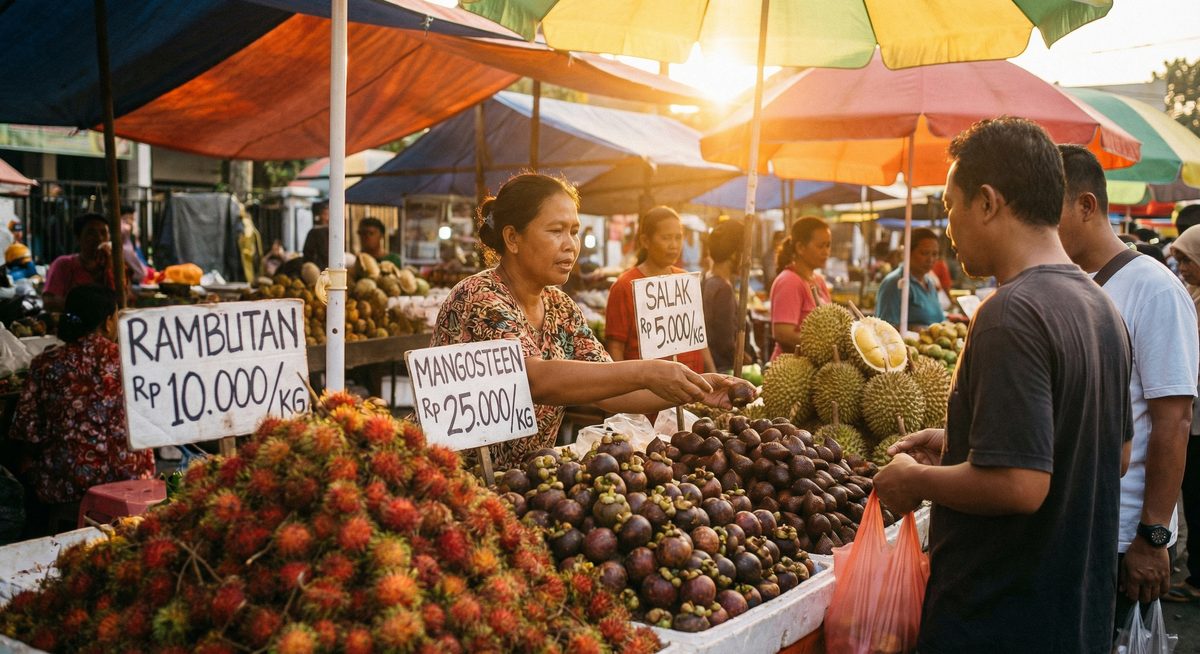
Then you're at a market in Jakarta and the vendor says "dua puluh lima ribu" and you're trying to multiply twenty by five by a thousand in your head while she's already wrapping the mangos. This is the stuff they don't tell you.
The basics (that everyone teaches)
Indonesian numbers from 1-10 are straightforward:
- 1 = satu
- 2 = dua
- 3 = tiga
- 4 = empat
- 5 = lima
- 6 = enam
- 7 = tujuh
- 8 = delapan
- 9 = sembilan
- 10 = sepuluh
Great. You're ready to count to ten. The problem is nobody at the market is selling anything for ten rupiah.
Where it gets weird: the -belas numbers
11-19 use this suffix "-belas" stuck on the end. So eleven is "sebelas" (literally "one-teen"). Twelve is "dua belas" (two-teen). Fine.
Except "sebelas" isn't "satu belas" — it contracts to "se-" because Indonesian hates redundant syllables. Same thing happens with "seratus" (one hundred, not "satu ratus") and "seribu" (one thousand, not "satu ribu").
This seems minor until you're learning and you keep saying "satu belas" and people keep correcting you. Just remember: whenever "satu" is stuck at the front of a number unit, it usually becomes "se-".
Puluh: the part that makes market math hard
After nineteen, you hit the "puluh" system. Twenty is "dua puluh" (literally "two tens"). Thirty is "tiga puluh" (three tens). This makes sense on paper.
But when someone says "tiga puluh lima ribu" you're hearing four different number words in rapid succession: three, tens, five, thousand. Your brain has to assemble: (3 × 10) + 5 = 35, then multiply by 1,000 = 35,000 rupiah.
I still have to pause and work this out consciously. The locals do it instantly because they've been hearing "X puluh Y ribu" their whole lives. You get there eventually, but be patient with yourself when you're standing at the warung counter doing mental arithmetic.
The ribu/ratus/juta mess
Indonesian has specific words for hundred (ratus), thousand (ribu), and million (juta). Vendors at traditional markets usually talk in thousands because that's the denomination that matters.
A mango costs 20,000 rupiah? They'll say "dua puluh ribu" (twenty thousand). Not "dua puluh ribu rupiah" — the "rupiah" is implied. If you're not expecting the thousands unit, you'll think everything costs 20x less than it does.
Here's what confused me early on: when writing prices, Indonesians use dots as thousand separators. So Rp 20.000 is twenty thousand, not twenty rupiah. (They use commas for decimals, opposite of English.) I saw "Rp 5.000" on a menu and thought coffee was five rupiah. It wasn't.
Shortcuts everyone actually uses
In real life, people drop words to save time. At the market:
- "Lima!" = 5,000 (not 5)
- "Dua lima!" = 25,000 (not 2.5 or 2-5)
- "Seratus lima puluh!" = 150,000
Context is everything. Nobody's selling bananas for 5 rupiah, so "lima" means lima ribu. If you're buying a motorcycle, "lima" might mean 5 million (lima juta). You pick this up by listening.
Also: people will say "sepuluh ribu" but almost never "satu ribu" — they'll just say "seribu" (one thousand). It's like how English speakers say "a thousand" instead of "one thousand."
Phone numbers are their own language
Indonesians read phone numbers in pairs. The number 08123456789 gets read as:
"nol delapan, satu dua, tiga empat, lima enam, tujuh delapan sembilan"
That's: zero-eight, one-two, three-four, five-six, seven-eight-nine.
Sometimes they'll say "dobel" for repeated numbers: "dobel delapan" = 88. But not always. It depends on the person.
I once tried to read out a phone number using the normal counting system ("nol, delapan, satu, dua, tiga...") and got very confused looks. Just pair them up.
The bargaining numbers you need
If you're going to bargain at markets, these phrases saved me:
- "Berapa harganya?" = How much?
- "Terlalu mahal!" = Too expensive!
- "Bisa kurang?" = Can you go lower?
- "[Number] aja" = Just [number] (offering a counterprice)
Example: Vendor says "lima puluh ribu" (50,000). You say "tiga puluh ribu aja" (just 30,000). They'll probably meet you at 40,000.
The key skill isn't fancy grammar — it's being able to hear "lima puluh" and instantly know that's fifty, not five and not five thousand. That comes from repetition, not textbooks.
What actually helped me
Reading price tags. Seriously. Every time I walked past a store, I'd read the price tags out loud in Indonesian. Rp 15.000 = "lima belas ribu." Rp 225.000 = "dua ratus dua puluh lima ribu."
It's boring. But after doing this for a few weeks, the puluh/ribu combinations started clicking automatically. I stopped having to consciously calculate.
Also: use Indonesian counting when you're doing mundane stuff. Counting stairs, counting reps at the gym, counting items at the grocery store. The more you use the numbers outside of "study time," the faster they become reflexive.
If you're serious about getting conversational quickly, numbers are one of those things you can't skip. They're not glamorous, but you'll use them every single day. At the market, in taxis, reading menus, checking your phone.
Start with the basics. Then go find a street market and force yourself to ask prices. You'll stumble. The vendors will repeat themselves slower. You'll get it wrong and hand them the wrong bills. That's fine. That's how it sticks.
The textbook gets you to "dua puluh lima ribu." The market gets you to the point where you hear it and instantly know it's 25,000 without thinking. There's no shortcut for that part — you just have to do the reps.
Ready to practice? Try our interactive lessons that include real market scenarios and listening exercises. The numbers module has audio from native speakers so you can train your ear on actual market speeds, not slow textbook pronunciation.