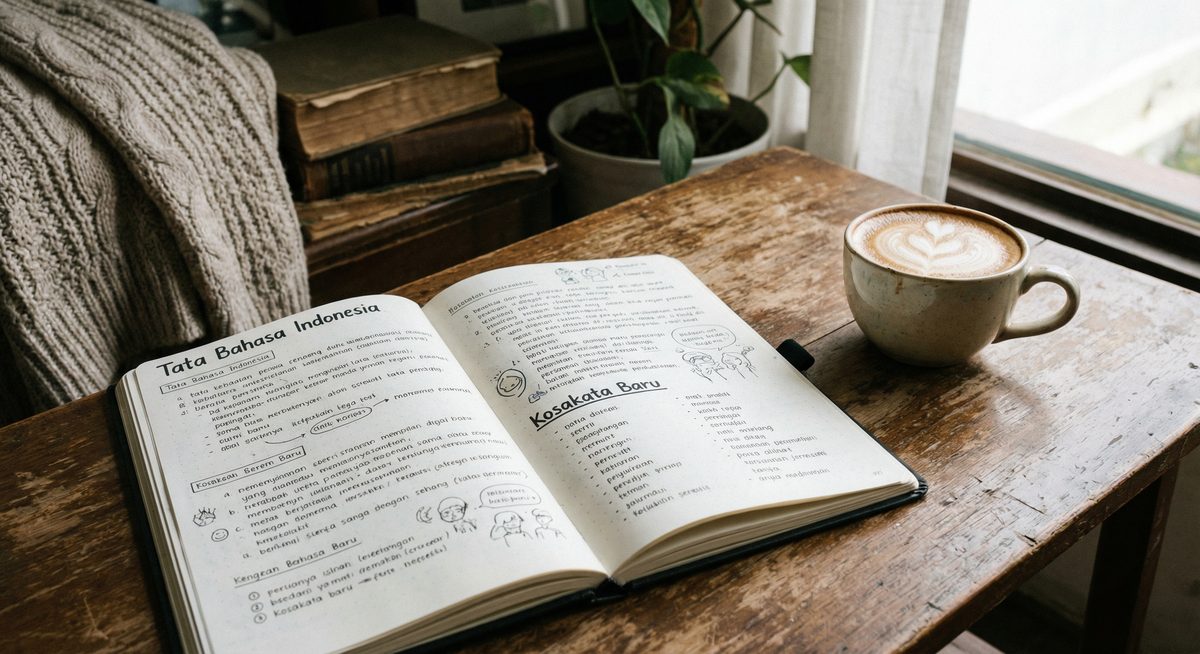
I have been thinking about this for a while, and I think the reason most language learning advice doesn't work is that it was written by people who had already learned the language. They're telling you what they remember working, not what actually worked. The two are different. Memory is generous with past effort. It smooths out the boring parts and the failures and leaves you with this clean narrative about immersion and discipline and daily practice. The reality, at least for me, was messier than that.
I started learning Indonesian in October 2024. By February 2025 I was having phone conversations, badly, but real ones, with a friend in Surabaya. Four months from nothing to functional. That sounds fast and in some ways it was. But it did not feel fast while it was happening. It felt slow and frustrating and full of plateaus where I'd go a week without feeling like I'd improved at all.
What I keep coming back to is that the conventional wisdom about language learning assumes a kind of person I am not. "Immerse yourself" assumes you live near speakers of the language or can move somewhere. I was in Manchester. "Watch films in the target language" assumes you can tolerate not understanding 90% of what is happening on screen for months. I cannot. I tried watching a film called Ada Apa Dengan Cinta, which everyone recommends, and turned it off after twenty minutes because the frustration outweighed any possible learning benefit. Maybe I have less patience than other people. Probably, actually. But the advice still didn't work for me, and pretending it did wouldn't help anyone reading this.
So here is what I did instead.
The first two weeks I spent entirely on what I'd call survival vocabulary. Not themed lists like "at the airport" or "in the kitchen." Just the words that appear in almost every sentence in any language. Ini, itu, mau, bisa, tidak, ada, sudah, belum, ke, dari, di, yang. Maybe 50 words total. I drilled these with spaced repetition until I could produce them without thinking. Not recognize them on a screen. Produce them. There is an enormous gap between those two things that nobody talks about enough. I could "recognize" probably 200 words after week one. I could actually use maybe 30 of them under any kind of pressure.
After those two weeks I started texting. Not speaking, texting. I found a conversation partner on HelloTalk, a university student in Malang named Dian who was learning English. Our deal was simple: I'd text her in Indonesian, she'd text me in English, and we'd correct each other. The reason texting worked so much better than speaking at that stage was time. When you're speaking, there's this social pressure to respond quickly. Your brain panics, goes blank, defaults to English. Texting gives you thirty seconds to look up a word, construct a sentence, double-check that you haven't accidentally said something offensive. I spent those first few weeks of texting with Google Translate open in a second tab and I don't feel bad about it. The point was production, not perfection.
Something I did not expect to matter as much as it did: talking to myself. I know how this sounds. But I started narrating my day in Indonesian, just in my head, while doing mundane things. Making coffee. "Saya mau bikin kopi." Walking to the shop. "Saya jalan ke toko." Waiting for the bus. "Busnya belum datang." (The bus hasn't come yet, which in Manchester is a permanent state of being.) What this does, I think, is train the retrieval pathway. The words are in your head from studying, but the route from thought to word is unpaved. You have to walk it enough times for it to become automatic. Talking to yourself paves that road without the anxiety of a real conversation.
By week six or seven I started doing something I haven't seen recommended anywhere. I would pick up my phone, open the voice recorder, and try to talk about my day in Indonesian for two minutes straight. Then I would play it back. The first few recordings were painful. Long pauses. English words jammed in where I couldn't find the Indonesian one. Pronunciation that sounded nothing like what I heard from native speakers. But the recordings also showed me exactly where my gaps were. I kept needing the word for "because" and not remembering it (karena). I kept wanting to say "I think that..." and freezing (saya pikir). So those became my focus words for the next few days. The recordings were ugly but they were honest in a way that quizzes and flashcards are not.
The grammar side of Indonesian is where things get genuinely interesting, if you're the kind of person who finds patterns interesting. There is no conjugation. Zero. The verb "makan" (eat) is "makan" whether I'm eating, you're eating, we ate yesterday, or they will eat tomorrow. Tense comes from context or from words like "sudah" (already), "sedang" (currently), "akan" (will). Once I stopped trying to find the conjugation tables that didn't exist, the language opened up. It is like, wait actually, it is more like building with Lego than following a recipe. You have these root words and a set of prefixes and suffixes that modify meaning in predictable ways. "Me-" makes it active. "Di-" makes it passive. "-an" makes it a noun. "Pe-" plus "-an" makes it the process. Once you know that, you can build and decode words you have never seen before.
I wrote the prefix and suffix patterns on a sticky note and put it on my monitor. Looked at it fifty times a day for two weeks. After that I didn't need it anymore. Those patterns are the single most valuable thing I learned and I wish someone had told me about them on day one instead of week four.
Around month three something shifted. I stopped translating in my head. Not for everything, but for common phrases. "Saya mau makan" stopped being "I-want-eat" and started just meaning what it means. This is the moment people talk about when they say a language starts to "click," and I understand why they use that word because it does feel like something clicking into place, like a gear engaging. It is not dramatic. You don't notice it happening. You notice afterwards that it happened.
By month four I made my first phone call in Indonesian. To Dian, the same person I'd been texting. It was terrifying. She spoke quickly, used slang I'd never seen in texts ("gue" instead of "saya," "nggak" instead of "tidak"), and I understood maybe 60% of what she said. But I got my point across. We talked for fifteen minutes. When I hung up I felt like I'd run a race. Exhausted but satisfied in a way that no flashcard session has ever made me feel.
If I were starting over, the things I would keep: survival vocab first, texting before speaking, talking to myself constantly, voice recordings, the prefix/suffix sticky note. The things I would drop: trying to watch films early on, using grammar textbooks, comparing my progress to other people's timelines. Everyone learns at a different speed and reading about someone who "became fluent in 8 weeks" just made me feel behind.
I am not fluent now. I want to be honest about that. I can have conversations, understand most of what's said to me if people speak at a normal pace, read simple articles, and text without needing to look things up every other word. I still struggle with fast speech, regional accents, and formal Indonesian. But the distance between where I started and where I am feels significant, and I covered it in four months of 20-30 minutes a day with a few trips to actually use what I'd learned.
The thing nobody tells you is that getting "conversational" is not a destination, it is a range. Some days I am sharp and words come easily. Other days I forget how to say "yesterday" and have to mime it. Both of those days count. Whatever tool you use, the real variable is whether you show up consistently, even on the days when it feels like you've forgotten everything you ever knew. You haven't. Your brain is just being difficult. It does that.