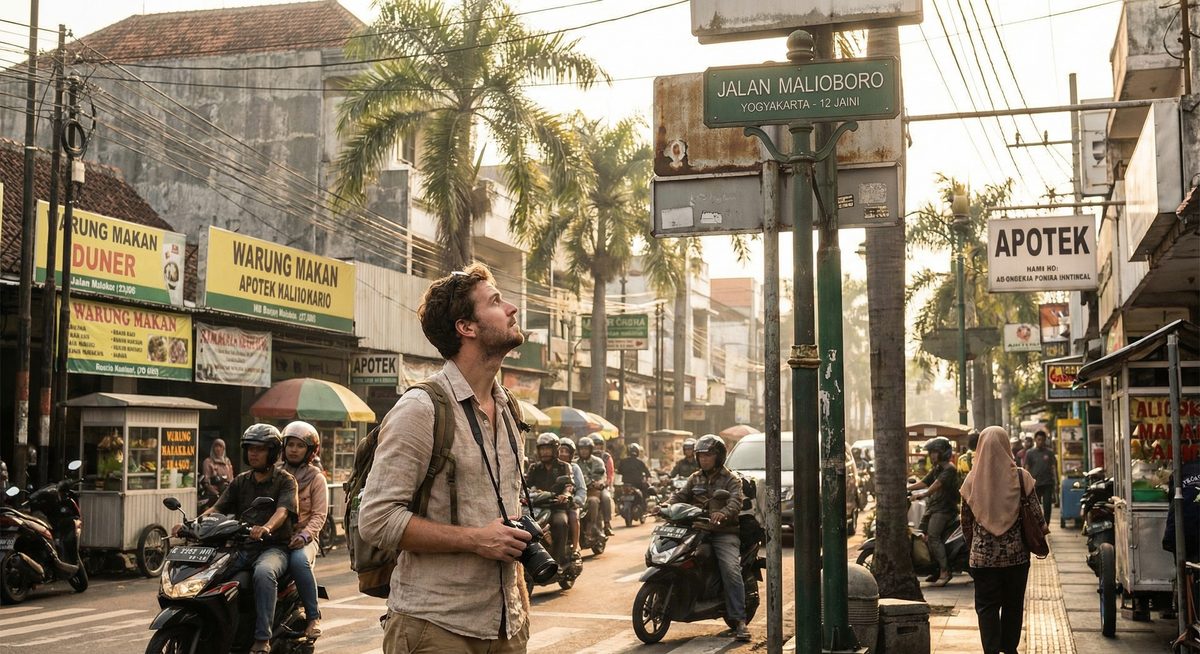
Notes from three weeks across Java and Bali. These are the phrases I actually used, roughly in order of how often I needed them. Not the phrases a textbook thinks you need.
The ones I said ten times a day, minimum
"Ini apa?" = What's this? Point at food, at signs, at anything confusing. I said this so much that a vendor at Pasar Beringharjo in Yogya started preemptively explaining things when she saw me coming. Probably got sick of me asking.
"Harganya berapa?" = How much? You need this constantly. Street food, markets, Grab drivers when the app glitches. At the Ubud art market I was quoted 450,000 rupiah for a wooden cat. I said "berapa?" with enough skepticism in my voice that she dropped it to 150,000 without me even negotiating. Your tone does half the work.
"Satu ini" = One of this. The ordering phrase. Point and say it. "Dua" for two. "Tiga" for three. That's it. I watched other tourists try to construct full sentences to order food and by the time they finished, the warung had served three locals. Just point, say the number, done.
"Terima kasih" = Thank you. Okay fine, this one IS in every phrasebook and yes, you do use it constantly. But shorten it to "makasih" in casual situations. Everyone does.
Food stuff (because eating is 70% of being in Indonesia)
"Tidak pakai" = Without. Then add whatever you want removed. "Tidak pakai cabe" got me through Padang restaurants where everything defaults to volcano-level spice. "Tidak pakai bawang" if you hate onions. I once forgot this phrase in a warung near Tugu station in Yogya and ended up with something so spicy my eyes were watering for twenty minutes. The guy next to me thought it was hilarious.
"Enak banget" = So good / so delicious. Say this after eating. Always. Even if the food is just okay, saying "enak banget" to the person who made it completely changes the interaction. I said this about some mediocre bakso at a random roadside place near Kintamani and the woman gave me a free es teh. Worth it.
"Pedasnya level berapa?" = What's the spice level? Not every place understands this phrasing actually. Some warungs just have one level: hot. But at places that cater to mixed crowds (especially in tourist areas of Bali) this helps. Alternative: just say "tidak pedas" (not spicy) and accept the mild version.
"Nasi goreng" and "mie goreng" and "nasi putih." Not phrases technically, but if you know nothing else, you can always eat. Fried rice, fried noodles, plain white rice. Available everywhere, any time of day, usually between 10,000-25,000 rupiah depending on where you are. The Rp 12,000 nasi goreng from a tent-style kaki lima stall at 11pm hits different from the Rp 45,000 version at a restaurant, and honestly I preferred the cheap one.
Getting around
"Di mana?" = Where? Add any noun. "Toilet di mana?" "ATM di mana?" "Stasiun di mana?" One time in Surabaya I literally just said "Tunjungan Plaza di mana?" to an ojek driver and he pointed me the right direction without even being hired. Just helpful. That seems to be the default mode here.
"Jauh nggak?" = Is it far? The casual version. "Jauh tidak" is the textbook way but nobody talks like that outside of formal settings. When someone says "nggak jauh" you're walking. When they tilt their head, suck air through their teeth, and go "yaaaa... lumayan" (yeahhh... kind of far), get a Grab.
"Kiri" = left. "Kanan" = right. "Lurus" = straight. "Stop di sini" = stop here. The four navigation words for taxis and ojeks. Write them on your hand if you need to. I did, the first week. No shame.
"Berapa ke..." = How much to get to... For metered taxis this doesn't apply, but for anything else (especially around Ubud where everything is negotiated), lead with this. "Berapa ke Tirta Empul?" My Grab wasn't working one morning in Tampaksiring so I flagged a local guy and used this. He said 50,000. Probably tourist price but still like two quid, so fine.
When things go sideways
"Maaf" = Sorry. Bumped into someone, stepped on a foot, broke something in a shop (I did this at a ceramics place in Ubud, cost me 80,000 rupiah and a lot of embarrassment). "Maaf" covers it all.
"Pelan-pelan" = Slowly. When someone's talking and you can't keep up. They will repeat everything at half speed. I love this about Indonesian speakers. There is zero annoyance. They just slow down.
"Bisa bantu?" = Can you help? The panic phrase. I used this when I got completely lost in Kampung Arab in Surabaya, which has these narrow alleyways that all look the same. A kid maybe ten years old walked me back to the main road. Refused any money. Just waved and ran off.
"Saya nggak ngerti" = I don't understand. The short version. Textbooks teach "saya tidak mengerti" which is fine but longer than necessary. Drop the "tidak" for "nggak" and shorten "mengerti" to "ngerti" and you sound less like a language cassette from 1995.
Random useful bits
"Boleh foto?" = Can I take a photo? Of food, of someone's stall, of their cat. Asking first is polite and the answer is always yes, usually followed by them posing.
"Terserah" = Up to you / whatever you want. When someone asks your preference and you have none. "Mau minum apa?" (What do you want to drink?) "Terserah." Works every time. I ended up with some amazing things this way, including a drink in Semarang that was bright green and tasted like pandan and coconut and I still don't know what it was called.
"Belum" = Not yet. This is weirdly useful. "Sudah makan?" (Have you eaten?) "Belum." In Indonesia, asking if someone has eaten is basically "how are you?" The correct answer is almost always "belum" even if you have, because then they might feed you. I messed up the cultural stuff more than the language stuff honestly, but people were always patient about it.
Last thing. I know people stress about pronunciation and whether Indonesian is hard to learn. For travel purposes, it is not. The language is phonetic, mostly. If you can read the word, you can say the word. The only sounds that tripped me up were "ng" at the start of words (like "ngomong," to talk) and the rolled R. But people understood me fine even with my flat British R, so don't worry about it.
I practiced these phrases with audio before my trip and it made a real difference. You don't need to speak Indonesian fluently to travel there. You need maybe 30 phrases and the willingness to look a bit silly using them.
You will mix up "ini" and "itu" at some point. You will accidentally say the wrong number and end up with four portions of something. It doesn't matter. People are gracious about it. Attempt the language, eat the food, and say "enak banget" a lot.