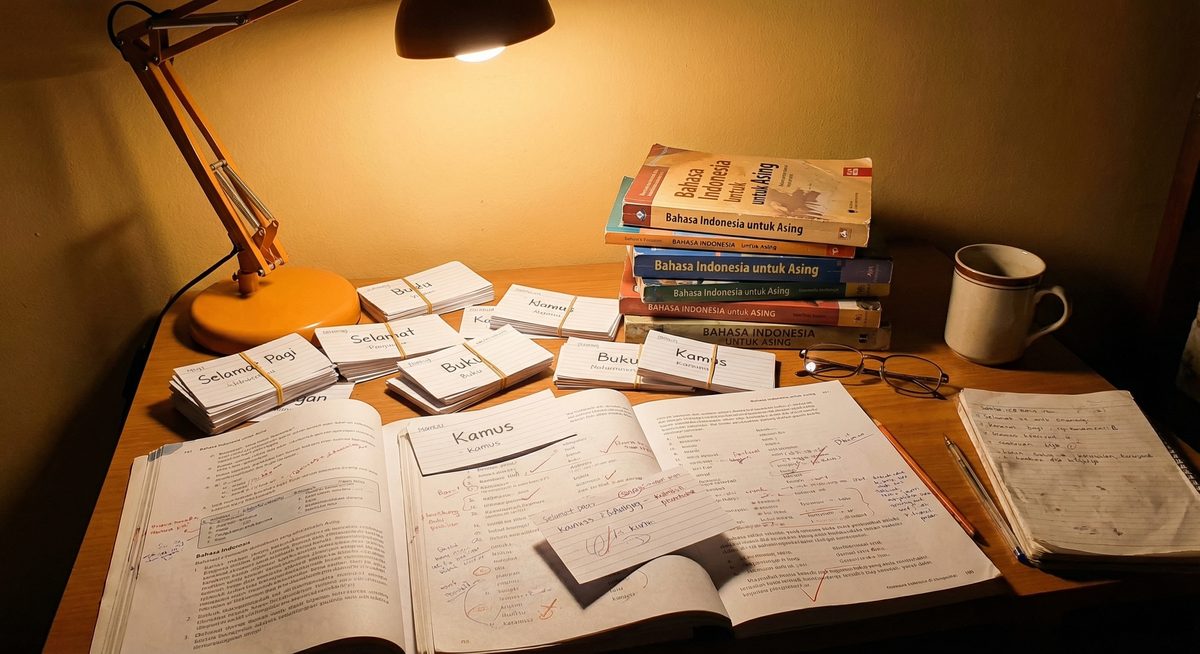
Right so let me just get this out of the way: I wasted the first three months learning a version of Indonesian that nobody speaks. Three months! Of formal, textbook, "Saya ingin memesan makanan" Indonesian that made me sound like I was reading from a government pamphlet. I'd walk into a warung in Kemang, south Jakarta, deliver my carefully rehearsed sentence, and the guy behind the counter would stare at me for a second and then say "mau apa?" Which means "what do you want?" Two words. That's all he needed. And there I was, fourteen syllables deep into a sentence structure that belonged in a boardroom.
That's mistake number one and I'm still annoyed about it. Textbooks teach formal Indonesian because it is technically correct, in the same way that saying "I would like to enquire about the availability of sustenance" is technically correct English. Nobody talks like that. In Indonesia, the gap between written formal bahasa and the way people actually communicate day-to-day is enormous. "Saya tidak tahu" (I don't know) becomes "nggak tau." "Apakah kamu mau makan?" (Would you like to eat?) becomes "mau makan?" The short versions aren't lazy or wrong. They're just... how the language works when real people use it.
I wish I had learned the informal register first. Would've saved me so much grief.
Okay, second thing. And this one is kind of embarrassing.
I spent weeks, actual weeks, looking for the verb "to be" in Indonesian. In English every other sentence has "is" or "are" or "am" in it. "The sky is blue." "I am tired." "They are students." My brain kept trying to find the Indonesian equivalent and failing. I'd write sentences like "Saya adalah lelah" which is... not a thing anyone says. "Saya lelah" is "I'm tired." There is no "am." It's just... gone. The sentence works without it.
This broke my brain for about two weeks. I kept feeling like my sentences were missing something. They weren't. Indonesian just doesn't need a copula for most situations. (I had to look up what a copula was to understand why I was confused. It is the linguistic term for "is/are/am" type words. I had gone 30+ years without knowing this word existed.)
Similarly: no articles. "The cat" is "kucing." "A cat" is also "kucing." You figure out which one from context. After English, where we agonise over whether it's "the" or "a" or "an," this felt bizarre. Now it feels efficient. Why specify when the conversation already makes it obvious?
Third thing, and I think this is where I lost the most time overall: I was terrified of speaking.
For the first two months I only studied. Flashcards, textbooks, listening exercises, the works. I told myself I'd start conversations "when I was ready," which was code for "never." The problem is that studying a language and using a language activate completely different parts of your brain. I could recognize hundreds of words on a screen. But in a live conversation, even over text, my mind would go blank and I'd forget how to say "yesterday" (kemarin, by the way, and I had to look it up embarrassingly often before it stuck).
When I finally started texting with someone, a guy called Reza from Bandung who I found on a language exchange app, everything changed. Not because he was a great teacher (though he was patient). Because using the words in actual conversation cemented them in a way that flashcards never could. I would forget a word, look it up mid-conversation, and then remember it forever because the moment was real. The embarrassment of not knowing it was real. That's a much stronger memory anchor than seeing a word on a screen and clicking "correct."
Reza also taught me something no textbook mentioned, which is that Indonesians shorten everything. "Sudah" becomes "udah." "Tidak" becomes "nggak" or "gak." "Apa" becomes "apaan" in slang. I had been listening to podcasts and Indonesian YouTube and not understanding half of it because I was listening for the textbook versions of words. Once Reza pointed this out, it was like someone had cleaned my glasses. Oh. OH. That's what they've been saying.
Here is a mistake that's more subtle: I obsessed over pronunciation for way too long. Indonesian is mostly phonetic. If you can read the word, you can more or less say the word. But I kept replaying audio clips trying to get the exact right intonation, the perfect rolled R, the precise vowel sounds. Then I met this Australian guy at a hostel in Canggu who spoke Indonesian with the thickest Aussie accent imaginable. Just absolutely mangling the pronunciation by any textbook standard. And everyone understood him. Perfectly. He'd say something that sounded like "mah-KAHN" instead of "MA-kan" and nobody blinked.
Turns out clarity matters way more than accuracy. If you hit the right syllables and the right consonants, your accent is irrelevant. I spent weeks trying to roll my Rs (still can't) when I should have been spending that time actually talking to people.
Another one, and I see other learners do this constantly: trying to learn too many words at once. There is a seductive feeling to flashcard apps where you review 50 new words in a session and feel productive. But there is a massive difference between recognizing a word when it appears on your phone and being able to pull it out of your brain mid-sentence when someone is looking at you expectantly. I "knew" the word "menunggu" (to wait) for weeks before I could actually use it. Kept fumbling for it in conversation. Now I limit myself to maybe 10 new words a day and drill them until they're reflexive. Slow, but it works.
Oh and one more thing that drove me absolutely mad. Word order.
In English you say "red car." In Indonesian you say "mobil merah" which is "car red." Adjectives come after the noun. I know this sounds minor but when you're trying to think on your feet in a conversation, your brain keeps defaulting to English word order. I would say "merah mobil" and people would understand (context, always context) but I could see them processing it. It took months for "noun first, adjective second" to feel natural. The self-talk technique helped with this a lot actually, because I could practice the right word order without anyone waiting for me to finish a sentence.
And look, I still make mistakes. Constantly. Last week I tried to say "I'm looking for a pharmacy" and what came out was something closer to "I'm looking for a farm" because I confused "apotek" with "a-something" and my brain just filled in the wrong word. The pharmacist figured it out anyway because I was clearly standing in front of her shop looking confused. Context, again, doing all the heavy lifting.
The thing that took me the longest to accept, and I mean really accept and not just acknowledge intellectually, is that mistakes are the mechanism. Not a side effect of learning. The actual mechanism. Every time I said something wrong and got corrected, that correction stuck harder than any flashcard ever did. Reza correcting my "Saya sangat lapar sekali" (I am very hungry very much, which doubles up on intensifiers and sounds ridiculous) to just "Saya lapar banget" taught me more about how intensifiers work than any grammar explanation could have. The phrases I ended up actually using when travelling came from corrections like that, not from textbooks.
If I could do it over: start informal from day one, speak before I feel ready, learn fewer words but learn them deeper, and stop trying to map English grammar onto a language that works completely differently. Also I'd use something built around how people actually talk instead of how the government thinks people should talk. That distinction matters more than you'd think.
You will make these mistakes too, probably. That is genuinely fine. The point has never been to avoid mistakes. The point is to make them out loud, in real conversations, where someone can catch you and set you straight. Your phone screen will never do that.