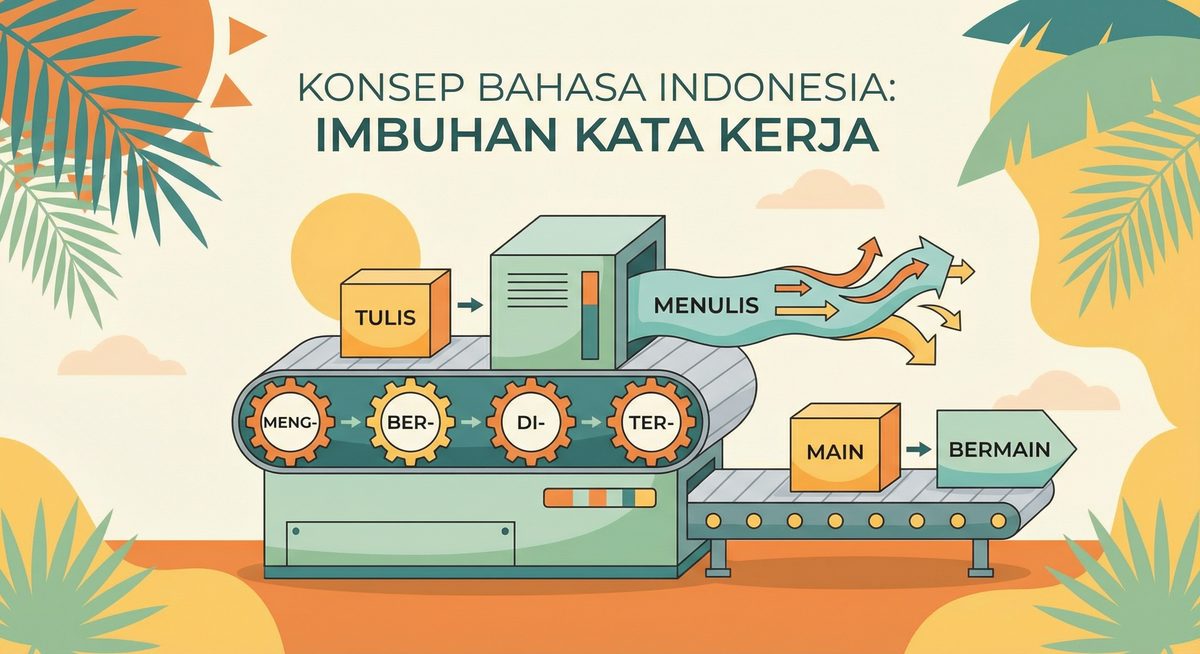
I put off learning Indonesian verb prefixes for about two months because everyone on Reddit made them sound terrifying. "Wait until you hit the me- prefix," one guy wrote. "It changes spelling based on the first letter and there's no logic to it." Another person said they'd been studying for a year and still couldn't figure out when to use ber- versus me-. I saw charts. Flow diagrams. People genuinely stressed about this.
Then I actually learned them and it turned out to be one of the easier parts of Indonesian. Not because the system is simple (it isn't, exactly) but because you can get 80% of the way there with about three patterns. The rest you pick up as you go.
Here's what I wish someone had told me at the start.
The ber- prefix: doing something, being something
Start with ber- because it's the most straightforward. You stick ber- on the front of a word and suddenly that word describes doing or being that thing.
kerja = work (noun)
bekerja = to work
nama = name
bernama = to be named
main = play
bermain = to play
That's it. That's the pattern. I spent weeks thinking there had to be more to it. There isn't. You take a base word, add ber-, and now it's a verb about doing or being that thing.
The only wrinkle is that sometimes the base word starts with R and you drop one of them to avoid doubling up. "Rencana" (plan) becomes "berencana" (to plan), not "berrencana." Your mouth would trip over that anyway so it makes sense once you try saying it out loud.
Oh and occasionally ber- means "having" instead of "doing." Rumah (house) becomes berumah (to have a house). Anak (child) becomes beranak (to have children). Context makes it obvious which meaning you're dealing with. I have never once been confused by this in an actual conversation.
Use ber- when the action doesn't have a specific target. You're just doing the thing. "Saya bekerja" means "I work." Not working *on* something or working *for* someone (though you can add those details). Just working, generally.
The me- prefix: doing something to something
This is the one everyone panics about. The me- prefix (sometimes written as meng- or mem- or men-, we'll get to that) turns a word into a verb where you're doing that action *to* something specific.
tulis = write
menulis = to write (something)
baca = read
membaca = to read (something)
makan = eat
memakan = to eat (something)
Wait, you're thinking. Makan already means "to eat." Why do we need memakan?
Right so here's the thing. Indonesian has this whole class of words that work as verbs even without prefixes. Makan is one of them. You can say "saya makan" (I eat) and it's fine. But when you want to emphasise that you're eating *something specific*, you add me-: "Saya memakan nasi" (I am eating rice). The me- form is more formal and more explicit about the object.
In casual speech you'll hear people drop the me- constantly. "Aku baca buku" instead of "Aku membaca buku." Both mean "I'm reading a book." The version without me- is just more relaxed. This is the formal versus informal gap I wrote about before, where textbooks teach you one thing and then real people do something simpler.
Now about the spelling changes. This is what scared me at first but honestly it's not random, it follows a pattern.
The me- prefix changes based on what letter comes next:
- Before b, f, v, or p: becomes mem-
- Before t, d, s, or c: becomes men-
- Before k or g: becomes meng-
- Before vowels or l, m, n, r, w, y: stays as me-
And sometimes when you add men- to a word starting with T, the T disappears. Tulis becomes menulis, not mentulis. Same with K after meng-: kirim (send) becomes mengirim, not mengkirim.
Look I know that sounds like a lot. But you don't memorise this. You just learn the verbs as complete words and your brain figures out the pattern without you consciously thinking about it. I can't recite those rules from memory but I can hear when someone gets it wrong. That's how language actually works. You absorb the pattern from exposure, not from studying charts.
The practical version: me- means you're doing something to a specific object. Use it when there's a target for the action. "Saya menulis email" (I'm writing an email). "Dia membaca koran" (He's reading the newspaper). Done.
The ter- prefix: accidentally, already, most
This one does three different things depending on context and I found it completely baffling until I stopped trying to find a unified logic. There isn't one. It just does three things.
**Thing one: accidental actions**
tidur = sleep
tertidur = to fall asleep (accidentally)
jatuh = fall
terjatuh = to fall down (unintentionally)
The ter- prefix can turn an action into something that happened by accident or without you meaning to. "Saya tertidur di sofa" means "I fell asleep on the sofa" (didn't plan to, just happened). This is different from "saya tidur di sofa" which is just "I slept on the sofa," no implication either way about whether it was intentional.
**Thing two: completed state**
tutup = close
tertutup = closed (already)
buka = open
terbuka = opened, open
Here ter- means the action is done. "Pintu tertutup" means "the door is closed." Not closing, not about to close. Already closed. It's describing a state that resulted from an action.
**Thing three: superlatives**
tinggi = tall, high
tertinggi = tallest, highest
besar = big
terbesar = biggest
Stick ter- on an adjective and it becomes "the most" of that thing. "Gunung tertinggi" is "the tallest mountain." This one's straightforward once you know it exists.
How do you know which meaning applies? Context, always context. If someone says "saya terjatuh," the ter- clearly means accidental (you don't fall on purpose). If they say "pintu tertutup," it's describing a state (the door being closed). If they say "gedung tertinggi," it's a superlative (tallest building). Your brain sorts this out faster than you'd think.
I was initially annoyed that ter- does three unrelated things. Then I realised English does this constantly. "Set" has like 400 meanings depending on context. "Run" can mean jog, operate, leak, campaign, or rip, among others. We just don't notice because we grew up with it. Same deal here.
The ke-an prefix-suffix combo: experiencing something
This one's a bit different because it wraps around the word. You add ke- at the start and -an at the end.
dingin = cold
kedinginan = to feel cold, to be too cold
panas = hot
kepanasan = to feel hot, to be too hot
hujan = rain
kehujanan = to get caught in the rain
The ke-an structure means you're experiencing or affected by that thing. "Saya kedinginan" is "I'm cold" (feeling the cold, suffering from it). Not the same as "dingin," which is just describing temperature. Kedinginan has that sense of being affected by the cold, maybe uncomfortably so.
"Kami kehujanan" means "we got caught in the rain." The rain happened to us. We're the recipients of the rain's behaviour, if that makes sense.
You don't use ke-an that often compared to the other prefixes but when you need it, nothing else works. When I was travelling and got stuck in a downpour without an umbrella, "kehujanan" was the exact word I needed. Can't express that concept as neatly any other way.
When to actually use these
Here's what nobody tells you: in casual conversation, people drop prefixes constantly. You'll hear "saya mau makan" (I want to eat) way more often than "saya mau memakan sesuatu" (I want to eat something). The base word makan does the job fine.
But in writing, in formal situations, in news articles, the prefixes show up everywhere. They add precision. They make it clear whether you're doing something generally (ber-) or to a specific object (me-). They distinguish between falling asleep accidentally (tertidur) versus just sleeping (tidur).
When I first started chatting with Indonesians on WhatsApp, I used prefixes everywhere because that's what the textbook taught me. I'd write "Saya sedang membaca buku" and they'd write back "lagi baca apa?" (reading what?). No prefixes. Much shorter. Same meaning. I felt like I was overdressing for a casual event.
Now I match the register. Texting friends: minimal prefixes, short forms. Writing anything formal or public: full prefixes, proper grammar. Knowing when to shift between these levels is half the game.
The bit that actually matters
You don't need to memorise prefix rules. I'm serious. Learn verbs as complete words. Membaca is a word. Bekerja is a word. Tertidur is a word. Your brain will figure out the patterns in the background while you're busy actually using the language.
What helped me more than any chart or rule was reading. I read Indonesian news articles (slowly, with a dictionary open) and Instagram captions and Reddit threads. You see membaca and membuat and membeli enough times, your brain goes "oh, all these mem- words have this vibe of doing something to an object." You don't have to consciously think "ah yes, the me- prefix indicating a transitive verb with specific object." You just know it fits.
Same with ter-. You see tertidur (fell asleep), terjatuh (fell down), terlambat (late, as in missed the time), and the pattern clicks. Accidental, unintended, or already-completed things. Your brain handles the categorisation. Let it.
The people who struggle with prefixes are usually the ones trying to memorise rules instead of absorbing examples. I tried the rules approach for about a week. Drove me mad. Then I just started reading and listening and the whole thing sorted itself out.
If you want to actually practice this stuff in context instead of staring at grammar tables, that's what we built Bahasa.fun for. Real example sentences, real usage, no charts required. The full version gives you thousands of examples and you can filter by the specific prefixes you're trying to get comfortable with. I wish this had existed when I was learning because I wasted so much time on Anki decks that just showed me isolated words with no context.
Prefixes make Indonesian verbs more flexible and more precise. Once you get past the initial "oh god there are rules" panic, they're honestly one of the more elegant parts of the language. You can build dozens of related words from one root just by swapping prefixes. Kerja (work) becomes bekerja (to work), pekerja (worker), pekerjaan (job, work as a noun), mengerjakan (to do/work on something). That's efficient. English makes you learn completely different words for these concepts.
Learn the common verbs, read a lot, listen to how people actually talk. The prefix system will click without you having to think about it. And if you mess one up in conversation, people will understand anyway because context is doing 90% of the work.
I spent two months dreading this topic. Turned out to be easier than particles like lah and dong, which genuinely have no rules, just vibes. At least prefixes have patterns. You'll be fine.