I spent three months in Jakarta thinking I was speaking good Indonesian. Subject-verb-object. Polite forms. Past tense markers. I could order food, ask directions, chat about the weather.
Then one afternoon, a friend laughed at something I said. Not mean, just surprised. "You sound like a textbook," she said. "Nobody talks like that."
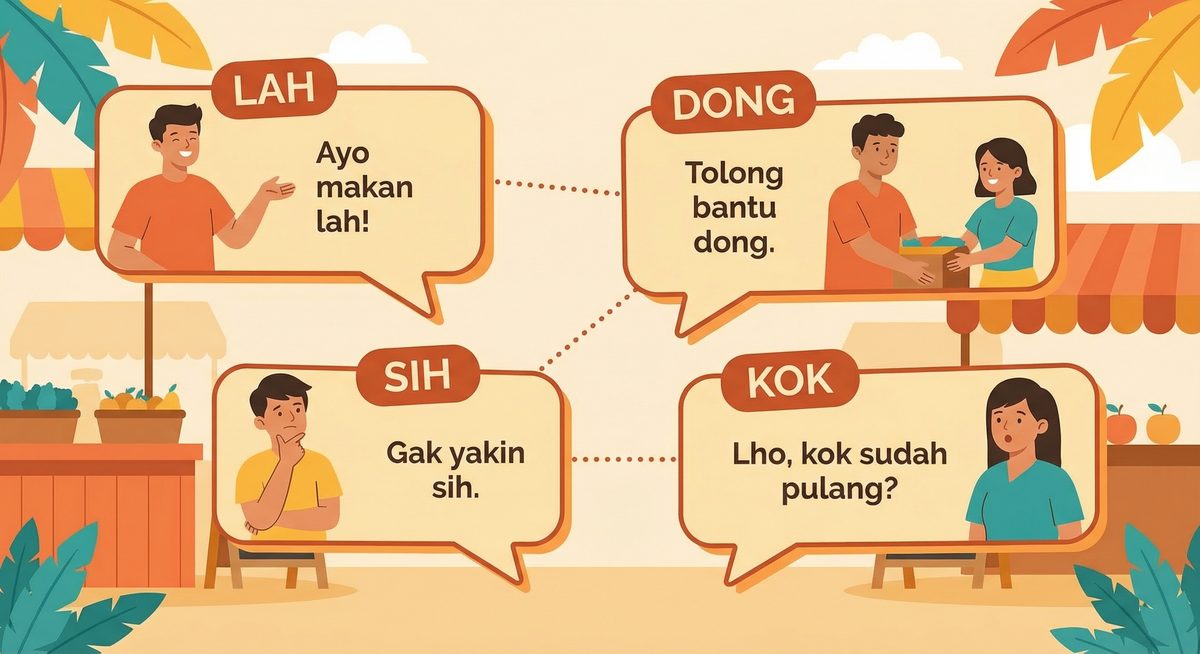
What I was missing: lah, dong, sih, and kok. Four particles that textbooks skip because they don't translate cleanly into English. They don't change meaning the way most words do. They change feeling.
Lah: The All-Purpose Softener
Lah is the workhorse. It can mean "just do it," or "obviously," or "come on," or nothing at all. Context decides.
When someone says "Makan lah" (eat lah), they're not commanding you to eat. They're saying "go ahead, eat, don't be shy." It's gentle encouragement.
"Sudah lah" (already lah) means "forget it" or "let it go." You use it when you're done arguing or when something's not worth the effort.
Here's the trick: lah makes statements less direct. Indonesians hate being blunt. When you add lah, you're wrapping the sentence in a layer of friendliness. "Pergi" (go) sounds like an order. "Pergi lah" sounds like friendly advice.
I use it when I want to sound relaxed. "Iya lah" instead of "iya" (yes). "Jangan lah" instead of "jangan" (don't). It's not required, but it makes you sound less robotic.
One warning: overuse it and you sound like you're trying too hard. Native speakers don't drop lah into every sentence. They use it when the situation calls for softening, not as punctuation.
Dong: The "Obviously" Particle
Dong adds impatience or obviousness. It's what you say when the answer should be clear.
"Aku lapar dong" (I'm hungry dong) translates roughly to "I'm hungry, duh." You're stating something that should be obvious from context.
"Iya dong" (yes dong) means "yes, of course" or "obviously yes." Someone asks if you want to go to the beach and you reply "Iya dong." You're not just agreeing, you're saying the question was almost silly to ask.
I hear it most often in playful disagreements. A friend complains about something minor, you respond with "Begitu dong" (that's how it is, dong). You're acknowledging the complaint but also saying it's not worth stressing over.
Be careful with dong in formal situations. It carries attitude. That's fine with friends, less fine with your boss or someone older. Save it for casual conversations where a bit of sass fits naturally.
Sih: The Curiosity Marker
Sih turns statements into gentle questions or adds emphasis. It's softer than a direct question but stronger than a plain statement.
"Kenapa sih?" (why sih) isn't aggressive. It's closer to "why though?" or "seriously, why?" You're genuinely curious, maybe a bit puzzled.
"Lucu sih" (funny sih) means something like "that's actually funny" or "I'll admit that's funny." The sih adds a layer of reflection, like you're commenting on your own reaction.
I use sih when I want to sound thoughtful without sounding formal. "Bagus sih, tapi..." (it's good sih, but...) signals I'm about to offer criticism in the gentlest way possible.
The trickiest part of sih is placement. It usually comes after the word it's modifying. "Siapa sih?" (who sih), not "Sih siapa?" Get that wrong and people will understand you, but it'll sound off.
Kok: The Surprise/Confusion Word
Kok expresses surprise, disbelief, or confusion. It's the particle you use when something doesn't match your expectations.
"Kok bisa?" (how kok can?) means "how is that even possible?" or "wait, really?" You're not asking for an explanation so much as expressing shock.
"Kok mahal?" (why kok expensive?) translates to "why is this so expensive?" but with an edge of disbelief. You expected something cheaper.
I learned kok the hard way. I was in a market, negotiating a price. The vendor quoted something ridiculous. I said "Mahal" (expensive). She didn't budge. A local friend nudged me and whispered "Say 'kok mahal?'" I did. The vendor laughed and dropped the price. The kok signaled genuine surprise, not just bargaining theater.
Unlike the other particles, kok almost always goes at the start of a question or statement. "Kok gitu?" (why kok like that?) means "why is it like that?" with a tone of mild exasperation.
When to Skip Them Entirely
Not every sentence needs a particle. In fact, most don't. Formal writing skips them completely. Business emails, official documents, news articles—none of these use lah, dong, sih, or kok.
They belong in spoken Indonesian and casual written Indonesian (texts, social media, informal blog posts). When you're learning, it's better to underuse them than overuse them. Listen to how often native speakers actually drop them into conversation. It's less than you think.
If you're in a formal meeting or talking to someone significantly older, stick to standard Indonesian. Particles can sound too casual, even disrespectful, in the wrong context.
How I Actually Learned Them
Textbooks won't teach you this. Neither will most language apps. I learned by paying attention to real conversations and copying patterns I heard repeatedly.
The best method: pick one particle and focus on it for a week. Listen for lah in every conversation. Notice when people use it, when they don't, what it sounds like in different contexts. Then try using it yourself a few times. You'll probably mess up. That's fine. Indonesians are forgiving with learners.
Once lah feels natural, move to dong. Then sih. Then kok. Don't try to master all four at once. That's a recipe for sounding weird.
I still make mistakes. Last week I used dong in a situation where lah would have been better. My friend corrected me gently. These particles are subtle. They take time.
The Particles That Make You Sound Real
Learning Indonesian without particles is like learning English without contractions. Technically correct, functionally awkward. Nobody says "I am going to the store" in casual conversation. They say "I'm going to the store." Same idea here.
Lah, dong, sih, and kok won't appear on any vocabulary test. They won't help you read formal documents. But they will make you sound less like a textbook and more like someone who actually lives here.
That's the difference between knowing a language and speaking it naturally. The particles are where that gap closes.
If you're ready to move past textbook Indonesian and start sounding natural, try our interactive lessons that include real conversational patterns. Or check out our guide on Indonesian slang for more ways to sound less foreign.
Just remember: use them sparingly. Listen more than you speak. Copy what you hear. You'll get there.