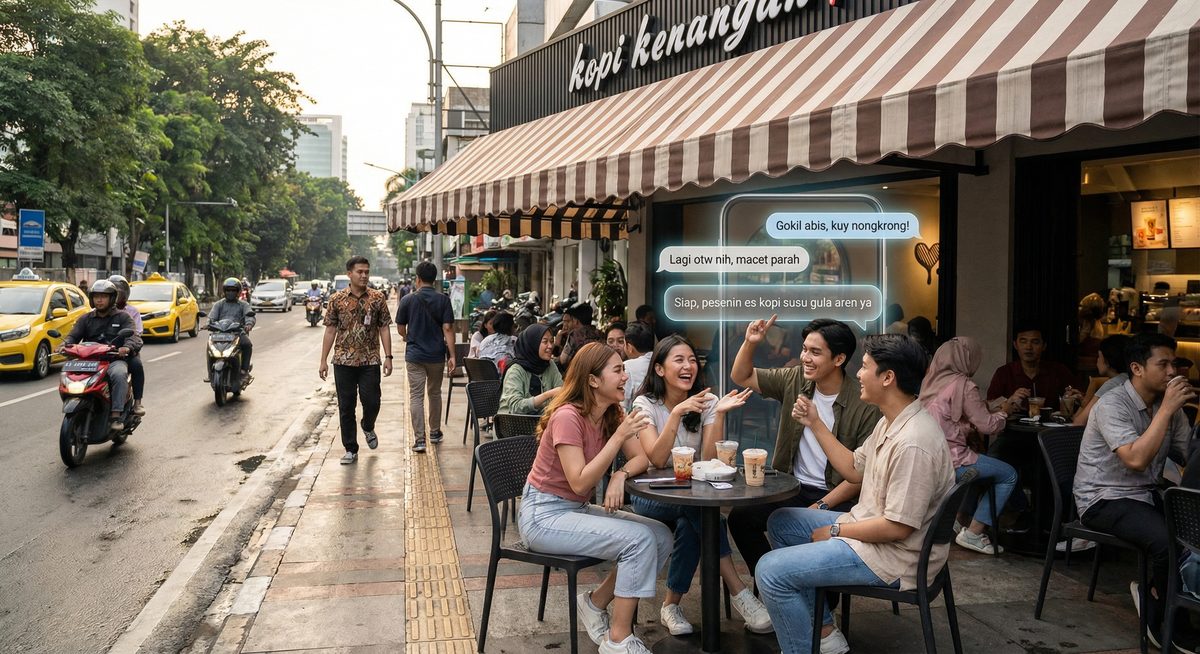
So here's the thing about learning Indonesian from textbooks. You end up sounding like a colonial administrator from 1955. Very proper. Grammatically flawless. Completely wrong for every actual conversation you'll have.
I learned this the hard way when I landed in Jakarta and tried to use my carefully studied formal bahasa at a coffee shop in Kemang. The guy behind the counter just stared at me for a second before switching to English. Not because my Indonesian was bad, technically speaking. Because it was so formal it sounded bizarre. Like walking into a Starbucks in London and asking if the barista might kindly prepare a beverage for one's consumption.
What I didn't know then was that Indonesians under 40 mostly speak what's called bahasa gaul. Gaul means cool, hip, associated with young people. It's not slang exactly, though it includes slang. It's more like... the actual language people use when they're not reading from a government document.
Take the word "tidak" which means "no" or "not." Textbooks drill this into you relentlessly. Tidak ini, tidak itu. But in real life? Nobody says tidak. They say "gak" or "nggak." Sometimes just "ga." "Tidak tahu" (I don't know) becomes "gak tau" or even "gatau" written as one word. The formal version sounds comically stiff.
Same thing happens with "apa" which means "what." In conversation it becomes "apaan" when you're confused or mildly annoyed. "Apaan sih ini?" What the hell is this? You won't find "apaan" in a dictionary but you'll hear it fifty times a day in Jakarta.
Here's where it gets messier. The "me-" prefix that textbooks obsess over? Often just... disappears. "Makan" is to eat. "Memakan" is the formal conjugated version. In practice people just say "makan" for everything. "Gue makan nasi goreng" (I eat/ate/am eating fried rice). Context handles the rest. I spent weeks looking for verb conjugations that don't really exist in casual speech because I was listening for the textbook versions.
And pronouns. Oh god, pronouns.
Formal Indonesian uses "saya" for I/me. Perfectly correct. Sounds incredibly stiff in casual conversation. In Jakarta people say "gue" (pronounced "gway"). You is "lu" instead of "kamu" or the even more formal "anda." So "saya ingin bertanya kepada kamu" (I would like to ask you) becomes "gue mau nanya lu." Four words instead of six, half the syllables, same meaning. That's how the language actually works when people aren't being interviewed on television.
There's also this whole category of words that exist purely in gaul and have no formal equivalent. "Anjay" for example. It's an exclamation of surprise or admiration. "Anjay, keren banget!" (Damn, that's really cool!) You can't translate anjay into formal Indonesian. It just... doesn't exist there.
"Santuy" is another one. It means relaxed, chill, no stress. Comes from "santai" but evolved into something slightly different. If someone's running late they might text "santuy aja" (just chill, no worries). I've watched people try to explain santuy to foreigners and struggle because there's no direct English equivalent either. It's a whole vibe compressed into one word.
Then there are the abbreviations. Indonesians abbreviate everything, especially in text. "Gimana" (how) becomes "gmn." "Dengan" (with) becomes "dgn." "Sama" (same/with) becomes "sm." At first this looks like lazy typing. Then you realize it's systematic. There are actual rules. Drop most vowels, keep consonants, everyone still understands.
Social media spawned a whole new layer of this. "Wkwk" is how Indonesians write laughter online (the equivalent of "haha" or "lol"). I spent probably two weeks seeing "wkwk" everywhere and having absolutely no idea what it meant. Nobody explains it because everybody already knows. It's the sound of laughing, apparently. Now I use it reflexively.
"Banget" is one you'll hear constantly. It means very or really. "Mahal banget" (really expensive), "capek banget" (super tired). But here's the thing - it comes at the end, not before the adjective like in English. This breaks the brain of every English speaker learning Indonesian. We want to say "very expensive." We have to train ourselves to say "expensive very." The word order difference extends to basically everything and it takes months to internalize.
Some gaul words are straight-up borrowed from other languages and mangled into Indonesian spelling. "Bokap" and "nyokap" mean dad and mom. They come from Chinese Hokkien (bak and nyok). "Baper" is an abbreviation of "bawa perasaan" which means taking things too personally or catching feelings. You'll hear it in conversations about relationships constantly. "Jangan baper ya" means don't take it personally, don't get emotional.
Food gets abbreviated too. "Nasi goreng" (fried rice) becomes "nasgor." "Mie goreng" (fried noodles) becomes "miegor" or "migo." Nobody bothers with the full words anymore. It's understood.
The funniest gaul word to me is "PHP" which stands for "pemberi harapan palsu" - giver of false hope. It's what you call someone who leads you on romantically. "Dia cuma PHP aja" means they're just stringing you along. The fact that this needed its own acronym tells you something about dating culture in Indonesia.
Here's what makes all of this extra confusing for learners: the rules aren't fixed. Gaul evolves constantly. What was cool slang five years ago might sound dated now. New words appear from social media, from regional dialects, from English. "Healing" became Indonesian gaul basically unchanged from English, meaning taking time for self-care or mental health. "Glow up" similarly. Young Indonesians just code-switch between languages mid-sentence and new hybrid words emerge.
And different cities have different gaul. Jakarta gaul differs from Bandung gaul differs from Surabaya gaul. In Jogja they have their own whole dialect with different pronouns. "Aku" and "kamu" instead of "gue" and "lu." Trying to use Jakarta slang in Jogja marks you as an outsider immediately.
So what's a learner supposed to do with all this?
Honestly? Stop obsessing over formal Indonesian first. The fastest way to actually communicate is to learn the informal register from day one. Yes, you need to know the formal versions exist. You'll need them for job interviews and official situations. But if your goal is to have actual conversations with actual Indonesians under the age of 50, learn gaul. Learn "gue" and "lu" before you learn "saya" and "anda." Learn "gak" before "tidak." Learn the shortcuts because those are what people actually use.
The best way I found to pick this up was watching Indonesian YouTube. Not language learning channels - actual content made for Indonesians. Gaming channels, vlogs, street interviews. The comments section alone will teach you more gaul than any textbook. You see the same words repeated hundreds of times in context and you start to absorb how they work.
Texting with Indonesians helped too. They'll naturally use abbreviated casual language and you can ask what things mean without the pressure of face-to-face conversation. I had a whole list in my phone of gaul words and phrases that I'd encountered and looked up. "Santuy," "baper," "anjay," "wkwk" - I added to it constantly. Still do, actually. The language moves faster than I can keep up.
I think what frustrated me most about textbooks is they pretend this whole layer of the language doesn't exist. Or they mention it briefly as something you might encounter "in informal situations" without acknowledging that basically every conversation you'll have is an informal situation. Learning tools that actually teach how people talk matter way more than ones that teach how newspapers write.
You will sound weird at first mixing formal and informal. I definitely did. I'd drop a "gue" in one sentence and switch back to "saya" in the next. People understood anyway. They're used to foreigners making these mistakes. The key thing is being aware of the register and actively practicing the informal one instead of defaulting to textbook Indonesian.
One last thing. Some learners worry that learning gaul first will make them sound uneducated or disrespectful. That's not really how it works. Context matters. An Indonesian using gaul with friends and formal bahasa in a job interview is perfectly normal. A foreigner doing the same thing is... also perfectly normal. The respect comes from making the effort to learn at all, not from sounding like you're reading from a government pamphlet. People appreciate when you talk like a human.
So yeah. Textbooks taught me Indonesian. Jakarta taught me how people actually talk. Those are very different things. If I could go back I'd skip straight to the second one and pick up the formal stuff later when I needed it. Would've saved me months of sounding like a time traveler from 1955.