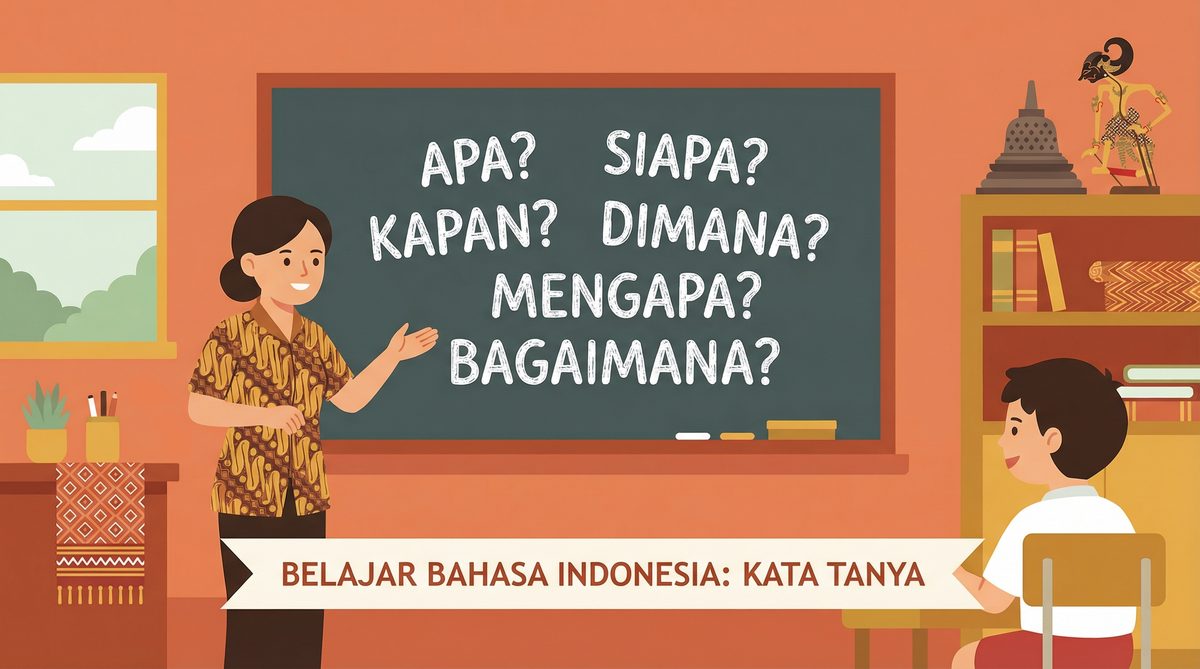
I spent my first month in Indonesia nodding along to conversations I barely understood, waiting for moments I could contribute something useful. Turns out the thing that changed everything wasn't vocabulary or grammar — it was learning how to ask questions properly.
Indonesian question words are stupidly straightforward compared to most languages. Five core words. No conjugation. No formal versus informal versions that change based on social context. Just five simple words that unlock basically every question you'll ever need to ask.
Let's start with the big one: apa.
Apa means "what." That's it. Put it at the start of a sentence and you've got a question. "Apa ini?" means "What is this?" "Apa kabar?" literally translates to "what news?" but functions as "how are you?" The word does exactly what you'd expect it to do, which is refreshing after years of wrestling with English's weird question constructions.
Here's where it gets better. You can also use apa to turn any statement into a yes/no question. Just stick it at the beginning. "Kamu suka kopi" means "you like coffee." "Apa kamu suka kopi?" means "do you like coffee?" Same sentence, add apa, now it's a question. This blew my mind when I first realized it because English makes you completely restructure the sentence.
In casual conversation, people often drop the apa entirely and just raise their voice at the end. "Kamu suka kopi?" with rising intonation. Works perfectly. Real Indonesian conversation cuts out everything unnecessary, and this is a perfect example.
Next up: siapa.
Siapa means "who." Again, wonderfully literal. "Siapa ini?" is "who is this?" "Siapa nama kamu?" technically means "who is your name?" but that's how you ask someone's name. English speakers want to say "what is your name" but Indonesian treats names as a who question, not a what question. Takes about a week to stop overthinking it.
You'll also hear "siapa saja" which means "who all" or "who else." "Siapa saja yang datang?" — who all is coming? It's a useful construction once you realize "saja" just means "only" or "just" normally, but paired with question words it becomes "all" or "else." Language is weird like that.
Dimana is "where," but it's actually two words smooshed together: "di" (at/in) plus "mana" (which). So you're literally asking "at which?" but it functions as "where." "Dimana kamu?" — where are you? "Dimana toilet?" — where's the bathroom? That last one is probably the most useful phrase for any traveler.
You can separate them too. "Kamu di mana?" means the exact same thing as "dimana kamu?" — you'll hear both. The combined version sounds slightly more formal, the separated version more casual. The formal/informal register shift in Indonesian is subtle like that, usually just tiny pronunciation or word order changes.
There's also "ke mana" which uses "ke" (to/toward) instead of "di" (at). "Kamu mau ke mana?" — where are you going? The preposition changes the meaning from location to direction. Once you notice this pattern you start seeing it everywhere. Di for "at," ke for "to," dari for "from." The question word "mana" stays the same, the preposition tells you what kind of where you're asking about.
Then there's kapan, which means "when."
This one's straightforward. "Kapan kamu datang?" — when are you coming? "Kapan kita makan?" — when are we eating? Unlike English where "when" questions need auxiliary verbs (when will you, when did you, when are you), Indonesian just... doesn't bother with that. Context handles the tense. The verb stays the same.
If you want to specify past or future you can add "sudah" (already) or "mau" (want/going to), but half the time people don't. "Kapan kamu makan?" could mean when did you eat, when are you eating, or when will you eat. The conversation makes it obvious which one you mean.
This drives some learners crazy because they want more precision. I've learned to appreciate it. Indonesian grammar is built for speed and context, not for specifying every little detail explicitly. Once you stop fighting that and just let context do the work, the language gets way easier.
Last one: bagaimana.
Bagaimana means "how." It's the longest question word and honestly feels a bit formal. In casual speech people shorten it to "gimana" constantly. "Gimana kabarmu?" — how are you? "Gimana caranya?" — how do you do it? The shortened version sounds natural. The full "bagaimana" sounds like you're conducting an interview.
You can use gimana for basically any how question. "Gimana rasanya?" — how does it taste? "Gimana kok bisa?" — how is that even possible? That last one is a great example of how Indonesians stack little words together. "Kok" adds emphasis or surprise, "bisa" means can/possible. Translate it literally and it's "how surprise can?" but it functions as "how is that even possible?" or "how did that happen?"
There's also "kenapa" and "mengapa" which both mean "why." Technically mengapa is more formal but kenapa is what everyone actually says. "Kenapa kamu terlambat?" — why are you late? "Kenapa tidak?" — why not?
The thing that took me forever to realize is that kenapa is "ke" + "apa." Literally "to what." So "why" in Indonesian is asking "to what purpose" or "to what end." Once I noticed that, I started seeing how the language builds questions from smaller pieces. Dimana is di + mana. Bagaimana is bagai + mana. Kemana is ke + mana. They're all combinations of prepositions and "mana" (which) or "apa" (what).
Understanding that structure means you can figure out words you haven't learned yet. Someone says "darimana" and you can work out it's dari (from) + mana (which) = "from where." The language has internal logic that makes sense once you spot the patterns.
Now here's what nobody tells you in textbooks: you can answer Indonesian questions with the same question word. Someone asks "kenapa?" and you can say "kenapa?" back with different intonation and now you're asking "what do you mean why?" or "why do you ask?" Context again. It's incredibly efficient once you get the hang of it.
Same with siapa. "Siapa ini?" (who's this?) can be answered with "siapa?" (who do you think?) if you're being playful or evasive. The question word becomes part of the conversation rather than just a grammatical tool.
For learners I think the hardest part is remembering not to restructure the entire sentence like English forces you to. In English, "you are going" becomes "are you going?" The verb moves to the front. Indonesian doesn't do any of that. "Kamu pergi" (you are going) becomes "kamu pergi?" or "apa kamu pergi?" The word order stays identical. Just add the question word at the start or raise your voice at the end.
This actually makes Indonesian way easier than English for building questions, but English speakers' brains fight it because we're trained to move words around. It takes practice to stop automatically restructuring and just... add apa at the beginning. That's it. That's the whole trick.
I also love that these question words work in any tense without changing. "Kapan" works for past, present, or future. "Dimana" doesn't care if you're asking about now or then. The flexibility means you can ask questions before you fully understand Indonesian's aspect system, which technically exists but is way more relaxed than English tenses.
One pattern worth noting: Indonesians often add "sih" after question words in casual speech. "Siapa sih?" "Kenapa sih?" "Apa sih?" It's a particle that adds emphasis or mild annoyance. Like saying "who even is that?" or "what's the deal?" You don't need it, but hearing it constantly and understanding it means annoying confusion becomes comfortable recognition. That shift from confusion to recognition is basically the whole learning process.
The other thing that helps: practice these question words with actual sentence patterns rather than memorizing them in isolation. "Apa" by itself doesn't stick. "Apa ini?" (what is this?) used fifty times while pointing at things in a market sticks immediately. Context beats flashcards every time.
After a few months of active use, these five words become automatic. You stop thinking about constructing questions and just ask them. "Dimana toilet?" comes out as naturally as English. Your brain stops translating and starts thinking in the question structure directly.
That's when Indonesian conversation really opens up. Because once you can ask questions fluidly, you can navigate any situation. Lost? Ask dimana. Confused? Ask apa or kenapa. Want to know someone's story? Ask siapa. Need to coordinate timing? Ask kapan. Want to understand a process? Ask gimana.
Five words. That's genuinely all you need to start asking about anything. The rest is just vocabulary and practice. But these five — apa, siapa, dimana, kapan, bagaimana — they're the foundation. Master these and you've unlocked the ability to drive any conversation instead of just responding to what others say.
Turns out the fastest way to stop nodding along cluelessly is to start asking questions properly. Who knew.