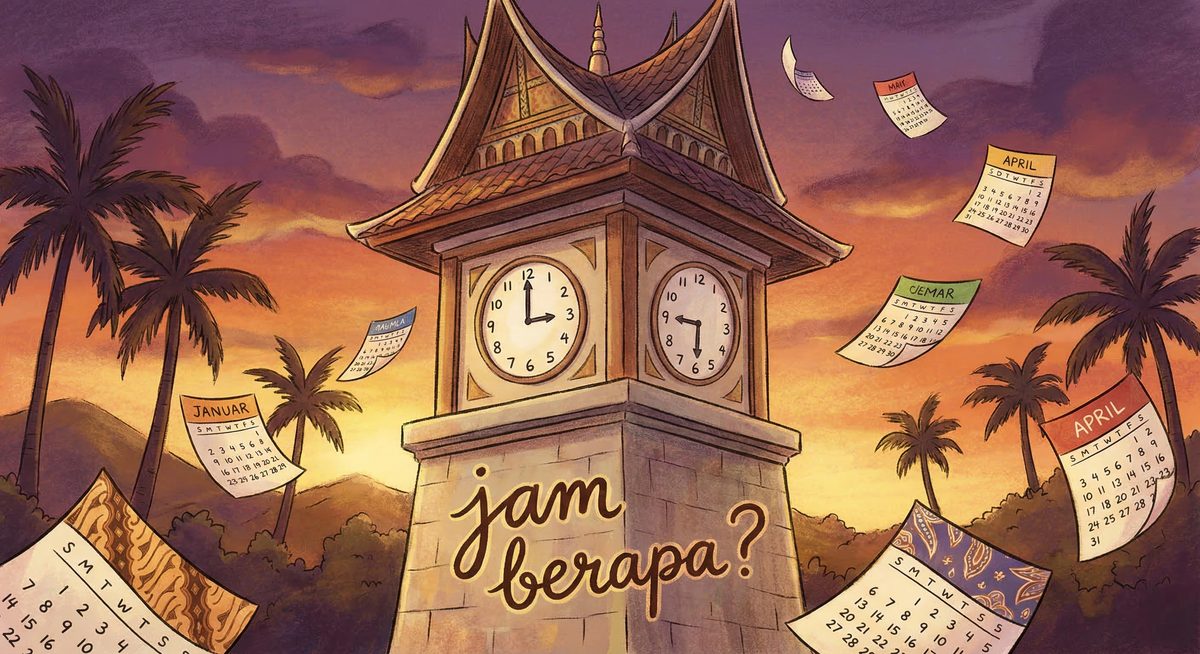
I lived in Indonesia for three years before I stopped mentally translating time expressions. "Besok" is tomorrow. Easy. But then someone says "lusa" and you freeze. Wait, is that the day after tomorrow or next week?
Indonesian time expressions are mostly straightforward, but they have a few quirks that trip up learners. The good news: once you get the patterns, you'll sound way more natural than the person saying "pada hari Senin yang akan datang" when they mean "next Monday."
Asking "What time is it?"
The standard question is jam berapa? (literally "hour how-much?"). You'll hear this constantly. The formal version is "pukul berapa?" but almost nobody uses it in conversation unless they're being extremely polite or reading a train schedule.
If someone asks you jam berapa, you answer with jam + number: "Jam tiga" (3 o'clock), "Jam sepuluh" (10 o'clock). For half past, add setengah before the next hour: "Jam setengah lima" means 4:30, not 5:30. This confuses everyone at first because you're saying "half of five," meaning halfway to five.
Minutes work exactly how you'd expect. "Jam tiga lima belas" is 3:15. "Jam enam lewat dua puluh" (6 past 20) is 6:20. For minutes before the hour, use kurang: "Jam lima kurang sepuluh" (5 minus 10) is 4:50.
Days of the week
Indonesian uses hari (day) before each day name. The days themselves are mostly borrowed from other languages, which makes them easier to remember if you speak Arabic or English:
- Senin (Monday, from Arabic)
- Selasa (Tuesday, from Arabic)
- Rabu (Wednesday, from Arabic)
- Kamis (Thursday, from Arabic)
- Jumat (Friday, from Arabic)
- Sabtu (Saturday, from Arabic/Hebrew)
- Minggu (Sunday, from Portuguese "Domingo")
To say "on Monday," you say hari Senin or just Senin in casual speech. "Pada hari Senin" is overly formal unless you're writing an official letter. Save it for visa applications.
Last/next week: minggu lalu and minggu depan. Notice that "minggu" means both "Sunday" and "week." Context makes it obvious which one you're talking about. If someone says "minggu depan" on a Tuesday, they mean next week. If they say it on Saturday, they probably still mean next week (the upcoming Sunday to Saturday block), but sometimes they mean tomorrow. Welcome to the fun part.
Relative time (this is where it gets interesting)
Here's the daily progression most learners memorise wrong the first time:
- Kemarin dulu: three days ago (literally "yesterday before")
- Kemarin: yesterday
- Hari ini: today
- Besok: tomorrow
- Lusa: the day after tomorrow
- Tulat: three days from now (rarely used, mostly in Java)
"Lusa" is the one that always trips people up. If today is Monday, lusa is Wednesday. Not next week. Not some vague future time. Wednesday.
For weeks, you've got minggu lalu (last week) and minggu depan (next week). For months, bulan lalu and bulan depan. Same pattern for years: tahun lalu, tahun depan.
"Two weeks ago" is dua minggu yang lalu. "In three months" is tiga bulan lagi. The word lagi here means "more" or "later," not "again" (though it can mean that too, depending on context).
Months of the year
Indonesian month names are borrowed from Dutch, which borrowed them from Latin. If you know European languages, you'll recognise these instantly:
- Januari (January)
- Februari (February)
- Maret (March)
- April (April)
- Mei (May)
- Juni (June)
- Juli (July)
- Agustus (August)
- September (September)
- Oktober (October)
- November (November)
- Desember (December)
To say "in March," you say pada bulan Maret or just bulan Maret. Nobody says "di Maret." That sounds broken.
The 24-hour clock (mostly for schedules)
Train tickets, flight times, and official schedules use the 24-hour format. "Pukul empat belas" is 14:00 (2 PM). But in conversation, Indonesians almost always use 12-hour time with context clues. "Jam tiga" could mean 3 AM or 3 PM depending on whether you're talking about meeting for breakfast or leaving the office.
If you need to clarify, add pagi (morning, roughly 5 AM to 10 AM), siang (midday, 10 AM to 3 PM), sore (late afternoon, 3 PM to 6 PM), or malam (night, 6 PM onwards). "Jam tiga sore" is 3 PM. "Jam tiga pagi" is 3 AM.
Common mistakes foreigners make
The biggest one: using "pada" everywhere. "Pada hari Senin, pada bulan Januari, pada jam tiga." It's not wrong, but it sounds stiff. Like you're reading a legal document. Drop the "pada" unless you're being extremely formal.
Second: forgetting that setengah refers to the next hour, not the current one. I've shown up 30 minutes early to meetings because of this. If someone says "jam setengah dua," they mean 1:30, not 2:30.
Third: overcomplicating relative time. You don't need to say "hari Senin yang akan datang" for "next Monday." Just say "Senin depan." Indonesians prefer short and clear over formally correct.
Time expressions you'll hear constantly
Once you start paying attention, you'll notice these phrases everywhere:
- Nanti: later (could mean in 5 minutes or in 5 hours, context is king)
- Sebentar: a moment (also elastic, anywhere from 30 seconds to 20 minutes)
- Tadi: earlier today ("I saw him tadi" means sometime earlier today, not yesterday)
- Kemarin sore: yesterday afternoon
- Besok pagi: tomorrow morning
- Akhir bulan: end of the month
- Awal tahun: beginning of the year
"Nanti" and "sebentar" are particularly slippery. If a shopkeeper says "sebentar ya" and walks away, you might be waiting 2 minutes or 15. It's not rude, it's just how Indonesian time works. Flexibility is built into the language.
Why this matters for real conversations
Time expressions come up constantly. Making plans, asking when someone did something, talking about schedules. If you're still translating from English in your head ("on Monday" → "pada hari Senin"), you'll sound like a textbook. If you just say "Senin depan" or "kemarin sore," you'll sound like everyone else.
The other reason: Indonesians are indirect when it comes to time. "Nanti" doesn't always mean "later." Sometimes it's a polite way of saying "probably not." Learning the actual expressions is only half the job. The other half is learning when people are being vague on purpose.
But start with the basics. Master jam berapa, get comfortable with besok and lusa, and stop saying "pada" in every sentence. The rest comes with practice.
If you want structured practice on this (and the 600+ other grammatical patterns Indonesian throws at you), we've built interactive exercises that actually work. Most learners pick up time expressions in about a week if they practice daily. Try Bahasa.fun and see how fast you can stop mentally translating.
For more on the quirks of everyday Indonesian, check out our guides on Indonesian particles and greetings that actually get used. Time expressions are just one piece of sounding natural. The particles are where it gets really fun.