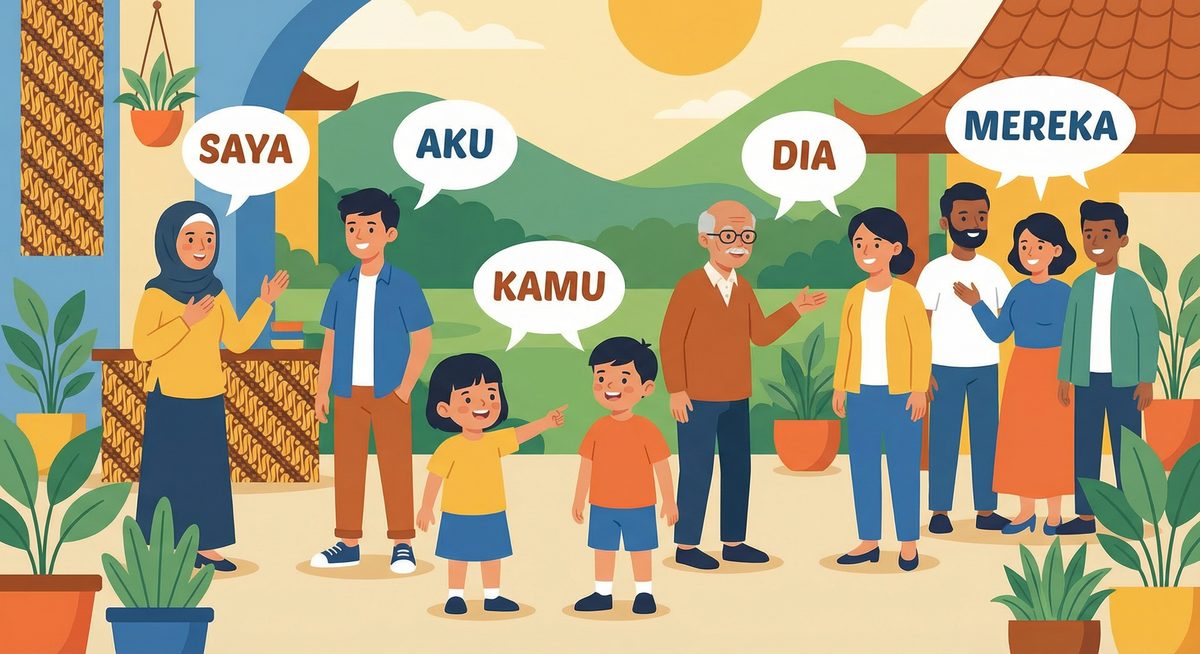
My first week in Bali, I walked into a warung and ordered nasi campur using perfect textbook Indonesian. "Saya mau nasi campur, terima kasih." The older woman running the place smiled and nodded. Totally normal interaction. I paid, ate, left feeling pretty good about my language skills.
Later that week, same warung, same order. But this time I'd picked up some street Indonesian from the guys at my coworking space. "Gue mau nasi campur, ya." The exact same woman looked genuinely pleased. Started chatting with me in Indonesian, asked where I was from, how long I'd been in Bali. The only thing that changed was one word. Not "saya" for I. "Gue."
That's when I started realizing Indonesian pronouns aren't just vocabulary to memorize. They're a whole social system I'd been completely oblivious to.
Every language learning app starts you with "saya" for I or me. Makes sense. It's formal, polite, safe. You can use "saya" with anyone and technically you're never wrong. But you're also never quite right. It's like wearing a suit to a beach barbecue. Nobody will be offended, but everyone knows you missed the memo.
Here's what textbooks don't tell you upfront. Indonesian has maybe a dozen common ways to say I or me. Which one you use depends on who you're talking to, how well you know them, where you are in Indonesia, how old you are compared to them, and what kind of vibe you're going for. It's not that complicated once you get it, but the textbook approach of "just use saya" leaves you completely unprepared.
Let me walk through the main ones.
"Saya" is formal. Business meetings, talking to government officials, speaking with strangers in professional contexts. That's its home. Outside of that it sounds stiff. I used saya constantly my first month and looking back I must have sounded like I was perpetually giving a presentation.
"Aku" is the everyday informal version. This is what most Indonesians use with friends and family. It's casual but not slangy. Perfectly appropriate for most situations once you know someone. "Aku mau kopi" (I want coffee). That's the baseline.
Then there's "gue" which I mentioned earlier. This is Jakarta slang, technically. But Jakarta's influence means you hear it everywhere now, especially from younger people. It's more casual than aku, a bit rougher around the edges. You use it with close friends, people your age or younger. Jakarta slang has basically colonized Indonesian under 30 and gue is exhibit A.
The pronoun for you follows the same pattern. "Anda" is extremely formal. Like, customer service script formal. "Terima kasih atas kunjungan Anda" (Thank you for your visit). Nobody actually talks like this except in written announcements or official statements. If someone calls you "anda" in conversation they're either being sarcastic or they work in government.
"Kamu" is the standard informal you. This is what you'll use most of the time. Friends, acquaintances, people roughly your age. It's the default. "Kamu mau kemana?" (Where are you going?). Safe, neutral, normal.
"Lu" is the Jakarta slang equivalent to gue. Super casual, slightly rough. You use it with people you're comfortable with. "Lu mau ngapain?" (What are you doing?). Pairs with gue naturally. "Gue" and "lu" go together, "aku" and "kamu" go together. Mixing them sounds weird, like mixing British and American slang in the same sentence.
Now it gets weirder. Indonesian also has what I'd call situational pronouns. Words that mean I or you but only in specific social contexts.
"Saya" can become "hamba" in very formal religious or royal contexts. You basically never need this unless you're attending a ceremony at a sultan's palace. I'm including it because I heard it once at a temple in Yogyakarta and spent twenty minutes afterwards trying to figure out what word the guy had used.
More practically, in Java especially, people often drop pronouns entirely when talking to someone older or of higher status. Instead of saying "I want" or "you want," they use names or titles. "Ibu mau kemana?" literally translates as "Mother wants to go where?" but it means "Where do you want to go?" Ibu is how you address older women respectfully. Bapak for older men. This whole system of titles and respect language sits on top of the pronoun system and yeah, it takes a while to get used to.
I learned this the hard way when I kept using "kamu" with my Indonesian teacher who was maybe 15 years older than me. She never corrected me directly. After a few weeks she gently mentioned that most students call her "Ibu" instead of using kamu. I'd been casually calling my teacher "you" like we were peers for a month. She was too polite to say anything but I definitely should have known better.
Third person pronouns are slightly more straightforward. "Dia" means he, she, or they (singular). Indonesian doesn't distinguish gender in pronouns, which honestly makes things easier. "Dia" works for everyone. "Mereka" is they (plural). Done. That part's actually simpler than English.
Though in casual speech people often just use names instead of dia. "Budi kemana?" (Where did Budi go?) rather than "Dia kemana?" Not a rule exactly, just how conversation flows. You'll hear both.
Here's where it gets tricky for learners. You can't always just translate English pronouns directly. Indonesian does this thing where they repeat the noun instead of using a pronoun. In English you'd say "I met Sari. She was really nice." In Indonesian it's more natural to say "I met Sari. Sari was really nice." Using "dia" isn't wrong but repeating the name sounds more natural. This feels redundant to English speakers but you get used to it.
And then there's the whole issue of what to do when you're not sure. You're talking to someone, you don't know how formal to be, you don't know the right title, you don't know if you should use aku or saya or what. My solution, learned from experience: use their name. Just skip the pronoun entirely. "Mau kemana?" instead of "You want to go where?" The subject is implied. Indonesian drops subjects all the time anyway. When in doubt, be vague.
Another thing that messed with me early on: pronouns don't change based on whether they're the subject or object of a sentence. "Saya" means I and me. "Kamu" means you in both subject and object position. English makes you learn I/me, he/him, they/them. Indonesian just... doesn't do that. One form, all uses. That's actually one of the easier parts of the language once you realize it.
But wait, there's more complexity. Some regions have their own pronoun preferences. In Medan they use "aku" and "kau" which is similar to aku/kamu but slightly different. In Manado I've heard "kita" used for I, which is normally we. Javanese has its own complete system of pronouns that corresponds to different levels of formality (ngoko, madya, krama). You don't need to learn all of these unless you're living in those specific places, but it helps to know they exist. Assuming all Indonesian is the same everywhere is a mistake I definitely made.
One more thing that confused me. "Kita" and "kami" both mean we. The difference: "kita" includes the person you're talking to. "Kami" excludes them. So if I'm talking to you about a group that includes both of us, I use kita. If I'm talking about a group that doesn't include you, I use kami. English doesn't make this distinction so it takes conscious thought at first. "Kita makan yuk" (Let's eat - includes you). "Kami sudah makan" (We already ate - not you though).
You know what helps with all of this? Just listening to how Indonesians actually talk to each other. Watch Indonesian YouTube, follow Indonesian Twitter accounts, use tools that show real conversational Indonesian instead of just textbook sentences. You'll start noticing patterns. Young people talking to friends: gue/lu. Talking to service workers: saya/you (or skip the you entirely). Talking to older relatives: drop all pronouns and use kinship terms. It becomes automatic after enough exposure.
I still mess this up sometimes. Last month I accidentally used "gue" with a police officer. His expression didn't change but I immediately realized my mistake and switched to "saya" for the rest of the conversation. He didn't seem bothered but I definitely sounded like an idiot. You learn by making these mistakes in real time.
The thing nobody tells you is that Indonesians are incredibly forgiving about this. They get that you're a foreigner, they get that it's complicated, they appreciate that you're trying. I've used the wrong pronoun hundreds of times. Nobody has ever been offended. Sometimes they gently correct you, more often they just move on. The effort matters more than perfect execution.
But also, getting it right feels good. Using the right pronoun at the right time with the right person makes the conversation flow better. People relax, they're more willing to chat, you sound less like a tourist and more like someone who actually speaks the language. It's worth putting in the time to understand the system even if you don't nail it immediately.
My advice after getting this wrong for months: start with aku/kamu for most situations. That's your baseline. Add saya for formal contexts as you encounter them. Pick up gue/lu from friends if you're in Jakarta or hanging out with younger Indonesians. Learn the kinship terms (ibu, bapak, mbak, mas) and use those with people older than you or in service contexts. And when in doubt, just drop the pronoun. Indonesian syntax allows for it and it saves you from making a choice you're not sure about.
The textbook approach of just teaching saya first and ignoring everything else does learners a real disservice. You end up sounding formal in situations that call for casual, or worse, you sound like you're reading from a script. Indonesian pronouns are social tools, not just vocabulary words. The sooner you treat them that way, the sooner you'll actually sound Indonesian.
I wish someone had explained all this to me upfront instead of letting me figure it out through months of awkward conversations and confused reactions. Would've saved me from inadvertently sounding like a colonial administrator every time I ordered coffee. But hey, at least that woman at the warung eventually warmed up to me once I learned to say gue.