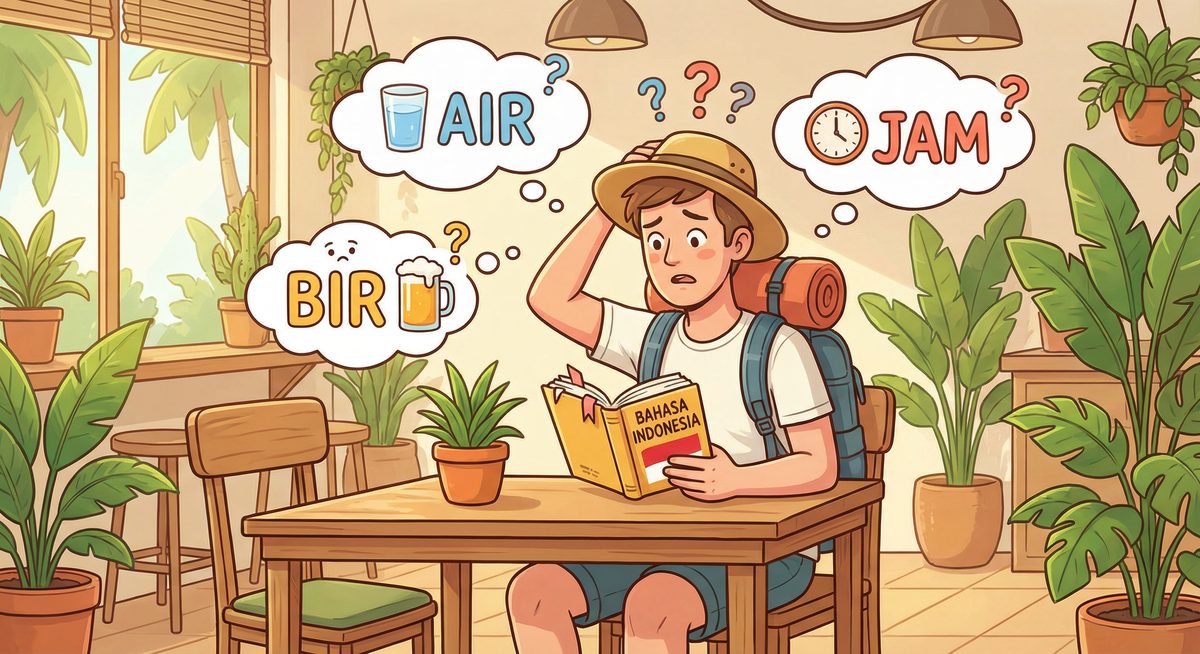
There's this word in Indonesian: bisa. If you've learned any Romance language, alarm bells should be going off in your head right now because that looks suspiciously like Spanish besa (kiss) or Italian bacio or French baiser (which… let's not get into that one). So naturally, when I first encountered bisa in a textbook, my brain confidently filed it under "probably something romantic."
Nope. Bisa means "can" or "able to." As in "I can speak Indonesian" (Saya bisa berbahasa Indonesia). Absolutely nothing to do with kissing. I used it correctly for about three weeks before someone mentioned the false friend thing and my brain short-circuited trying to figure out why I'd been so confident about the wrong etymology the entire time.
Indonesian is full of these. Words that look or sound like they should mean one thing based on your existing language knowledge, but mean something completely different. And because Indonesian borrows from Dutch, Portuguese, Arabic, Sanskrit, and about six other languages depending on which island you're on, there are false friends hiding everywhere.
Let me walk you through the ones that got me, and a few that I've watched trip up other learners.
The Dutch ones (because colonialism)
Kantor looks like it should be related to English "cantor" (a singer) or maybe Spanish cantar (to sing). It means "office." Boring office. The kind with fluorescent lights and a broken printer. Comes from Dutch kantoor. I spent an embarrassing amount of time wondering why someone was inviting me to their "singing place" before I figured this one out.
Gratis is actually correct if you speak most European languages (Spanish, Italian, Dutch all use variants of this for "free"). But if you're a native English speaker, your brain wants this to mean "grating" or "gratuity" and neither of those is right. It just means free. No charge. Ini gratis means "this is free," which is a sentence you will hear approximately never in Bali tourist areas, but it's good to know anyway.
Bis (sometimes spelled bus) means bus. Straightforward, right? Except if you speak German where bis means "until," or if your brain is trying to parse it as the English prefix "bi-" meaning two. It's just a bus. This one didn't trip me up but I watched a German guy get very confused about timetables because of it.
The Portuguese ones (also colonialism, different century)
Mentega means butter. Comes from Portuguese manteiga. If you don't know that etymology, it just looks like a random Indonesian word and you move on. But if you speak Spanish, your brain sees manteca (lard/fat) and files it accordingly. Close enough that you probably won't mess up, but the Portuguese got there first.
Sabun means soap. Comes from Portuguese sabão. The thing is, if you speak French, sapin means Christmas tree, and if your brain is tired and you're trying to buy soap at a minimarket, you might have a moment where you question whether you're asking for soap or somehow accidentally referencing conifers. You're not. It's just soap.
Keju means cheese. From Portuguese queijo. Spanish speakers will see queso and get it immediately. English speakers will look at "keju" and have absolutely no idea until someone tells them. This is one of the few food words where the Portuguese etymology is actually helpful if you already speak a Romance language.
The Arabic ones (because trade routes and Islam)
Kursi means chair. From Arabic كرسي (kursī). If you speak Arabic, this is free real estate. If you don't, your brain might try to connect it to "curse" or "curtsy" and neither of those will help you. It's just a chair. You sit on it.
Maaf means sorry or excuse me. From Arabic معاف (maʿāf). Absolutely essential word. You'll say this fifty times a day in Jakarta just navigating through crowds. No false friend issue unless you speak Arabic and get excited that you already know it, which, fair.
Pikir means to think. From Arabic فكر (fikr). English speakers might see "picker" or something tool-related. It's not. Saya pikir means "I think." You will use this constantly. Once you've got your pronouns sorted, pikir is one of the next verbs you'll want locked in.
The ones that just look like English words but aren't
Bom means bomb. This one is actually cognate with English (both from French/Latin roots), but I'm including it because the spelling is different enough that you might not recognize it in text, and the pronunciation is slightly off. Indonesians will say it more like "bome" with a longer O sound. Not a false friend, just... not quite a true friend either.
Mati means dead or to die. If you speak Italian, matto means crazy (and matto in Spanish is a completely different thing involving tea). Mati in Indonesian has nothing to do with madness. It's just dead. Battery dead. Phone dead. Relationship dead. All mati.
Bodoh means stupid or foolish. Looks vaguely like it could be related to English "body" if you squint and ignore linguistics entirely. It's not. Someone who is bodoh is being an idiot, not doing anything body-related. Don't confuse this with bodo which is the slang shortened version and sounds slightly less harsh.
Buku means book. Looks like it should be Japanese for "buku buku" (the sound of bubbling) or maybe something related to "bouquet." Nope. Book. Plain old book. Saya mau beli buku means "I want to buy a book," not "I want to buy bubbles" or "I want to buy flowers."
The sneaky sound-alikes
Makan means to eat. Sounds like "mackin" which is slang in some English dialects for kissing or making out. Do not get these confused. If someone asks sudah makan? (have you eaten?), they are asking about food. This is an extremely common greeting in Indonesia. People ask about your meal status the way English speakers ask about the weather.
Lumpur means mud. Sounds like "Lumpur" as in Kuala Lumpur, which is literally "muddy estuary," so this one is actually correct, but English speakers unfamiliar with Malay/Indonesian will hear "Lumpur" and think it's just a place name without realizing it means mud. I mention this because I've watched people get confused when discussing Indonesian geography and place names.
Toko means shop or store. Sounds identical to Japanese 所 (tokoro, place) and sort of similar to 床 (toko/yuka, floor). If you've studied Japanese, your brain will try to file this under existing Japanese vocabulary. It's not related. Different language family entirely. Toko just means shop. Toko buku is a bookshop.
The absolutely bizarre one that haunts me
Tahu. This word has two completely different meanings depending on context and it's killed me multiple times.
Meaning one: tofu. The food. From Chinese 豆腐 (dòufu). Tahu goreng is fried tofu.
Meaning two: to know. Saya tidak tahu means "I don't know." Completely different etymology (probably from Sanskrit).
So when someone asks you about tahu in conversation, you need context immediately or you're going to answer a question about knowledge when they're asking about food preferences, or vice versa. I have done both. Neither was smooth.
This isn't technically a false friend because the two Indonesian meanings aren't related to any other language's similar word, but it's a false friend with itself, which might be worse. I mentioned this in the mistakes post but it deserves repeating because it's such a common stumbling point.
Why this matters (beyond just not sounding confused)
False friends aren't just a curiosity. They actively slow you down when you're learning because your brain keeps trying to map new Indonesian words onto existing vocabulary from other languages you speak. The more languages you know, the worse this gets, because you have more possible false matches.
When I learned bisa wrong, I didn't just misunderstand the word. I built a mental association that then had to be unlearned and overwritten. That takes longer than just learning the word correctly the first time. Every false friend you catch early is one less correction you'll have to drill into yourself later.
The other thing is, Indonesian borrows a lot. Like, a staggering amount. From Dutch, Portuguese, Arabic, Sanskrit, Chinese, and recently English. Some of these borrowings are obvious (like komputer for computer), but others have shifted meaning or pronunciation enough that they're no longer transparent. Once you understand how Indonesian builds words through affixes, you'll start recognizing roots, but borrowed words don't always play by those rules.
If you're learning Indonesian and you already speak multiple languages, train yourself to be suspicious. When a word looks familiar, double-check it. Ask someone. Look it up. Your brain is probably doing pattern matching based on incomplete information and leading you somewhere wrong.
The ones I'm still waiting to screw up
There are definitely more false friends I haven't encountered yet because my Indonesian is nowhere near complete. I'm waiting for the day I confidently use some Sanskrit-derived word thinking it means one thing because I've heard it in Hindi or Thai, and then discover Indonesians took it in a completely different semantic direction. It'll happen. The question is just when, and how embarrassing the context will be.
If you're just starting out, honestly the best approach is to jump in and use the language even when you're not sure. You'll catch false friends faster through real mistakes than through theoretical study. Someone will correct you. You'll remember. That's how this works.
Right, I need to stop before this turns into a full etymology lecture. The main takeaway: be suspicious of familiar-looking Indonesian words, especially if they look like Romance languages or Dutch. Half the time they mean what you think. Half the time they're linguistic traps. Good luck figuring out which is which.