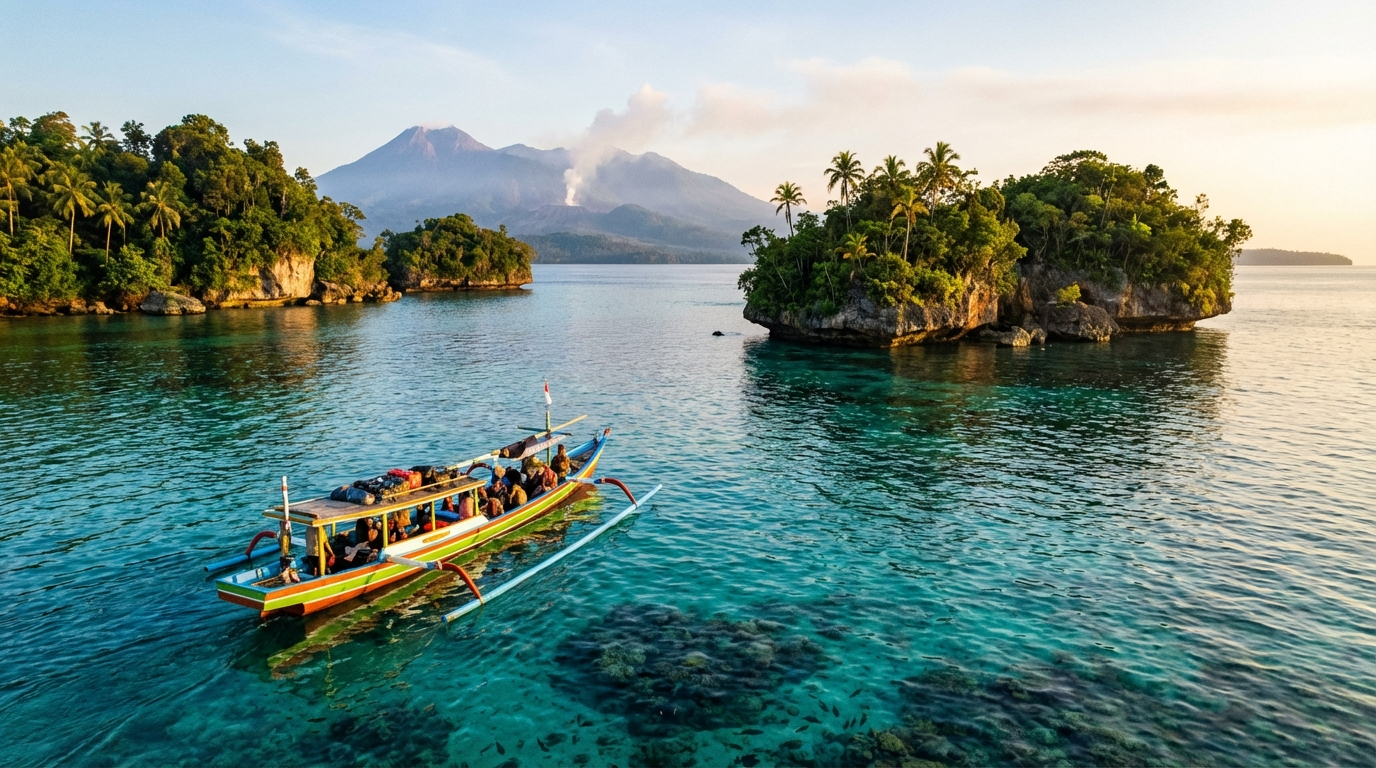
I'll start with the thing nobody tells you before your first trip to Indonesia: you cannot do it all. Not in two weeks, not in two months. The country spans three time zones and contains something like 17,000 islands, most of which don't appear on the tourist circuit at all. Every time I go back I end up in a different corner, doing completely different things, and still feeling like I've barely scratched the surface.
So this isn't a checklist. It's more like field notes from repeated visits, organised roughly by what I found most worth doing. Your mileage will vary. That's sort of the point.
The Volcanoes Will Ruin Other Hikes for You
Start with this, because it sets the tone for everything else about Indonesia: the landscape is absurd. Java alone has over 40 volcanoes, and several of them are climbable without technical gear. Mount Bromo is the famous one, and yes, the sunrise views from the caldera rim really are as good as the photos suggest. You'll share them with a hundred other people at 4am, but that somehow doesn't ruin it.
The better hike, if you're up for it, is Ijen. You leave around midnight to reach the crater before dawn, partly to see the blue flames from the sulfur vents and partly because the sulfur miners start their shifts early and the trail gets crowded with their loads. These are men carrying 70-kilo baskets of raw sulfur up a volcanic crater for roughly $5 per trip. It puts your "tough hike" in perspective fairly quickly.
On Bali, Mount Batur is the easy option: two hours up, decent views, banana sandwich at the top from a vendor who somehow beats you there every time. Mount Agung is the serious one. Eight hours round trip, proper fitness required, and you need a guide. The summit sits above the cloud line on a clear morning and the whole of eastern Bali spreads out below you. I've done it once and my knees reminded me about it for a week afterwards.
Rinjani on Lombok is the big commitment: three days, two nights, a crater lake in the middle, and legs that stop working properly on day two. Genuinely one of the best multi-day treks in Southeast Asia, but you need to actually want it.
Diving, and Why Indonesia Specifically
Indonesia sits at the heart of the Coral Triangle, which is the marine equivalent of the Amazon rainforest. More species of coral and reef fish live here than anywhere else on the planet. That's not tourism marketing; it's biogeography. If you dive anywhere in the world, at some point you need to dive here.
The range is what gets you. The Liberty wreck in Tulamben is a US cargo ship torpedoed in 1942, now sitting in 30 metres of water off Bali's northeast coast, completely encrusted with coral and swarming with reef fish. You can snorkel parts of it. It's about as accessible as world-class wreck diving gets.
Head south to Nusa Penida and the game changes. Crystal Bay is where people go hoping to see oceanic sunfish (mola mola) between July and October. The water temperature drops noticeably here because of deep upwellings, and the visibility can be extraordinary or terrible depending on the currents. It's unpredictable. That's part of the appeal.
Komodo is a different beast entirely. Labuan Bajo has transformed from a sleepy fishing town into a full-blown dive tourism hub, and for good reason. Castle Rock is one of those sites where the current rips across a submerged pinnacle and everything shows up: grey reef sharks, giant trevally, Napoleon wrasse, sometimes even dolphins circling above. It's not a gentle dive. You hook in, hold on, and watch the show. Manta Alley near Labuan Bajo does exactly what the name suggests. Reef mantas glide through a channel between two islands to visit cleaning stations, and on a good day you'll see ten or more in a single dive.
Then there's Raja Ampat, which exists in a category of its own. Cape Kri holds the world record for fish species counted on a single dive: 374. Let that number sit for a moment. A marine biologist actually counted 374 distinct species in one hour on one reef. Melissa's Garden is the soft coral version of that abundance. Fields of leather coral stretching across a shallow plateau, with damselfish and anthias hovering above in clouds of colour. It looks like an aquarium designed by someone with an unlimited budget.
The Gili Islands offer easier access for newer divers. Turtle Heaven off Gili Meno is named accurately: green sea turtles rest on the sandy bottom and the coral bommies here, seemingly unbothered by the parade of divers drifting past. It's a good place to get comfortable underwater before heading somewhere with stronger currents.
Surfing, for Those Who Chase Waves
I don't surf, so I'll keep this honest rather than pretending expertise. What I do know is that half the surfers I've met in Bali didn't come for the temples. They came for the breaks.
Uluwatu is the headline act. The wave breaks over a shallow reef below limestone cliffs, and even watching from the cliffside warungs is impressive. Padang Padang is nearby and apparently better for intermediate surfers, though "intermediate" in Balinese terms might not match your definition. Canggu has become the default spot for beginners and digital nomads, with beach breaks that won't punish you too hard for mistakes.
The serious surf crowd goes to the Mentawai Islands off Sumatra, or to G-Land (Grajagan) in East Java, which has one of the longest left-hand barrel waves in the world. These are trip-defining destinations for experienced surfers. Everyone else sticks to Bali's south coast and has a perfectly good time.
Lombok's south coast is gaining reputation too. Desert Point (Bangko-Bangko) produces world-class barrels when the swell lines up properly, which it doesn't always do. That uncertainty keeps the crowds manageable.
The Food Alone Justifies the Plane Ticket
Indonesian food is one of the most underrated cuisines on the planet and I will die on this hill. The problem is that most visitors eat at tourist restaurants in Seminyak and think "Indonesian food" means a mediocre nasi goreng with a fried egg on top. That's like judging Italian food by the Olive Garden.
The real food lives in warungs. Small, often family-run places with laminated menus or no menus at all. You point at what's in the glass case and they pile it on rice. A full meal costs 15,000 to 30,000 rupiah (roughly one to two quid). The quality is often staggering.
Padang food is the system I find most fascinating. You sit down and they bring out fifteen small dishes without you ordering anything. You eat what you want and they charge you for what's gone. Rendang (slow-cooked spiced beef), ayam pop (steamed then flash-fried chicken), gulai otak (brain curry if you're feeling adventurous), and about ten different sambal options. A Padang restaurant on Jalan Sabang in Jakarta called Sari Ratu changed my entire understanding of what spiced food could taste like.
Yogyakarta is the other food city. Gudeg (young jackfruit stewed in coconut milk and palm sugar) is the signature dish, and it's unlike anything else in the archipelago. Sweet, rich, and served with krecek (spiced beef skin) that adds a savoury counterweight. Every gudeg place claims to be the best. They might all be right.
Street food after dark is its own experience. Martabak (thick stuffed pancake, both sweet and savoury versions), sate (skewered meat with peanut sauce, but the regional variations are enormous), and bakso (meatball soup) vendors who wheel their carts through residential streets announcing themselves with a distinctive knock on a wooden block. You hear the knock, you grab your bowl, you go outside. It's a system that's been working for decades.
Temples, Culture, and the Stuff That Sticks With You
Borobudur at sunrise is one of those experiences that genuinely lives up to the hype. The largest Buddhist temple in the world, built in the 9th century, rising out of the Javanese jungle in concentric tiers. The bas-reliefs tell the story of the Buddha's path to enlightenment across 2,672 individual panels. Walking the galleries at dawn, with mist still hanging in the valleys below, is properly moving regardless of your religious inclinations.
Prambanan is fifteen minutes away and almost as impressive. Hindu rather than Buddhist, with towering spires dedicated to Shiva, Vishnu, and Brahma. The two temples together represent one of the most remarkable concentrations of medieval religious architecture anywhere in the world. You can do both in a single day from Yogyakarta.
Bali's temple culture is different: living, not archaeological. Tirta Empul is a water purification temple where Balinese Hindus (and tourists, if they're respectful about it) stand under fountains of spring water in a prescribed order. Tanah Lot sits on a rocky outcrop in the sea and is best visited at low tide during golden hour, when half of Bali's Instagram accounts converge on the same spot. Uluwatu's temple is perched on a cliff with monkeys that will steal your sunglasses.
But the culture that actually stays with you tends to happen by accident. A ceremony blocking the road, so you pull over and watch a procession of women carrying fruit towers on their heads. A gamelan rehearsal drifting from a community hall at night. A family inviting you to sit during a house blessing. These aren't bookable experiences. They're just Indonesia being Indonesia.
Island Hopping and the Places Between the Highlights
The Komodo day trips from Labuan Bajo deserve a mention because seeing Komodo dragons in the wild is exactly as surreal as it sounds. They're enormous, they're prehistoric-looking, and they move faster than you'd expect. The rangers carry forked sticks. You stay behind the rangers.
Nusa Penida has become a day trip from Bali, but it deserves longer. The broken beach (Pasih Uug) is a collapsed limestone cave forming a natural rock arch over turquoise water. Kelingking Beach looks like a T-Rex head from above. The roads are terrible, the infrastructure is basic, and it's better for it.
Flores beyond Labuan Bajo is genuinely underexplored. The Trans-Flores highway winds through volcanic landscapes, traditional villages, and rice paddies that rival anything in Bali without the crowds. Kelimutu, a volcano with three crater lakes that change colour depending on mineral oxidation, is worth the early alarm alone.
The Banda Islands (Maluku) are for the truly committed. The original Spice Islands, where nutmeg grew and European empires fought wars over flavouring. The diving is excellent, the history is extraordinary, and the tourist numbers are essentially zero. Getting there takes effort. It's worth the effort.
Practical Bits That Actually Matter
The wet season (November to March) doesn't mean constant rain. It means afternoon downpours that last an hour and then stop. The dry season (April to October) is more comfortable for hiking but diving is good year-round in most places. Raja Ampat peaks between October and April, which is conveniently opposite to Komodo's best season.
Domestic flights are cheap and frequent. Lion Air and Citilink will get you between islands for $30 to $60 if you book a few days ahead. Ferries exist but they're slow and not always reliable.
Learn a few Indonesian phrases. "Terima kasih" (thank you) and "Berapa?" (how much?) will cover about 40% of your daily interactions. The language is surprisingly approachable for English speakers: no tones, Latin alphabet, and grammar that's more forgiving than most Asian languages. There's a reason we built an entire site about learning it.
Don't try to do everything in one trip. Pick a region, go deep, come back for the rest. Indonesia rewards return visitors more than almost anywhere I know. Every trip reveals something the last one missed, and the country is changing fast enough that even familiar places feel different each time you return.