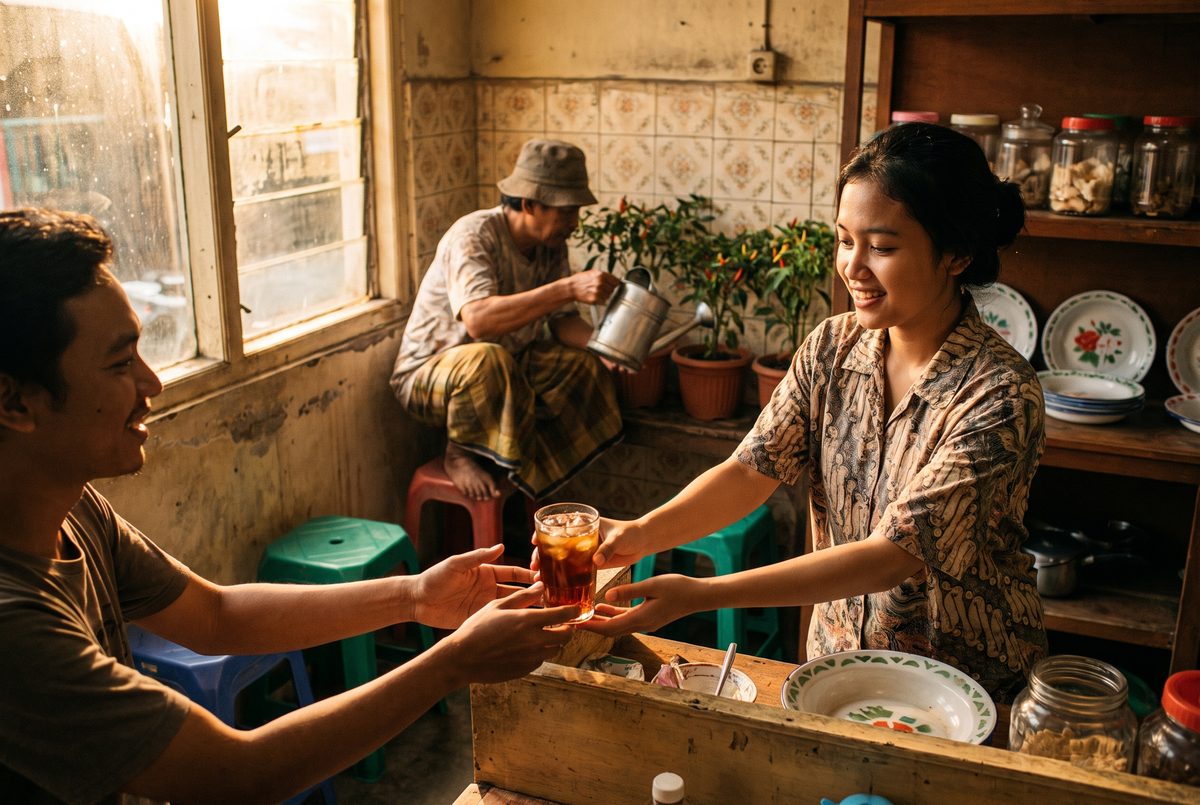
Two sentences that look almost identical. Dia membeli kopi saya and Dia membelikan saya kopi. The first one means they bought my coffee, as in they picked up the cup I had already paid for. The second means he bought me a coffee, as a favour. Four letters glued onto the end of the verb, and the coffee travels in the opposite direction.
That was the moment I stopped treating -kan and -i as decoration. Most courses introduce them somewhere around month three, give you a short list, and hurry on to something friendlier. Which is a pity, because these two suffixes handle a job that English does with word order and little words like "for" and "to". Once you can see what they are doing, a lot of Indonesian that looked like it had spare syllables suddenly makes sense.
They are not really about meaning. They are about the slot after the verb.
Here is the model that finally made this click for me. In Indonesian, the noun that sits immediately after the verb is doing the important work. It is the thing the sentence has decided to be about. Everything else gets pushed out to the edges with a preposition.
A plain verb puts the obvious candidate in that slot. Saya kirim surat. I send a letter. The letter is the thing being sent, so the letter goes straight after the verb.
-kan and -i both interfere with that. They evict the obvious candidate and promote something else into the slot: a person who benefits, a surface that gets covered, an object that gets made to move. The core meaning of the verb barely shifts. The grammar around it rearranges itself entirely.
-kan, first job: doing it for somebody
This is the use you will meet most often, and the only one I would bother producing deliberately as a beginner. Take an ordinary transitive verb, add -kan, and the person you are doing it for takes the slot straight after the verb.
Ambil buku itu. Take that book.
Ambilkan saya buku itu. Get me that book.
Beli kopi. Buy coffee.
Belikan dia kopi. Buy them a coffee.
Same shape with buatkan (make something for someone), bawakan (carry something for someone), bukakan (open something for someone), pesankan (order on someone's behalf) and carikan (look for something for someone). If you have ever wondered why tolong ambilkan sounds so much more natural than tolong ambil when you want a fork passed over, this is why. The suffix is what makes it a favour rather than an instruction. I wrote more about the surrounding etiquette in the piece on how to ask for things in Indonesian.
Notice the word order. Belikan dia kopi, not belikan kopi untuk dia. The second version is grammatical and people say it, but the whole point of the suffix is that you no longer need the preposition. If you find yourself using both at once, you have done extra work for nothing.
-kan, second job: making something happen
The other big use takes a verb or an adjective that describes a state, and turns it into "cause that state". English usually swaps in a completely different word here, which is why the pairs look unrelated in translation.
Duduk, to sit, becomes dudukkan, to seat someone.
Masuk, to go in, becomes masukkan, to put in.
Jatuh, to fall, becomes jatuhkan, to drop.
Naik, to go up, becomes naikkan, to raise.
Panas, hot, becomes panaskan, to heat.
Ingat, to remember, becomes ingatkan, to remind.
The doubled consonant in masukkan and dudukkan confuses people for about a week. There is nothing clever going on. The root ends in k, the suffix begins with k, and Indonesian spelling writes both of them.
If you want free practice with this, read the back of a packet of instant noodles. Cooking instructions are almost entirely causative -kan. Masukkan mi ke dalam air mendidih. Tuangkan bumbu ke dalam mangkuk. Sajikan selagi hangat. Every product label in the country is quietly drilling you on this pattern, and unlike a textbook exercise you get noodles at the end.
-i: covering the thing, or aiming at a person
-i is the one learners tend to skip, partly because you rarely need to build one yourself and partly because the examples in grammar books are agricultural. But the contrast is genuinely elegant.
Saya menanam bunga di kebun. I planted flowers in the garden.
Saya menanami kebun dengan bunga. I planted the garden with flowers.
Look at what moved. In the first sentence the flowers are the object and the garden is tucked behind di. In the second the garden is the object, and the flowers get demoted to dengan. The English translation is nearly the same, but the second one carries an implication the first does not: the whole garden, covered, finished.
The same logic gives you menduduki, to occupy a place rather than merely sit; mengairi, to irrigate a field; menggarami, to salt something. It also handles people as targets. Mendatangi is to go to someone, menyurati is to write to someone, and mengunjungi is to visit. And there is a repetition flavour: memukul is to hit, memukuli is to hit over and over.
The clearest pair I know is kirim. Saya kirimkan surat itu puts the letter in the object slot. Saya kirimi dia surat puts the recipient there instead. Same event, two different decisions about what the sentence is about.
So the rough rule is: -kan promotes the thing, -i promotes the place or the person. That rule will carry you a long way. It also leaks.
Where the tidy rule stops working
A large share of the -kan and -i verbs you meet are frozen. Nobody parses them live. Melakukan (to do), menggunakan (to use), mengatakan (to say), menemukan (to find), memerlukan (to need), menyukai (to like), menikmati (to enjoy), mengetahui (to know about). These arrived as whole words in the mind of every Indonesian speaker and they should arrive as whole words in yours. Trying to reverse engineer melakukan from laku mid-conversation is a waste of a perfectly good second.
Then there are pairs where both suffixes exist and the difference has drifted into idiom. Menghindari means to avoid something. Menghindarkan means to keep someone away from something. You cannot derive that from a rule about object slots, you just learn it.
And plenty of roots simply refuse one of the two. There is no belii. There is no obvious tidurkan in everyday speech even though the logic would allow it. Indonesian is regular enough to give you a pattern and irregular enough to punish you for trusting it completely. That tension shows up all over the language, and it is the same reason the verb prefix system looks tidier on paper than it behaves in the wild.
One spelling note that saves confusion: -i does not stack on a root that already ends in i. Beri stays memberi. When you want the benefactive version you reach for memberikan instead.
In Jakarta, both of them collapse into -in
Here is the part that will be most useful if you are actually in Indonesia rather than working through a course. In colloquial Jakartan speech, and increasingly in the informal Indonesian of anyone under about thirty-five anywhere in the country, -kan and -i both turn into -in. The me- prefix falls off at the same time.
Ambilin, beliin, buatin, bawain, bukain, tungguin, bantuin, benerin, bikinin.
Tolong beliin gue kopi. Buy me a coffee.
Bukain pintunya dong. Open the door for me.
Tungguin ya. Wait for me.
This is not sloppiness, it is a different register with its own rules, and it is what you will hear in every WhatsApp voice note and every conversation between friends. It came out of Betawi Jakartan and spread nationally through television and social media, so you will hear it in Bali and Surabaya too, though it still reads as a Jakarta import to older speakers there. What you should not do is put -in in an email to a landlord or an immigration office. That distinction between what people say and what people write runs through the whole language, and I have gone into it further in the piece on the Indonesian people actually speak.
What I would actually do with this
Split it into recognition and production, and be honest about how lopsided the split is.
For production, learn maybe eight benefactive verbs and start using them tomorrow: ambilkan, belikan, buatkan, bawakan, bukakan, kirimkan, tunjukkan, pesankan. Their -in equivalents come along for free. That covers nearly every daily situation where the suffix does real work for you.
For everything else, aim only at recognition. You need to read menduduki and mendatangi without stalling. You almost never need to invent one under pressure. If you are unsure, fall back on the bare root plus a preposition. Saya kirim surat ke dia is unremarkable Indonesian and nobody will think twice about it. The suffix is a tool for precision, not a test you have to pass.
The one thing worth doing deliberately is noticing the object slot when you read. Every time you hit a verb with -kan or -i on it, look at the noun immediately after it and ask why that noun got the position. Do that for a month and the pattern stops being grammar and starts being obvious. It also makes the passive constructions much easier to follow, since they are built on exactly the same question of what the sentence has chosen to foreground.
If you want to drill this with sentences that came from real Indonesian rather than a textbook, you can practise Indonesian with our exercises, or sign up and start with the free tier. Our plans are there if you decide you want the whole thing.