The first clue that passive voice in Indonesian works differently came when I tried using active voice on purpose.
I'd been told passive was everywhere in Indonesian and kept wondering why. So I started paying attention. Sudah dimakan (already eaten). Sudah dibeli (already bought). Lagi dibersihkan (currently being cleaned). The thing being acted on kept arriving first, in text messages, on menus, in conversation. Once I noticed it, I couldn't stop noticing it.
It took a while to understand what was actually going on. The structure of Indonesian sentences isn't organised around who's doing something the way English sentences usually are. It's organised around what you're talking about. And when the topic is a thing that something happened to, passive is just the natural fit.
The di- passive: when who did it doesn't matter
The basic passive form works by adding di- to the front of a verb. Beli (buy) becomes dibeli (bought). Makan (eat) becomes dimakan (eaten). Bawa (carry) becomes dibawa (carried).
Kopi sudah dibeli. The coffee has already been bought.
Tasnya dibawa. The bag was taken.
Pintunya dikunci. The door is locked.
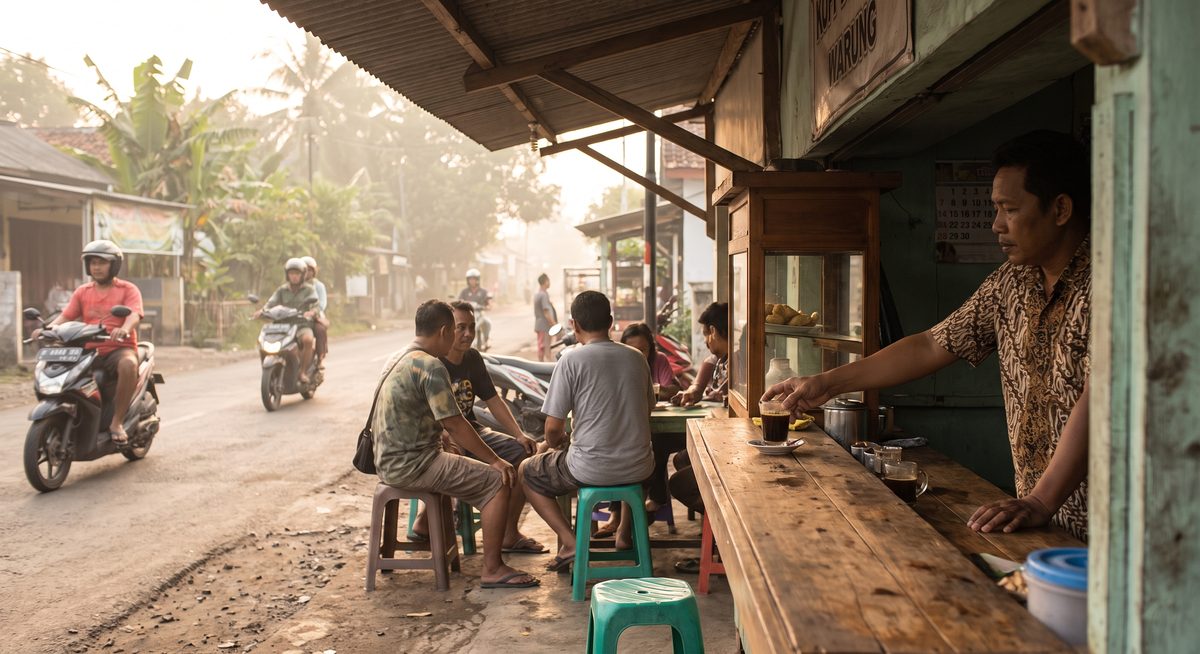
In each case, you're putting the thing being acted on at the front. You're not saying who did it, and that's fine. Often it's obvious from context. Sometimes it genuinely doesn't matter. A note on a warung counter that says makanan sudah disiapkan (food has been prepared) is giving you useful information. Adding who prepared it would just be noise.
This is where English passive and Indonesian passive go different ways. In English, passive often implies something is being obscured. Why won't you say who did it? Are you avoiding blame? Indonesian passive has no such connotation. The object is first because it's the topic, not because the agent is being hidden.
The pronoun passive: when who did it does matter
When the person doing the action is both known and relevant, Indonesian uses a different construction. The object still comes first, but the pronoun slots in between the object and the verb.
Kopi itu saya minum. That coffee, I drank it.
Buku ini sudah kamu baca? This book, have you read it?
Tasnya sudah dia kembalikan. The bag, she's already returned it.
This gets called the pronoun passive and the label is a bit misleading, because what's really happening is topic-fronting. The speaker establishes the object as the thing they're talking about, then gives information about it. It's closer to "as for this coffee, I drank it" than to any English passive construction.
One thing worth knowing: this form only works with short pronouns, saya, kamu, aku, dia, kami, mereka. You can't naturally substitute in a full name the same way. Saying "buku ini Dan baca" isn't idiomatic in casual speech, even if people understand what you mean. The pattern is specifically for pronouns.
Why passive is so common
Indonesian is often described as topic-prominent rather than subject-prominent. English sentences are generally built around who's doing something; Indonesian sentences are often built around what's being discussed. When the topic is a thing that had something done to it, passive is the default, not the exception.
I noticed this most clearly at a hotel in Bali. The receptionist, explaining that my room wasn't ready, said "Kamarnya sedang dibersihkan" (the room is being cleaned). An English speaker in the same situation might lead with the agent: "We're still cleaning your room." The Indonesian version leads with the room, which is what we're both thinking about anyway.
It isn't purely about indirect communication, though that does come into it. It's more fundamental than that. The thing under discussion gets the topic slot, and the topic slot comes first. Passive follows naturally from that logic.
The active form (and when it shows up)
Active voice in Indonesian uses the me- prefix. Membeli (to buy), memakan (to eat), membawa (to carry). This is the form most textbooks lead with, which is part of why passive feels unfamiliar to beginners. They're taught the me- active form as the standard form and passive as the exception. In practice it tends to be the other way round, at least in speech.
In casual conversation, you'll often hear neither prefix. Just the base verb: beli, makan, bawa. These bare forms read as active in most contexts. "Kamu beli apa?" (What did you buy?) is natural. The full membeli form appears in formal speech, news, and writing. If you spend time with Indonesians but not with Indonesian newspapers, you might hear membeli relatively rarely.
The post on the me- prefix goes into this in more depth, including which consonants trigger which version of the prefix. It's worth reading alongside this one, since the two forms are genuinely a pair.
Getting it right in practice
The practical advice is to stop treating passive as something to avoid. It isn't a sign of weak or unclear language in Indonesian. It's often the most direct way to say what you mean.
If you're talking about something that happened to an object and the agent is unknown or irrelevant, di- passive is what you want. If you're in casual conversation and the agent is a known pronoun, the pronoun passive works well. If the emphasis is genuinely on your action, active is natural too. The choice isn't about correctness so much as what's in the foreground.
Developing the instinct for which version fits takes time. Reading Indonesian text outside of textbooks helps a lot, because you start seeing which constructions native speakers actually reach for. If you want structured exercises that show active and passive forms in real contexts, practise Indonesian on bahasa.fun or take a look at our plans to see what's included.
For more on how Indonesian orders information within a sentence, the post on sentence structure covers topic position and why the beginning of an Indonesian sentence often isn't the subject in the English sense. It fills in a lot of the background that makes passive feel less strange once you understand it.
If you want to start practising Indonesian with content that reflects how the language is actually used, rather than how textbooks present it, that's exactly what we're trying to build.