Three weeks into learning Indonesian, I was sitting in a warung in Ubud trying to order food, and the guy behind the counter said something I didn't catch. I asked him to repeat it. He did, slower this time. "Mau membeli apa?" Want to buy what? I knew "mau" meant want. I knew "apa" meant what. But "membeli" threw me off even though I'd seen it before. Was that related to "beli" which I knew meant buy? Why the extra "mem-" part?
I asked him. He looked confused by the question, like I'd asked why English uses "the." It's just how you say it, he explained. The active verb form.
That didn't help at all.
Later that week I was reading signs and kept seeing "menulis" (to write), "membaca" (to read), "memasak" (to cook). They all had that "me-" sound at the start. Then I'd see "tulis," "baca," "masak" written without it in different contexts. Sometimes the same root with "di-" instead. I couldn't figure out when to use which form or why the prefix kept changing shape.
Then someone actually explained the system, and suddenly half the language made sense.
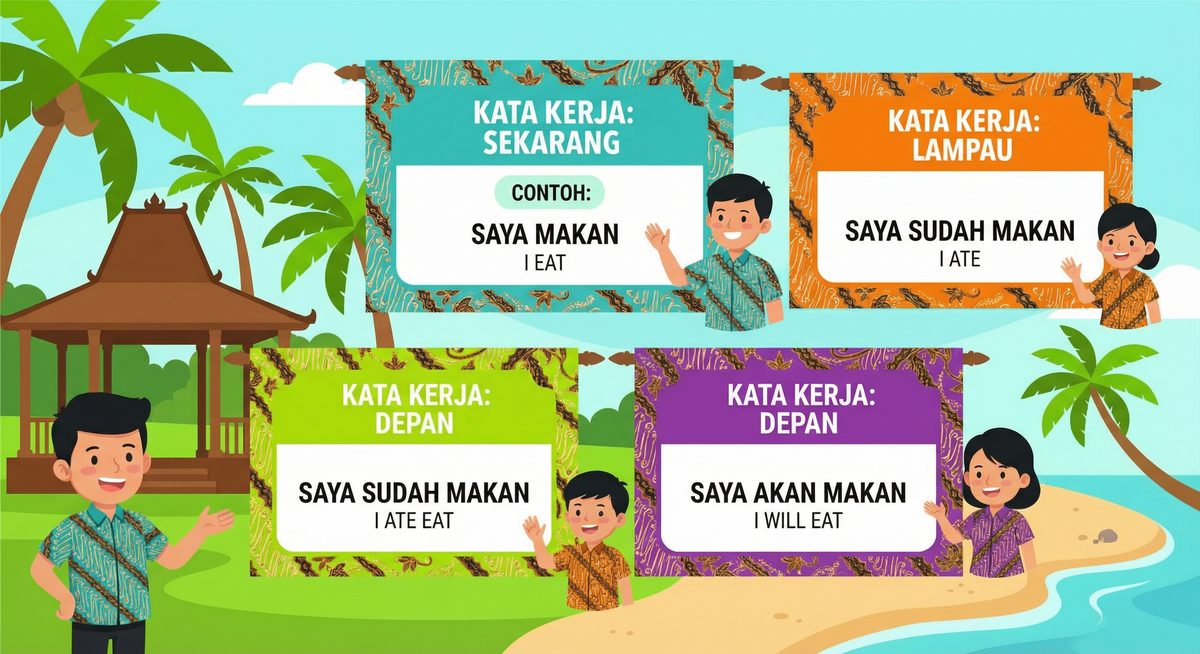
Indonesian doesn't conjugate verbs the way European languages do. "I eat," "you eat," "they eat" is all just "makan" with context telling you who's doing it. No tables to memorize, no irregular past tenses. But Indonesian does care about something European languages often ignore: whether the action is active or passive, and whether you're stating a command or describing an ongoing action.
The "meN-" prefix (which changes shape depending on what letter comes after it) is how you show active voice. The subject is doing the action to something else.
"Tulis" is the root: write. Just the bare concept.
"Menulis" means actively writing something. I am writing, you are writing, they are writing. The subject does the action.
"Ditulis" flips it to passive. Being written. Something is being written by someone.
The shape-shifting part confused me at first. Why "menulis" but "membaca" and "memasak"? Turns out there's a pattern. The "meN-" prefix adapts based on the first letter of the root word to make pronunciation smoother.
If the root starts with a vowel or certain consonants like "l," "m," "n," "r," you get "me-" and the root stays intact. "Lihat" (see) becomes "melihat." Simple.
If it starts with "p," "t," "k," or "s," the prefix absorbs that first letter and the "N" changes to match what would have come next. "Tulis" loses the "t" and becomes "menulis." "Beli" (buy) keeps its "b" but the "N" becomes "m" so you get "membeli." "Sapu" (sweep) loses the "s" and becomes "menyapu."
I won't lie, this was annoying to learn. I spent a week getting it wrong constantly. "Metulis" instead of "menulis." "Mesapu" instead of "menyapu." People understood me anyway because the root was obvious, but I wanted to get it right.
What helped was just listening to how Indonesians actually said these verbs and mimicking the sounds without overthinking the rules. After enough repetition, "membaca" started to sound right and "mebaca" sounded wrong. The pattern became automatic.
But here is what made it click conceptually. I realized the "meN-" forms were action verbs. When you want to say someone is doing something to something else, you use this form. "Saya menulis email" - I am writing an email. "Dia membaca buku" - He is reading a book. "Mereka memasak nasi" - They are cooking rice. The action is being performed.
If there's no direct object, or if the action is more of a state or condition, Indonesian often uses "ber-" instead. "Bekerja" is to work (as in, having a job or being engaged in work). "Berbicara" is to speak or talk. "Belajar" is to study or learn. These aren't actions you do to a specific object. They're activities you're engaged in.
Commands are different again. You usually drop the prefix entirely. "Tulis namamu!" - Write your name! "Baca ini!" - Read this! Just the bare root. Direct and simple.
The passive "di-" form shows up constantly in Indonesian, way more than passive voice appears in English. "Buku ini ditulis oleh Pramoedya" - This book was written by Pramoedya. "Email itu sudah dibaca" - That email has already been read. Indonesians use passive constructions all the time, especially in formal writing and news. It's part of the formal register.
One thing that threw me early on: sometimes you'll see the root verb used by itself in casual speech without any prefix at all. "Saya sudah baca" instead of "Saya sudah membaca" - I already read it. This happens a lot in conversation. People drop the "me-" when the meaning is clear from context. It sounds less formal, more relaxed. When I started doing this myself, my Indonesian friends said I was starting to sound natural. That felt good.
There's also a form called "memper-" which makes verbs causative - causing something to happen or making something a certain way. "Panjang" means long, "memperpanjang" means to lengthen or extend. "Besar" means big, "memperbesar" means to enlarge. I didn't learn this form until later because it's less common in everyday conversation, but it follows the same logic. The affixes carry meaning.
The system isn't arbitrary. It's structured. Once I understood what each form was doing, I stopped getting confused about when to use "menulis" versus "ditulis" versus just "tulis." It depends on what you're trying to say. Active or passive? Command or description? The form follows the meaning.
I tested this out one afternoon by reading Indonesian news articles and trying to spot the pattern. Every "meN-" verb was in an active sentence where the subject did something. Every "di-" verb was passive. Every command was a bare root. It was consistent. The language was following rules, and once I knew the rules, I could predict what form would appear next.
What really drove it home was when I started trying to construct my own sentences and realized I could build verbs I'd never actually heard before. I knew "dengar" meant to hear. So logically "mendengar" should mean actively listening to something, and "didengar" should mean being heard. I tried them in conversation. They worked. Native speakers understood me perfectly.
Same with "lihat" (see). I figured "melihat" would be to look at something actively, and "dilihat" would be being seen or watched. Correct on both counts. The system was predictable enough that I could generate correct forms without having encountered them first. That's powerful. That means the language wants you to figure it out.
There are some verbs that are irregular or borrowed from other languages and don't follow the pattern. "Pergi" (to go) doesn't break down into neat affixes. "Datang" (to come) stands alone. "Bisa" (can) doesn't change form. But these are exceptions, and there aren't that many of them. The majority of Indonesian verbs follow this "meN-" system.
The phonetic changes still trip me up sometimes. I occasionally forget whether a word starting with "c" becomes "menc-" or "men-" (it's "meny-" actually, because "c" is pronounced like "ch"). But getting it slightly wrong doesn't usually cause confusion. The root is still there. People are forgiving of small pronunciation mistakes when your meaning is clear.
What I wish someone had told me earlier is that you don't need to master all the phonetic variations before you start using these verbs. You can learn the basic concept - "meN-" is active voice, "di-" is passive voice - and then just absorb the specific sound changes through exposure. Listen to how Indonesians say "membaca" versus "menulis" versus "menyapu" and your brain will start picking up the pattern without you consciously memorizing rules.
I practiced by taking common roots I already knew and building their active forms. "Makan" (eat) becomes "memakan" when you're actively eating something specific. "Minum" (drink) becomes "meminum." "Ambil" (take) becomes "mengambil." Just running through these in my head while walking around helped them stick.
There's something satisfying about how logical this system is once you see it. Indonesian builds vocabulary through combinations rather than conjugations. You learn the building blocks and then you can construct what you need. "MeN-" is one of the most important building blocks for verbs. It signals action, agency, someone doing something to something else.
The moment I stopped seeing "menulis," "membaca," "membeli" as separate vocabulary items and started seeing them as "tulis," "baca," "beli" with a predictable transformation applied, the number of verbs I had to actively memorize dropped by half. I just needed to know the roots and understand how to activate them.
If you're learning Indonesian and the verbs feel overwhelming, this is the pattern to focus on. Not every exception, not every phonetic rule, just the basic idea: "meN-" makes it active, "di-" makes it passive, bare root is often a command. That alone will get you through most situations. The details can come later through practice and exposure.
I still remember that moment in the warung when "membeli" finally made sense. Not as a random word, but as "beli" with active voice applied. It was one of those small breakthroughs that makes language learning feel possible. The thing that seemed random and confusing turned out to have a reason behind it.
Indonesian has a lot of those moments. The language rewards pattern recognition. If you're willing to look for the structure instead of brute-forcing vocabulary, it opens up much faster than you'd expect. The "meN-" prefix system is one of the first big patterns to learn. Get this right and suddenly hundreds of verbs start making sense.
If you want to practice this pattern with real examples, look for texts where you can see the same root used in different forms. Travel phrases are good for this because you'll see both command forms and active forms of the same verbs. "Tolong bantu" (please help) versus "Saya mau membantu" (I want to help). Same root, different contexts, different forms. That's the system working.