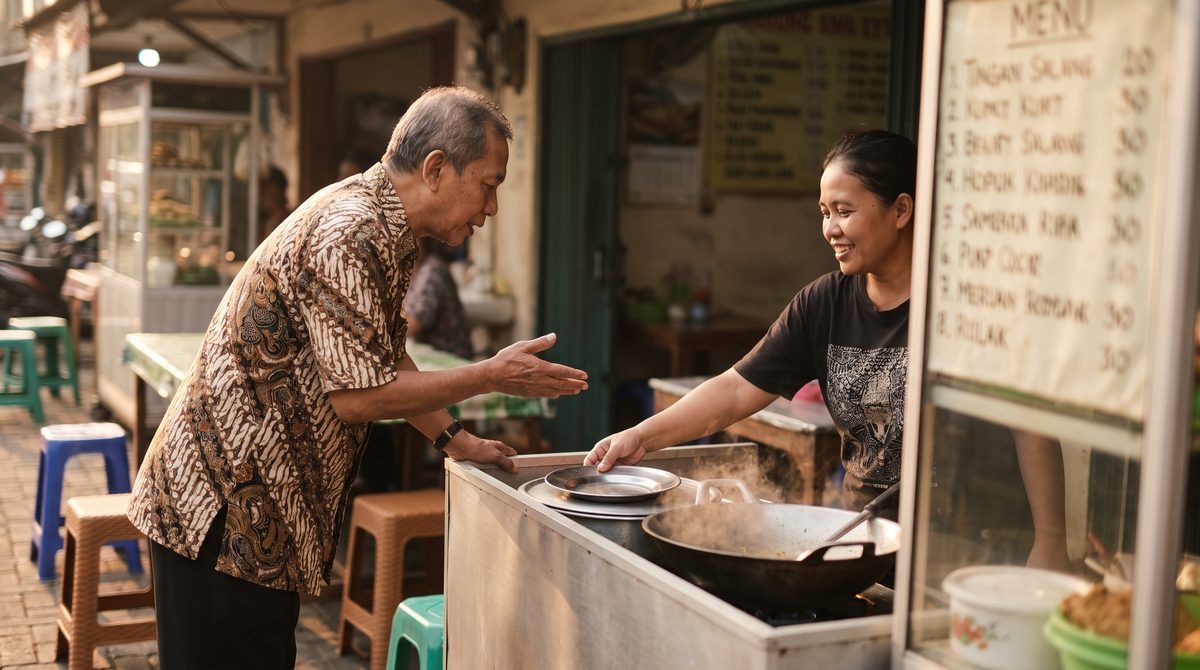
The first time I tried to ask for a fork in a warung in Yogyakarta, I said silakan garpu. The woman behind the counter looked at me for a second, worked out what I meant, and handed one over anyway. It took me another month to understand what I had actually said, which was roughly "go ahead, fork".
That mistake came from a reasonable assumption. English has one word for softening a request, and it works everywhere. Please pass the salt, please sit down, please stop doing that. Indonesian splits that job across four or five words that are not interchangeable, and none of them is really "please". Tolong, minta, coba and silakan each handle a different kind of asking, and the one you pick says something about what you think the other person is doing for you.
The bare command is not rude
Start with the thing that unsettles English speakers most. The Indonesian imperative is just the verb with nothing attached, and for verbs that normally carry the me- prefix, you strip it off.
Ambil. Take it.
Lihat. Look.
Tunggu. Wait.
Duduk. Sit.
To an English ear that lands like a drill sergeant, because in English a bare imperative with no "please" is either an emergency or an insult. In Indonesian it is neutral. Friends say duduk to each other constantly. A mother says makan to a child. What carries the politeness is not an added word but who you are talking to, whether you attach their title, and how your voice moves at the end of the sentence. Tunggu snapped flat is impatient. Tunggu ya, Pak with a rising tail is fine.
This is why learners who bolt tolong onto every single sentence end up sounding strange in the other direction, which I will come back to.
Tolong: asking someone to do something
Tolong is the closest thing to "please", and it is the one most textbooks lead with. It goes in front of the verb.
Tolong tutup pintunya. Please close the door.
Tolong tunggu sebentar. Please wait a moment.
Tolong ulangi. Please say that again.
The word itself means "help", and that is not a dead metaphor. Shouted on its own, Tolong! is what you yell when you are being robbed. Inside a sentence it keeps a faint sense of "do me a favour here", which is exactly why it works for requests and not for offers.
Two things make it sound much more natural. The first is the -kan suffix, which turns a verb into something done on your behalf. Tolong ambil buku itu is fine, but tolong ambilkan buku itu means "please get that book for me", and it is what people actually say. In Jakarta the colloquial version of that suffix is -in, so you get tolong ambilin, tolong bukain, tolong beliin. Once you notice -in you hear it constantly.
The second is the address term. Tolong tunggu to a stranger is a bit bare. Tolong tunggu sebentar ya, Pak is what a real person says. If you are shaky on when to use Pak, Bu, Mas and Mbak, that system does more work for your politeness than any single word, and I went through it properly in the piece on how Indonesians address each other.
Minta: asking for a thing
Here is the split that tripped me up for months. Tolong asks for an action. Minta asks for an object.
Minta air putih. Can I have some water.
Minta garpu, Mbak. Could I get a fork.
Minta bonnya dong. Can I get the bill.
Literally minta means "request" or "ask for", and grammatically you are stating that you are asking, not issuing a command at all. This is the workhorse in any shop, warung or kiosk. If you learn one construction from this article, make it minta plus the noun, because you will use it several times a day and it never sounds wrong.
You can dress it up: boleh minta tisu? or bisa minta sendok? The choice between boleh and bisa matters more than most learners expect, and I unpicked that difference in the article on bisa versus boleh. Short version: boleh minta is asking whether you are allowed to have it, bisa minta is asking whether it is possible, and in a restaurant both work.
The two words also fuse. Minta tolong means "ask a favour", and it prefaces a request that costs the other person some effort. Aku minta tolong dong is how you open when you need someone to drive you to the airport, not when you need the salt.
Coba: the gentlest way to tell someone what to do
Coba means "try", and as a softener it is badly underrated. Put it in front of a verb and a command turns into a suggestion that the other person might have a go.
Coba lihat. Have a look.
Coba cek lagi. Try checking again.
Coba tanya Rina. Maybe ask Rina.
I hear this constantly in offices and in any situation where someone senior is directing someone junior without wanting to sound like they are giving orders. It has a lightness that tolong lacks. Tolong cek lagi is a request. Coba cek lagi is closer to "why don't you check again", which is somehow both softer and, if your boss says it, not optional at all.
It also works on yourself. Coba deh means "just give it a try", and coba-coba means messing about with something to see what happens.
Silakan is not a request word
Back to my fork. Silakan means "go ahead" or "help yourself". It grants permission or offers something. It never asks for anything.
Silakan duduk. Please sit down, said by the host.
Silakan masuk. Come in.
Silakan dicoba. Please try some.
Notice that last one. When an Indonesian host invites you to eat, the verb usually turns passive: silakan dimakan, silakan diminum, silakan dicicipi. Grammatically the food becomes the subject and nobody is being ordered around, which is about as polite as the language gets. You will also hear the passive form alone, with a host waving at the table and saying dimakan, dimakan. If that construction looks odd to you, the passive voice in Indonesian is worth a detour, because it does far more everyday work than the English passive.
Regionally you will also meet monggo in Java and mangga in Sunda, both doing the job of silakan among people who share the local language. An older man in Solo waving you towards a chair with monggo is not speaking Indonesian at all, but you should probably sit down.
The particles do the emotional work
None of these words carries the warmth on its own. That comes from the little words at the end, and they change a sentence more than the verb does.
Dong adds a slightly pleading, familiar tone: minta es teh dong. Ya turns a command into a check that you both agree: tunggu sebentar ya. Deh signals a concession, a "fine, just do this one": coba deh. Getting these wrong with a stranger sounds overfamiliar, which is a real risk and why I wrote a whole piece on lah, dong and sih. There is also -lah stuck onto the verb, as in duduklah, but you will meet that mostly in writing, speeches and subtitles rather than in a warung.
And for stopping someone, you need jangan, which replaces the verb's negator entirely in commands. Jangan lupa, don't forget. Jangan pedas ya, not spicy please, possibly the most useful sentence in the language.
Where the textbook version breaks down
Among friends, tolong starts to sound stiff. Indonesians in their twenties asking a mate for something rarely say it. They use the bare verb with -in and a particle: ambilin dong, fotoin dong, temenin gue ya. If you deploy tolong in every sentence with people your own age, you sound like you are reading from a form. It is a lovely problem to have compared with sounding rude, but it does mark you as a learner who has only ever spoken to teachers.
The opposite trap is dropping politeness markers with people who outrank you. Indonesian society pays close attention to age and position. A bare tunggu to a man twenty years older than you, with no Pak attached, registers. Nobody will correct you, which is the frustrating part. They will just decide something quiet about you.
There is also the one nobody warns you about: kiri. Riding an angkot or a small bus, you do not ask the driver to stop. You say kiri, meaning left, and he pulls over. Kiri, Pak is a complete, polite, perfectly normal request, and the first time I tried to construct a full sentence about wanting to get out, we were three hundred metres past where I meant to be.
What to actually practise
Drill minta plus a noun until it is automatic, because ordering and buying is most of what you will do in your first month. Add tolong plus -kan for anything that involves someone doing you a favour. Keep silakan filed under things you say to guests, not to waiters. Use coba when you want to suggest rather than instruct. Then stop worrying about it, listen to how the person in front of you asks for things, and copy that.
The reassuring bit is that Indonesian is forgiving here. My silakan garpu got me a fork. Getting the register slightly wrong in this language is a much smaller crime than it is in Japanese or Korean, and most people are visibly pleased that you are trying at all.
If you want to practise Indonesian with these patterns in real sentences rather than lists, that is roughly what our exercises are built around. You can sign up for free and see whether it suits you before looking at our plans.