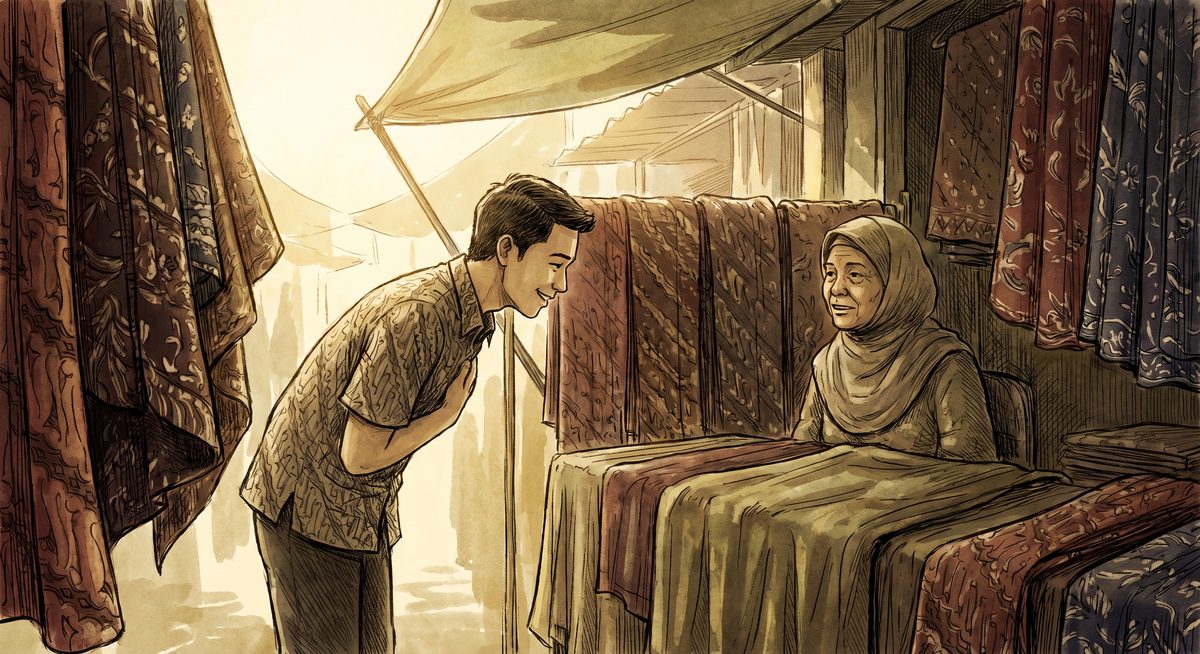
About two weeks into learning Indonesian, I walked into a pharmacy in Yogyakarta and called the male pharmacist "kamu." Not "Pak." Just "kamu." He was maybe 40, clearly senior to me in every social dimension, and I had just used the Indonesian equivalent of "hey, you."
He helped me fine, didn't say anything. But my Indonesian friend who was with me gave me a look on the way out. "You should call him Pak," she said. "He's not your friend."
That's the thing about Indonesian forms of address: nothing is technically wrong until it suddenly is. The language gives you a whole parallel system for referring to people, one that runs alongside pronouns and sits on top of them. Get it right and conversations flow. Get it wrong and you create this faint awkward energy that nobody talks about directly.
The basic split: Pak and Bu
Pak (short for Bapak) and Bu (short for Ibu) are the foundation. Pak for men, Bu for women. They come from words meaning father and mother, but Indonesians use them for any adult who seems older than you or is in a position of authority.
The pharmacist, the taxi driver, the woman at the bank counter, your landlord, your teacher, an official who's checking your documents. All Pak or Bu. It's the safe default for any adult you don't already know well.
What trips foreigners up: you don't just use Pak and Bu as titles in front of names. You can use them instead of "you" entirely. "Pak mau kemana?" (Where are you going, Pak?) is natural. So is "Bu bisa bantu saya?" (Can you help me, Bu?). The title replaces the second-person pronoun. Once you know that, a lot of overheard conversations start making sense.
Age is the main factor, not status exactly. A young driver isn't automatically Pak just because he's doing a job for you. If he looks roughly your age or younger, Mas or Bang fits better. An older woman selling food at a street stall is Bu regardless of what she does for a living. The read you're making is social age relative to yourself, not occupation.
Mas, Mbak, and the Javanese layer
Mas and Mbak are for younger adults or peers: men and women respectively. They come from Javanese and technically mean elder brother and elder sister, but Indonesians have absorbed them into everyday speech across the country.
In practice, Mas covers any man who seems roughly your age or a few years older, and Mbak does the same for women. Call a waiter in his twenties "Mas" when you're flagging him down. Call a woman at the cashier "Mbak" when she's clearly younger than a Bu. These are the everyday urban forms, especially in Java.
Jakarta complicates things slightly. There you'll hear Bang (short for Abang, meaning older brother) used where Mas would be used in Yogyakarta or Surabaya. Ojek drivers, street food vendors, guys at the parking lot. Bang is the Jakarta default for men who'd be Mas elsewhere. Both work. Neither is wrong in the other city. It's just about what sounds natural locally.
For women, Kak (short for Kakak) shows up in some regions and contexts as an alternative to Mbak. You'll hear it in Bali quite a bit. A Balinese shop worker might be Kak rather than Mbak. Same idea, different word. In some contexts Kak also reads as slightly more gender-neutral, so younger speakers sometimes use it broadly.
The age guessing problem
This is where it gets genuinely awkward. The system requires you to make a judgment call about whether someone is older or younger than you, and you're often working with limited information.
My rough rule: when in doubt, go up. Calling someone Pak when they're actually Mas age is harmless. They'll quietly correct you, or not, and nobody is offended. Calling someone Mas when they're clearly Pak age is a minor faux pas. Not terrible, but noticeable.
There's also the situation where you genuinely can't tell. Indonesian women in their thirties often look much younger to foreign eyes, which means I've called people Mbak who were clearly Bu by local standards. The correct response when someone seems uncertain is to just use their name if you know it, or dodge the pronoun entirely. "Mau pesan apa?" (What would you like to order?) works without committing to any title.
One thing I didn't expect: Indonesians also use these forms with each other constantly, not just when talking to foreigners. Listen to two Indonesians who've just met and you'll hear Pak, Bu, Mas, Mbak used within the first few exchanges. It's how you signal social positioning without having to spell it out. The pronoun system and the address system work together in ways that take a while to feel natural.
Calling people by profession
Certain jobs come with their own forms of address. Dok for doctors. Prof for university professors. Pak Guru or Bu Guru for schoolteachers (literally Pak/Bu + the word for teacher). Pak Polisi if you're talking to a police officer, though I'd recommend just saying Pak on its own if you want to sound less formal.
These aren't complicated. You hear them once or twice and they stick. The main thing is knowing they exist so you're not confused when someone introduces themselves as "Dok" rather than giving a name.
Drivers and service workers sometimes introduce themselves with just Mas or Bang as a kind of name substitute. Your Grab driver might say "Saya Bang Rudi" (I'm Bang Rudi) rather than just "Rudi." That's normal. It signals the social register for your interaction upfront.
When you just use the name
Once you're actually friends with someone, all of this falls away and you use first names. That's the end state. The forms of address are for people you don't know well, or for situations where the social gap matters.
With close friends, dropping titles and using just the first name, or even a nickname, is normal. Casual Indonesian drops a lot of formality, and address is one of the first things to go when people are comfortable with each other. The guy who was Mas Budi when you met him is just Budi after a few hangouts.
There's a middle ground too. Some Indonesians will use their own name in third person as a kind of softening device. A woman named Sari might say "Sari mau ke mana dulu" (Sari needs to go somewhere first) instead of "saya" or "aku." This sounds odd translated but is warm and slightly playful in context. You'll hear it from women more than men, more in Java than other islands.
What about Anda?
Anda is the hyper-formal "you" that appears in instruction manuals, customer service scripts, and official signage. It's not how anyone actually addresses another person in conversation.
I mention it because learners sometimes default to Anda thinking it's the polite option, when it's actually the weird-robot option. If you're talking to someone face to face and you say "Anda mau kemana," you sound like a recorded announcement. Use their title or name instead. That's more polite than Anda by a wide margin.
The formal versus natural Indonesian split matters everywhere in the language, but address forms are where it's most socially visible. Getting the grammar wrong is forgivable. Getting the register wrong is what makes people feel slightly uncomfortable in ways they can't always articulate.
Practical summary for new learners
Use Pak and Bu for adults who are older than you or in any kind of authority position. Use Mas and Mbak for peers and younger adults in most of Java. Use Bang and Kak as region-specific alternatives in Jakarta and Bali. When you're not sure, default up (Pak rather than Mas) or skip the title and dodge the question. Use first names once you're actually friends.
The goal isn't to get this perfect immediately. Indonesians are patient with learners and will correct you gently if at all. But even a rough feel for the system changes how conversations go. People engage differently when you address them correctly. It signals that you're not just reciting tourist phrases but actually paying attention to how Indonesian social life works.
If you want to get comfortable with this in context rather than in the abstract, practising with real Indonesian conversations is where it starts to click. You see these forms in use and your ear calibrates. Check out how we structure lessons if you're just starting out, or have a look at what the full programme includes if you want something more structured.
And maybe don't call the pharmacist kamu.