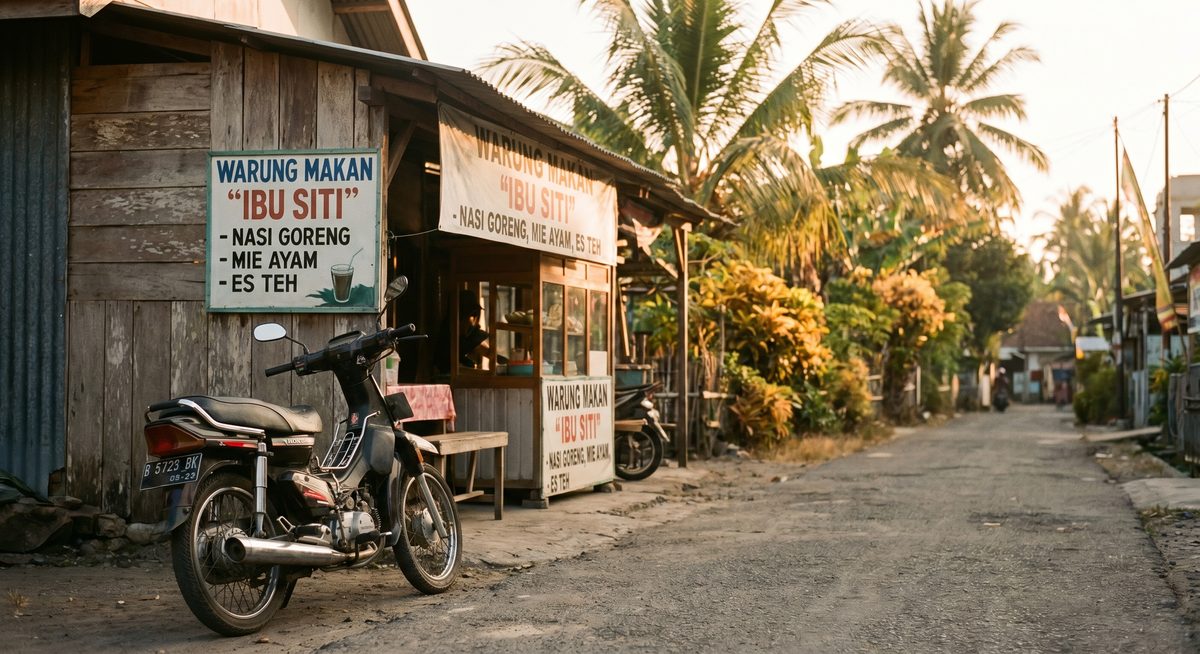
Walk down almost any Indonesian street and you'll eventually pass a hand-painted banner that reads di jual, two words, with a gap in the middle. A few doors down, another one says dijual, no gap. Both mean "for sale". One is spelled correctly and the other isn't, and the people who painted them mostly couldn't tell you which is which.
This is the di problem. Indonesian has two completely different things that both look like the letters d and i stuck to the front of a word, and they follow opposite spelling rules. Mix them up and your writing looks off to anyone paying attention. The strange part is that native speakers get this wrong all the time, which is oddly reassuring once you understand why.
Two things wearing the same costume
The first di is a preposition. It means "at", "in", or "on", and it points at a location. di rumah (at home), di Bali (in Bali), di pasar (at the market), di atas meja (on the table). This di is its own word, so it gets its own space, the same way English keeps "at" separate from "home".
The second di is a prefix. It glues onto a verb and flips that verb into the passive. Beli is "buy", dibeli is "bought". Makan is "eat", dimakan is "eaten". Jual is "sell", dijual is "sold" or "for sale". This di is not a separate word. It's part of the verb, so it never takes a space.
That's why dijual (one word) is the right way to write "for sale": it's the passive of "sell". And di jual with a space is wrong, because there's no place called "jual" for a preposition to point at. The sign painter heard the right sound and guessed the spelling.
The test that actually works
When you're unsure, ask what comes after the di. If it's a place, somewhere you could stand or point to, then di is the preposition and it gets a space. If it's an action being done to something, then di- is the passive prefix and it stays attached.
Di kamar, in the room. Kamar is a place, so a space. Dikunci, locked. Kunci here is the act of locking, so no space. Di kantor, at the office, place, space. Dibayar, paid, action, no space. Run that check and most cases sort themselves out.
The awkward pairs are the ones where the same root could go either way. Parkir is a good example. Di parkir would mean "at the parking", treating parkir as a place. Diparkir means "parked", as in the car was parked by someone. You'll see both on signs around Jakarta, and only context tells you which the writer had in mind.
Why the spacing trips up natives too
Here's what surprised me: the mistake runs in both directions. Plenty of Indonesians split the prefix, writing di jual when they mean dijual. Just as many fuse the preposition, writing disini and dirumah when the correct forms are di sini (here) and di rumah (at home). It's such a common slip that Indonesian schools drill it on purpose, and you'll still find it wrong on official notices.
If you grew up speaking the language by ear, the space is invisible. You never hear it. Dirumah and di rumah sound identical out loud. The spacing rule only exists on paper, which is exactly the kind of rule that erodes when most of your daily Indonesian is spoken or typed fast into a chat thread. As a learner you actually have a small advantage here, because you probably met the rule as a rule rather than absorbing the sound first and worrying about spelling later.
The passive is doing more than you think
The bigger reason the prefix di- deserves attention is that Indonesian leans on the passive far more than English does. In English we're taught to avoid the passive, to say "I sent the email" rather than "the email was sent by me". Indonesian goes the other way. The passive is often the natural, neutral choice, not a stiff or evasive one.
Email itu sudah dibaca. That email has been read. Nobody says who read it, and nobody needs to. Pintunya dikunci. The door is locked. Nasinya sudah dimasak. The rice is already cooked. English would often hunt for an active subject in these spots. Indonesian is happy to leave the doer out entirely.
When you do want to name the doer, you add oleh ("by"): Buku itu ditulis oleh Pramoedya. That book was written by Pramoedya. In casual speech the oleh usually drops, and Buku itu ditulis Pramoedya works fine. This is the same passive system the post on the meN- prefix describes from the active side. Menulis is "to write" (active), ditulis is "written" (passive). Two faces of the same verb.
The passive that doesn't use di- at all
This part took me ages to notice. The di- prefix is only for third-person doers: "he", "she", "they", or an unnamed someone. When the doer is "I" or "you", Indonesian switches to a different passive, and it drops the prefix completely.
Suratnya sudah saya kirim. The letter, I've already sent it. Literally something like "the letter, already by-me sent". The verb kirim sits there bare, with the pronoun saya in front of it doing the job di- would do for a third person. You can't say dikirim saya. It has to be saya kirim.
Kopinya sudah kamu minum? Have you drunk the coffee? Itu nanti saya kerjakan. I'll do that later. This object-first, agent-in-the-middle, bare-verb pattern shows up constantly in real conversation, and it's one of the things that makes early Indonesian feel like it's running backwards. It ties into the wider story of how flexible Indonesian word order is, which is its own rabbit hole.
ke and dari play by the same rule
Once the di split clicks, two more prepositions fall into place. Ke means "to" and dari means "from", and like the locational di they always take a space before a place. Ke pasar (to the market), dari rumah (from home), ke sana (to there). You'll never attach them to a place name. Kepasar is wrong the same way dirumah for "at home" is wrong.
There's a ke- that behaves like a prefix in other constructions, so I'm simplifying slightly. But for plain "to a place" purposes, treat di, ke and dari as the location words that all want a space.
Where it stops mattering
In speech, none of this exists. You'll never be misunderstood for "mispronouncing" a space, because there's nothing to pronounce. The spacing rule is purely a writing concern, so if your goal is chatting at a warung or haggling in a market, you can park it for now and the meaning still lands.
It starts to matter the moment you write: texting Indonesian friends, leaving a comment, filling in a form, or reading a menu and trying to work out whether dibakar means the fish is grilled (passive verb) or whether you've misread something. For reading, the attached-or-not spelling is actually a gift. Dijual reads instantly as a verb. Di Bali reads instantly as a place. The space is a clue, at least when people get it right.
My honest advice: don't try to memorise lists of which words take which di. Use the one test. Place after it, space. Action after it, no space. Run that check a few hundred times while reading real Indonesian and it turns automatic, the same way you stopped consciously choosing between "a" and "an" in English years ago.
If you want to practise reading real Indonesian where both kinds of di turn up in context, that's the quickest route to building the instinct. Our lessons pull from actual sentences rather than isolated word lists, so you see di rumah and dibeli sitting near each other and start feeling the difference. You can sign up and try it, and the full breakdown is on our plans page.
If passive verbs still feel slippery, the guide to the ber-, ter- and me- prefixes covers the rest of the system, including ter-, the accidental passive that pairs with di- in ways worth knowing. And once the spacing has settled in, those hand-painted dijual banners stop looking like typos and start looking like a language quietly showing you its grammar.