The first time I saw "OTW" in an Indonesian WhatsApp, I thought my friend had typed it by accident. She was on her way. On The Way. Borrowed from English texting and absorbed into Indonesian like everything else they shorten.
That was my introduction to one of the actually difficult things about Indonesian, which nobody warns you about. The language isn't hard. Reading it is hard, because half of what you see written down has been compressed into letters or made-up portmanteau words that don't appear in any dictionary you'd buy.
I want to walk through what's happening, because once you spot the patterns, signs and chats stop looking like code.
Indonesia loves to shorten things
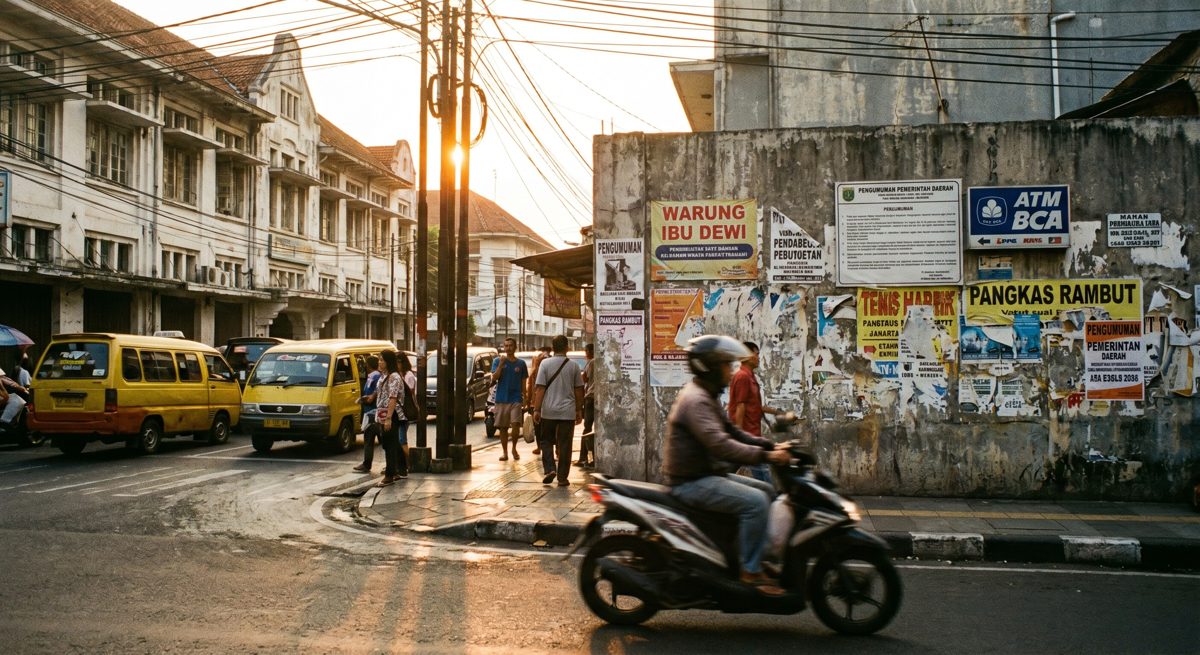
I don't mean this as a quirky observation. I mean it's a structural feature of how the country writes. Every government body, every shop, every casual chat compresses words. Step out of the airport in Jakarta and you'll pass twenty signs before you read your first complete word. KTP. BPJS. NPWP. SIM. ATM. These aren't English borrowings. They're Indonesian, and you're supposed to know what they mean.
There are roughly three flavours of abbreviation you'll meet, and each one works a bit differently.
The alphabet-soup ones (singkatan)
The first kind is the proper initialism. You take the first letter of each word and string them together. KTP is Kartu Tanda Penduduk: identity card. SIM is Surat Izin Mengemudi: driving licence. NPWP is Nomor Pokok Wajib Pajak: tax number. BPJS is Badan Penyelenggara Jaminan Sosial, which is the national insurance scheme.
If you're in Indonesia for any length of time you'll meet all four of these whether you want to or not. KTP gets asked for at hotels. BPJS shows up on hospital forms. SIM is what you flash at police checks. NPWP is what your employer wants, or your accountant if you have one.
The reason it's intimidating at first is that nobody ever says the full version. Indonesians say "ka-te-pe", "be-pe-je-es", "en-pe-we-pe". The acronym is the word now. The original phrase is almost archaeology. You can spend two years in Jakarta and still not know what BPJS actually stands for. You just know it's the thing you sign up for.
Place names get shortened too
This one tripped me up for a while. Jakarta is divided into five regions (north, south, east, west, central), and Indonesians do not say "Jakarta Selatan" when they can say "Jaksel". Jakut is Jakarta Utara, Jakbar is Jakarta Barat, Jaktim is Jakarta Timur, Jakpus is Jakarta Pusat.
Then there's Jabodetabek, which sounds like a swear word in some Slavic language but is in fact the entire metropolitan region: Ja(karta), Bo(gor), De(pok), Ta(ngerang), Bek(asi). When the news says "rain across Jabodetabek tomorrow", that's what they mean.
Other cities do the same. Yogyakarta is almost always Yogya or Jogja. Surabaya becomes Sby in headlines. If you live somewhere long enough, the city gets a nickname and you're supposed to use it. Calling Yogyakarta by its full name in a conversation marks you as a tourist who learned the formal name and never adjusted.
Chat speak: where things get fun
This is where Indonesian starts to look like a private code. Open any WhatsApp thread between friends under 35 and you'll see a wall of letters. OTW. BTW. WA (WhatsApp itself, used as a verb, like "WA aku nanti" meaning WhatsApp me later). PR (homework, from Pekerjaan Rumah, but used loosely as "stuff I have to do"). PHP, which is great, and I'll come back to.
PHP in Indonesian texting doesn't mean the programming language. It means Pemberi Harapan Palsu: giver of false hope. It's what you call someone who's been stringing you along romantically. "Dia PHP banget" means he or she is such a PHP. The acronym fits so neatly into the rhythm of casual Indonesian that I've heard people use it without thinking about what it stands for.
Then there's PDKT (pe-de-ka-te), short for Pendekatan: the period of approaching someone romantically before you're officially together. There is no English word for this. You have to import the concept, and Indonesians have abbreviated it because of course they have.
The portmanteau slang (akronim)
The third category is where Indonesian gets genuinely creative. You take the first syllable of two words and squash them together into a brand new word. The result looks like a normal Indonesian word but isn't in any standard dictionary.
Mager (Malas Gerak): too lazy to move. "Gue mager banget" means I really can't be bothered to get up.
Baper (Bawa Perasaan): bringing feelings into something, taking things personally. If someone teases you and you get visibly upset, you're baper.
Curhat (Curahan Hati): pouring out your heart, venting. The verb form is also curhat. "Mau curhat nggak?" means want to vent?
Bucin (Budak Cinta): love slave, used to describe someone obsessed with their partner. Mildly mocking.
Mantul (Mantap Betul): really cool, really solid. Mostly Gen Z, slightly cringe to use if you're over 30.
These aren't initialisms. They look like real words. They behave like real words. They take prefixes and suffixes like real words (kebaperan is the noun form of baper). The only difference is that they were invented by teenagers in the last twenty years and the older generation often doesn't know what they mean.
Why this happens
I don't have a definitive answer, but I have theories. Indonesian as a national language is young, codified in 1928 and pushed nationally only after independence in 1945. It absorbed words from Dutch, English, Arabic, Sanskrit, and regional languages. There was no centuries-old literary tradition to preserve, so the written form stayed flexible. Speaking of Dutch, our piece on the Dutch words hiding in your Indonesian shows how much of the everyday vocabulary actually came in by ship.
The other factor is that Indonesian government and culture both run on jargon-heavy bureaucracy and tight-knit social groups. Long official names get compressed because nobody wants to say "Badan Penyelenggara Jaminan Sosial" out loud six times a day. Chat slang gets compressed because Indonesians joke around constantly, and inventing a shared shorthand is how the joke spreads.
It's not random. The instinct is to take whatever takes three seconds to say, compress it to one second, and make it sound playful if you can manage that on the way.
How to actually keep up
You can't memorise them in advance. There are too many, and new ones appear every few months. What you can do is stop being thrown when you see one.
When you see four uppercase letters together, assume it's a government body or a service of some kind, and either ask or look it up. When you see a weird two-syllable word that doesn't appear in your dictionary, assume it's a portmanteau and ask what the two original words are. Indonesians find it charming when foreigners ask about slang, so this is a low-cost way to make friends.
Honestly the fastest way is exposure. The more Indonesian chat and signage you read, the faster the pattern stops feeling like a code. Practise reading real Indonesian with our app and you'll start picking up the common ones without having to study them as a separate vocabulary list.
The ones you'll meet first
If you want a starter kit, these are the ones I'd prioritise. The government acronyms (KTP, BPJS, SIM, NPWP) you'll meet the second you do anything official, so those come first. Jakarta region names like Jaksel, Yogya, and Jabodetabek show up constantly in news and conversation. The chat ones (OTW, PDKT, PHP) you'll see in messages from anyone under 40. The portmanteau slang (mager, baper, curhat) lives in casual speech.
Beyond that, just stay alert. New ones get coined every year. The one that's everywhere now might be cringe by next year, and there'll be a new word you've never heard. That's just how Indonesian chat works.
One practical thing
If you're filling out a form and an acronym confuses you, ask. Don't guess. I once wrote my passport number in the NPWP field because I assumed they meant something like "national ID". It took six months to undo. Indonesians filling out the same form daily will explain it without judgment if you ask politely.
If you're texting a friend and they use a slang acronym you don't recognise, just ask "apa itu?" or "artinya apa?" (what does it mean?). Nobody minds. The whole point of slang is to play with language, and explaining it is half the fun.
If you want a more structured way to build the vocabulary, our interactive lessons walk through the high-frequency abbreviations as they come up in context. Our plans are reasonable if you want to skip the trial and dive in.
The other thing worth reading if you want to sound less foreign in chat: our piece on the particles that nobody teaches you covers the small words that, together with the acronyms, are what make written Indonesian look like a different language to the one in your textbook. And our guide to street Indonesian (gaul) goes deeper into the slang side.
Don't try to learn them all. Just stop treating them as obstacles. They're part of how the language breathes.