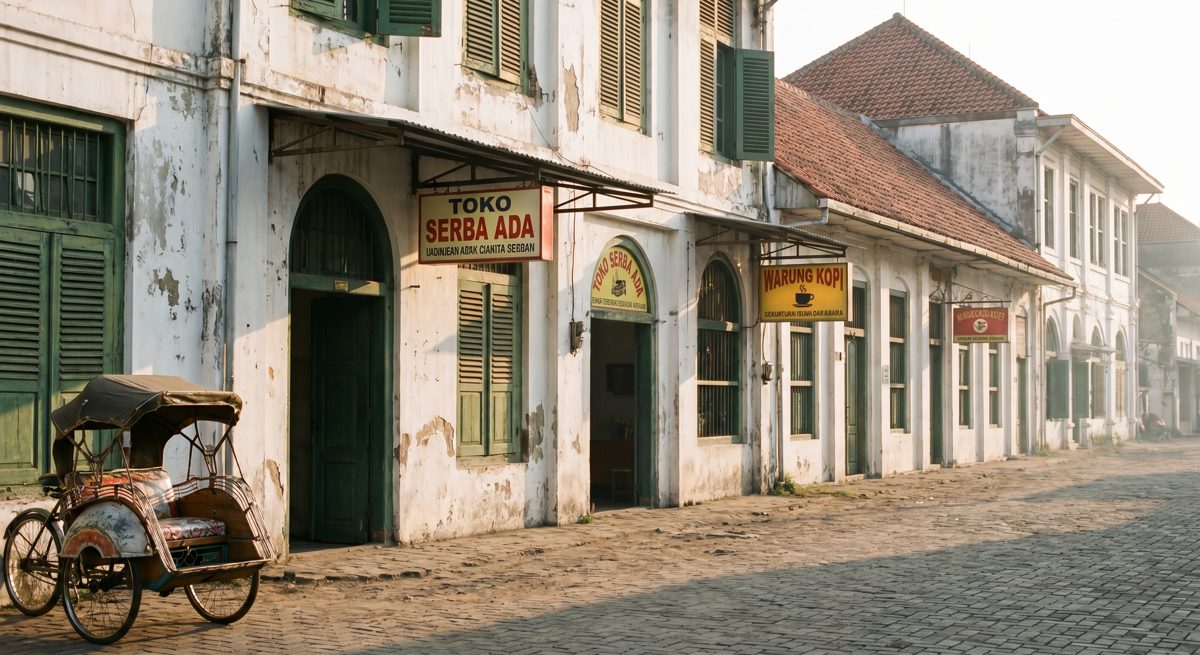
I was buying a fridge in Sanur. The shop owner asked what size kulkas I wanted. I said the word back to him, kulkas, and it felt vaguely familiar in a way I couldn't place. Half an hour later it hit me. Koelkast. My Dutch grandmother used to use that word. Koel means cool, kast means cupboard. Cool-cupboard. Fridge. The Indonesian word is just the Dutch one, slightly bent for an Indonesian mouth.
Once you notice one, you can't stop noticing them.
Handuk, towel. That's handdoek in Dutch, hand-cloth. Bioskop, cinema. Bioscoop. Bengkel, workshop. Winkel, which used to mean shop in Dutch before Indonesian narrowed it down to the place you take your motorbike. Kantor, office. Kantoor. Gratis, free. Identical.
There are hundreds of them. Possibly closer to a thousand if you count rarely-used technical terms. Three and a half centuries of Dutch presence in the archipelago left a vocabulary residue that no textbook ever sat me down and explained, and once I started spotting them I realised a decent chunk of my everyday Indonesian was hiding in plain sight, dressed in Indonesian spelling but Dutch underneath.
The kitchen, the bathroom, the desk
The most domestic vocabulary is where the Dutch words concentrate. The things you'd buy for a colonial household in 1920 still carry their Dutch names in modern Indonesian.
Kulkas (fridge) is koelkast. Handuk (towel) is handdoek. Ember (bucket) is emmer. Asbak (ashtray) is asbak, no change at all. Kran (tap) is kraan. Saus (sauce) is saus. Wortel (carrot) is wortel, also unchanged. Buncis (green beans) is boontjes, the Dutch diminutive for little beans.
My favourite is pulpen, the standard Indonesian word for pen. It comes from vulpen, which is Dutch for fountain pen. Indonesians borrowed the word for the fancy 1930s writing instrument and then quietly applied it to all pens forever after. Every cheap plastic biro in Indonesia is technically called a fountain pen, etymologically speaking. Nobody minds.
The Dutch loanwords cluster in domains the Dutch ran: offices, schools, shops, hospitals. Apotek (pharmacy) is apotheek. Polisi (police) is politie. Kantin (canteen) is kantine. Kabel (cable) is kabel. Helm (helmet), worn by every motorbike rider in the country, is just helm. None of these words feel foreign in Indonesian. They've been there longer than anyone alive.
Cars and motorbikes are basically Dutch
Anything to do with vehicles in Indonesian is a Dutch museum. The Dutch ran the roads, brought the cars, opened the workshops, and the vocabulary stuck.
Bensin (petrol) is benzine. Rem (brake) is rem. Ban (tyre) is band. Knalpot (exhaust) is knalpot. Persneling (gear) is versnelling. Pelek (wheel rim) is velg. Sopir (driver) comes from chauffeur via Dutch. Even setir (steering wheel) traces back to stuur.
The first time I walked into a Balinese motorbike workshop and had a conversation that consisted almost entirely of rem, ban, oli, knalpot, and the mechanic nodding, I realised I was basically having a Dutch conversation with one Indonesian word for yes glued on the end. The 18-year-old mechanic had no idea. To him these were just Indonesian words. They are Indonesian words now. But the ghost is right there in the spelling.
The family words that don't sound Indonesian at all
This one took me longer to notice because the words felt so completely Indonesian. Om, uncle. Tante, aunt. Opa, grandfather. Oma, grandmother. These are Dutch words, fully and unambiguously, used by Indonesian children every day without anyone thinking twice.
What's odd is that Indonesian already has perfectly good family terms. Paman for uncle. Bibi for aunt. Kakek and nenek for grandparents. The Dutch words sit alongside the native ones and carry slightly different vibes. Om and tante often get used for non-relatives, the family friends who come over for dinner, the older neighbour you wave at. The Indonesian words feel more formal, more about blood relations. The Dutch words feel warmer and more casual, which is the opposite of what you'd expect from a colonial leftover.
Why so many words stuck
This is the part that surprised me. Dutch colonialism in Indonesia was famously brutal and economically extractive, but it was also linguistically very restrained. The Dutch deliberately did not teach Dutch to most Indonesians. They wanted a small elite of bilingual administrators, not a Dutch-speaking population. Compare that to what the British did in India, or the Spanish in the Philippines, where the colonial language saturated everything.
So Indonesian didn't absorb Dutch the way Filipino absorbed Spanish or Hindi absorbed English. It absorbed Dutch in narrow technical channels: the office, the workshop, the kitchen of the colonial household, the doctor's surgery. Anywhere a Dutch person was giving instructions or a name to something new, the word survived. Anywhere they weren't, Indonesian kept its Malay or Javanese roots.
That's why the loanwords feel so domain-specific. You'll find Dutch all over the vocabulary for cars, electricity, plumbing, paperwork, and Western food. You'll find almost no Dutch in vocabulary for nature, emotion, family relationships (mostly), religion, or rural life. The colonial bubble had vocabulary inside it that leaked outwards. The rest of life carried on in Malay.
The ones that look Dutch but aren't
Not every European-sounding word in Indonesian is Dutch. This trips people up.
Meja (table) sounds like it should be Dutch. It isn't. It's from Portuguese mesa, a leftover from the brief Portuguese trading presence in eastern Indonesia in the 1500s, before the Dutch even arrived. Jendela (window) is also Portuguese, from janela. Sepatu (shoe) is Portuguese, from sapato. Gereja (church) is Portuguese, from igreja. The Portuguese were in Indonesia for less than a century, but they got there first, so the words for some basic introduced objects are theirs, not Dutch.
Other words look European but come from Sanskrit, which left a much older layer in Indonesian. Kentang (potato) sounds vaguely Dutch but isn't. Bahasa (language) itself is Sanskrit. Cinta (love), guru (teacher), raja (king) all came from Indian traders and Hindu-Buddhist influence centuries before the Dutch showed up.
So when you spot a word that looks foreign, don't assume Dutch automatically. The default explanation is right about half the time. The other half it's Portuguese, Sanskrit, Arabic, or occasionally English from the more recent past.
What this actually means for learning
If you grew up in Europe, especially the Netherlands, Belgium, Germany, or anywhere with Germanic-language influence, you already know more Indonesian than you think. The everyday domestic vocabulary will feel weirdly familiar. You'll be able to guess words from context just because the Dutch root is recognisable.
The trick is to let yourself notice it. Don't dismiss the resemblance as coincidence. If a word looks Dutch or German, it probably is. Lampu (lamp), kabel (cable), plastik (plastic), radio, televisi, komputer: most modern technology vocabulary is borrowed, and a lot of it came via Dutch in the early twentieth century before English took over as the global default.
This is one of the quiet reasons Indonesian is friendlier to European learners than it has any right to be. The grammar is alien, but a surprising chunk of the vocabulary is half-familiar if you squint. I've argued before that Indonesian is the easiest Asian language for English speakers to learn, and the Dutch substrate is a real if usually unspoken part of why.
A small caveat
None of this matters in the slightest to an Indonesian speaker. To them kulkas is just kulkas. There's no Dutch echo, no colonial subtext, no etymological flavour. The words have been fully naturalised for a century or more. Pointing out the Dutch origin in conversation can come across as weird or vaguely tone-deaf, depending on the audience. It's interesting to learners. It's not interesting to most Indonesians, and you should read the room before bringing it up.
The history that gave Indonesian its Dutch words was not, on balance, a happy one. The loanwords are a side effect of a long extraction. I find them fascinating as a learner, but I try to be careful about how I talk about them.
What to do with this
Start collecting them. Every time you spot a Dutch loanword in Indonesian, file it mentally. After a few weeks you'll have built up a list of fifty or sixty words you basically learned for free. The pattern recognition gets faster. By the time you're seeing spanduk (banner, from spandoek) or selop (slipper, from slof), you'll be guessing them right before you check.
It pairs nicely with understanding how Indonesian builds words from roots using affixes. The loanwords sit on top of that system. Kantor (office) plus the suffix -an doesn't quite work, but per-kantor-an (office complex) does. Once a Dutch root gets absorbed, it plays by Indonesian grammatical rules.
If you want to practise spotting these in real Indonesian content, our reading exercises pull from menus, signs, and articles where the Dutch loans appear naturally in context. You can also practise Indonesian conversationally and watch how often the vocabulary skews Dutch in everyday domains like cars, food, and offices. If you're weighing it up, our plans are cheap enough that it's not really the bottleneck.
Three hundred and fifty years of Dutch ships left behind a fridge, a towel, a bucket, and a few hundred other words. Useful ones, mostly. Worth knowing they're there.