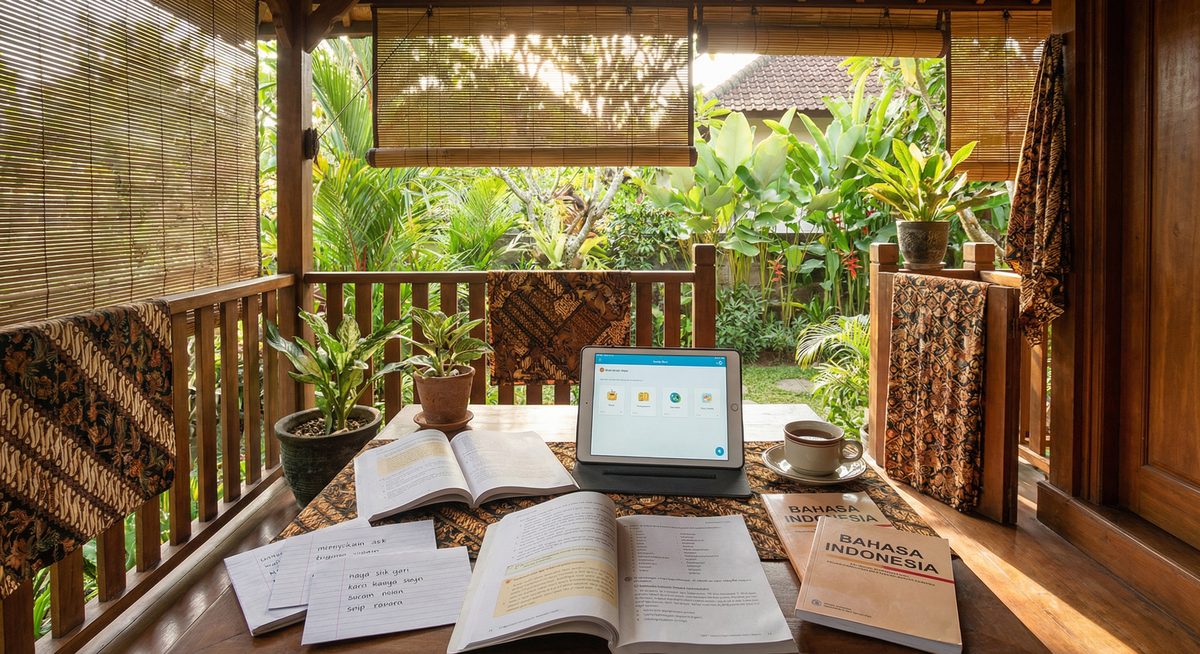
I started learning Indonesian on a Tuesday afternoon because I was bored and someone on Reddit said it was easy. Not exactly a compelling origin story. But two months later I could hold actual conversations, and six months in I was texting friends in Jakarta without needing Google Translate open in another tab.
Try doing that with Japanese. Or Mandarin. Or Korean.
The thing nobody tells you about Asian languages is that most of them are genuinely difficult for English speakers. Not in a "practice makes perfect" way. In a "this will take years of your life" way. Tonal pronunciation. Writing systems that require memorising thousands of characters. Grammar structures so different from English that your brain has to rebuild itself from scratch.
Indonesian has none of that.
I'm not saying it's trivial. But compared to the rest of Asia, it's like someone left the difficulty slider on Easy whilst designing the language. And I mean that as a compliment.
The alphabet is just the Latin alphabet. No new script to learn. No characters, no tones, no weird sounds your mouth wasn't designed to make. You see a word, you say it. "Makan" is pronounced exactly how it looks: mah-kahn. "Terima kasih" (thank you) is teh-ree-mah kah-see. If you can read English, you can read Indonesian immediately. There's no learning curve on day one.
That alone puts it miles ahead of Thai, where you spend months decoding squiggles before you can even attempt pronunciation.
Then there's the grammar, which is so stripped-back it almost feels incomplete at first. Verbs don't conjugate. At all. "Saya makan" means I eat. "Dia makan" means he eats. "Mereka makan" means they eat. Same word. No changes. You want past tense? Stick "sudah" in front. Future? Use "akan." Or don't bother, because context usually makes it obvious anyway.
After three years of Spanish class where I conjugated "hablar" into seventeen different forms depending on who was speaking and when, this felt like cheating.
There's no gendered nouns either. No masculine chairs and feminine tables. No articles that change depending on whether the thing you're talking about is considered male, female, or conceptually neuter for reasons lost to history. Everything is just "the." Simple.
Plurals? You just say the word twice. "Anak" is child. "Anak-anak" is children. "Buku" is book. "Buku-buku" is books. Elegant. Logical. Makes sense the first time you see it.
I remember sitting in a coffee shop in Surabaya about four months in, ordering "dua kopi hitam" (two black coffees), and the barista just nodded and made them. No confused look. No switch to English. It worked. That's the kind of small win that keeps you going when you're learning a language, and Indonesian gives you those wins early.
The word-building system is brilliant once it clicks. Indonesian builds vocabulary from root words by adding prefixes and suffixes. Take "tulis," which means write. Add "me-" to get "menulis" (to write, as an action). Add "di-" for "ditulis" (being written, passive). Add "-an" for "tulisan" (something written, like a document). "Penulis" is a writer. "Penulisan" is the act of writing.
Once you learn the pattern, you can reverse-engineer words you've never seen. I saw "pembaca" on a sign, broke it down (pe- + baca + -an pattern minus the -an), knew "baca" was read, and guessed it meant reader. It did. That pattern repeats across thousands of words. You're not memorising isolated vocabulary. You're learning a system.
I tested this with a mate who'd been studying Mandarin for two years. Asked him how long it took before he could guess new words. He laughed. Said it doesn't really work like that. You just memorise characters until your brain hurts.
The pronunciation is ridiculously forgiving too. I make mistakes constantly, and people still understand me. There's no tonal nightmare where "ma" with a rising tone means mother and "ma" with a falling tone means horse, and if you get it wrong you've just told someone their horse is visiting next week. Indonesian doesn't punish you for bad pronunciation. It lets you get away with it.
I can't roll my Rs properly. My accent is unmistakably British. Sometimes I forget words mid-sentence and have to mime like an idiot. None of this has ever stopped me having a conversation.
Compare that to Mandarin, where I've watched people spend years perfecting tones and still get corrected constantly. Or Thai, where I sat in a language class in Bangkok and watched a Canadian woman nearly cry because she couldn't hear the difference between rising and falling tones on the same syllable.
Indonesian doesn't do that to you.
Now, it's not all easy. There are tricky bits. The affixation system I mentioned earlier gets complex once you dig deeper into formal Indonesian. There are four types of passive voice, which is more than English has, and knowing when to use which one requires actual thought. Informal spoken Indonesian (especially Jakartan slang) drops half the prefixes and suffixes, so you're effectively learning two versions of the language at once.
But those are advanced problems. Beginner Indonesian is genuinely straightforward in a way that beginner Japanese just isn't.
Here's the other thing: people actually want to talk to you. Indonesia doesn't get many tourists who bother learning the language. Most foreigners stick to Bali, speak English, and leave. If you show up speaking even basic Indonesian, people light up. They're surprised. They're helpful. They want to talk more because it's rare.
I've had restaurant owners give me free desserts. I've had strangers on buses explain local history in slow, careful Indonesian because they were excited I was trying. That positive feedback makes learning easier. It's hard to stay motivated when nobody cares that you're learning their language. Indonesians care.
The practical side matters too. Indonesia is huge. 270 million people. The largest economy in Southeast Asia. Fastest-growing tech scene in the region. Seventeen thousand islands, most of which see almost no English-speaking tourists. If you can speak Indonesian, you unlock the entire country, not just the bits designed for foreigners.
And unlike some languages, you'll actually use it. Bahasa Indonesia is the national language, and everyone speaks it. You're not learning a regional dialect that only works in one province. You learn Indonesian, and it works from Sumatra to Papua.
If you've ever thought about learning an Asian language but got intimidated by the difficulty, Indonesian is the answer. It's easier than Mandarin, Thai, Vietnamese, Japanese, or Korean. It's probably easier than Tagalog. It's definitely easier than any language that requires you to learn a new alphabet.
I'm not saying it's effortless. But it rewards early effort faster than any other Asian language I've seen. Two months in, you can have real conversations. Six months in, you're comfortable. A year in, you're conversational.
I know people who've studied Mandarin for five years and still struggle with basic directions.
If you're curious, just start. Learn fifty words. Try using them. The language will meet you halfway. That's the difference between Indonesian and the rest of Asia's languages. It actually wants you to succeed.