The first time I really noticed it, I was reading a sign at a Bali warung that said harganya berapa?. I knew harga meant price. I knew berapa meant how much. But harganya looked like a typo. Where did the extra bit come from? And why did it appear on every other word once I started watching for it?
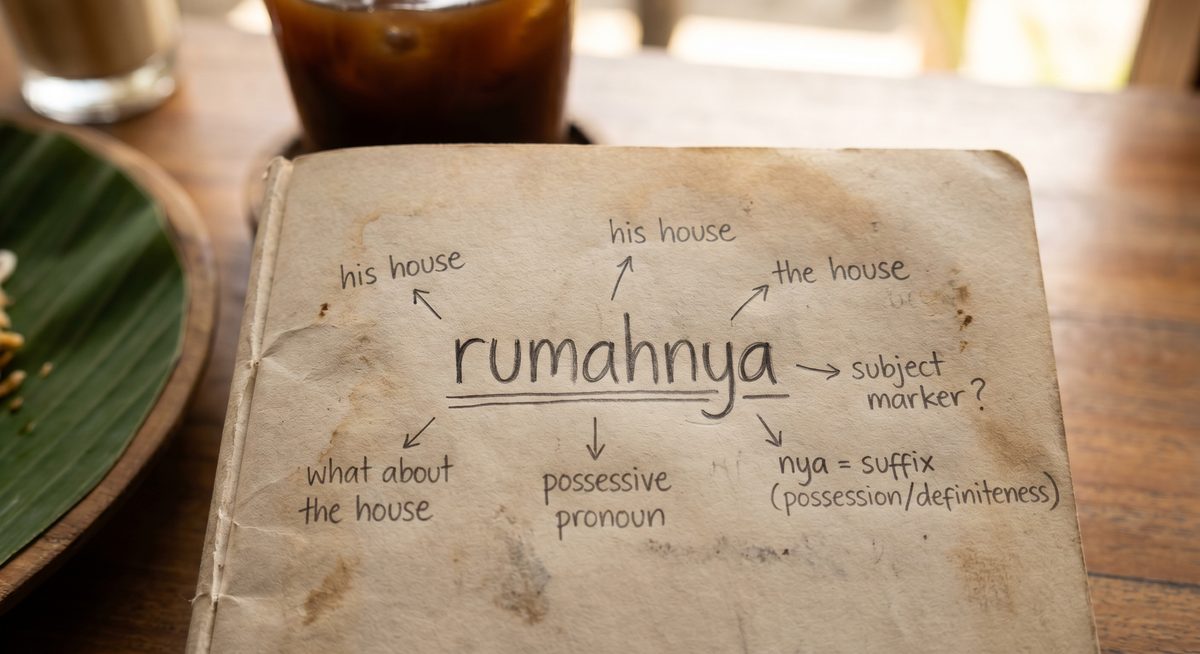
That bit is -nya. It hooks onto the end of nouns, adjectives, and sometimes verbs, and it does at least four different jobs depending on context. None of them line up cleanly with English, which is why textbooks tend to mention it once, label it "third person possessive", and then quietly stop helping. In real Indonesian, -nya is doing more work than that label suggests.
The textbook job: his, her, its
Start with the version every learner gets first. -nya attached to a noun can mean "his", "her", or "its", depending on context. Mobilnya is "his car" or "her car" or "its car". You figure out which from the conversation around it.
Rumahnya besar. Their house is big.
Namanya Andi. His name is Andi.
Bukunya hilang. Her book is missing.
Indonesian doesn't have separate words for "he", "she", and "it" the way English does, which I went into in the pronouns piece. The same suffix covers all three. Context tells you who the owner is.
If you came up through a textbook, this is usually where your understanding stops. Then real conversation hits and you realise -nya is on words that have nothing to do with possession.
The version they don't really teach: "the"
Indonesian has no word for "the". So when speakers want to mark a noun as specific, the one we just talked about, the one in the room, the obvious one, they often clip -nya on the end.
Mana kuncinya? Where are the keys? (the keys we both know about)
Tutup pintunya. Close the door. (this door, the one in front of you)
Pesan kopinya sudah datang. The coffee order has arrived.
This one threw me off for ages. I'd hear tutup pintunya and translate it as "close his door" in my head, then get confused because nobody in the conversation owned a door. The trick is that -nya here isn't pointing to a person. It's pointing at the door we both know exists. Closer in spirit to "the" than to "his".
If you remember the post on yang, the contrast helps. Yang picks out one specific item from a group, usually with a description attached. -nya assumes the listener already knows which one we mean. Both narrow a noun down. They just narrow differently.
The "as for X, the X-ness of it" version
This is the one that makes -nya feel slippery. Indonesians use it on adjectives and abstract concepts to turn them into nouns, roughly mapping to "the X-ness" or "as for X, it's...".
Enak. Tasty.
Enaknya ditambah sambal. The tasty part is when you add sambal.
Bagus. Good.
Bagusnya dia jujur. The good thing is, he's honest.
You'll hear this constantly when people are giving opinions or reflecting on something. Susahnya bahasa Inggris itu pengucapan. The hard part of English is the pronunciation. Asyiknya tinggal di Bali tuh dekat pantai. The fun thing about living in Bali is being close to the beach.
It looks complicated but it's basically a nominaliser. Stick -nya on a quality and you've turned it into "the X-ness". Small little machine, used a lot.
Sentence vibe: -nya as soft reference
Spoken Indonesian uses -nya in a way that's hard to capture in translation but easy enough to feel. It softens references and sometimes works like English's "the thing is..." or "...you know, that thing".
Gimana cuacanya? How's the weather? (the weather, the weather situation)
Bagaimana hasilnya? How did it turn out? (the result of the thing we were just discussing)
Apa kabarnya? What's the news? Literally "what's its news?", but really just "how are things?".
You'll see this in news headlines too. Begini ceritanya. Here's the story. The -nya isn't owning anything. It's pointing back at the situation we're already inside.
This use is one of the reasons spoken Indonesian feels relaxed once you tune in. It doesn't keep restating the topic. It just hangs -nya off the next relevant noun and trusts you to follow.
Fixed expressions where -nya is just there
Some words have basically welded -nya onto themselves. You'll never see them without it.
Akhirnya. Finally, in the end. From akhir, "end".
Sebenarnya. Actually. From benar, "true".
Biasanya. Usually. From biasa, "ordinary".
Rupanya. Apparently. From rupa, "appearance".
Pokoknya. Basically, the main thing is. From pokok, "core".
Treat these as vocabulary, not grammar. Trying to derive each one from its root will slow you down. Just learn them as one-piece adverbs. They show up in nearly every conversation.
If you're already comfortable with how Indonesian builds words from roots and affixes, this will feel familiar. -nya in this role behaves like a productive suffix that has frozen into specific lexical items.
When it sounds wrong
The fastest way to overuse -nya is to start treating it as English's "the". You'll hear yourself stick it on every definite noun and start sounding off.
Saya minum kopinya tadi pagi. I drank the coffee this morning. Sounds like you're talking about some specific contextual coffee, which might be true or might be confusing.
Saya minum kopi tadi pagi. I had coffee this morning. Just normal.
If the noun is generic (coffee in general, books in general), no -nya. If it's the specific one already on the table between you and your friend, -nya fits naturally. The default for learners should be to leave it off and only add it when it points at something concrete in the conversation.
Same logic with adjectives. Bagusnya fits when you're singling out the good aspect of something. Sticking it onto every adjective will get you weird looks.
How I'd actually learn it
Don't memorise the four uses as a list. They blur together in real speech anyway. What worked for me was reading short Indonesian texts and asking, every time I saw -nya, what is it doing here? Possession? Definiteness? Nominalisation? Vague topic reference?
After a few hundred examples, your brain stops needing to label and just gets the feel. The same way English speakers don't consciously decide between "the" and "a", you don't really decide between the senses of -nya. You absorb it.
This is one of the better arguments for practising Indonesian on real sentences rather than vocabulary cards. -nya only makes sense in context. A flashcard saying "his/hers/its/the" will not save you the first time you read begini ceritanya.
A small phrase bank to keep
If you treat these as fixed building blocks, -nya stops being a grammar puzzle and becomes a tool you reach for:
Apa kabarnya? How are things?
Berapa harganya? How much does it cost?
Mana orangnya? Where's the person?
Sebenarnya... Actually...
Akhirnya... At last...
Pokoknya... The main thing is...
Enaknya gimana? What's the best way (to do this)?
Biasanya saya... Usually I...
If you want to practise this with real Indonesian content, the lessons drill -nya through hundreds of context sentences instead of relying on rule memorisation. Full pricing is on our plans page. And if you want a related pattern that does similar gluing work in casual speech, the post on lah, dong, sih, kok covers the spoken-flavour particles that pair nicely with -nya.
The honest takeaway: -nya won't fall into place from a single explanation. You'll keep meeting it, and each time it'll fit into a slightly different slot. After a few months it stops registering as anything strange. Until then, when in doubt, leave it off. Indonesian is forgiving. It's much easier to add -nya later than to scrub it out of habits you've built around overusing it.