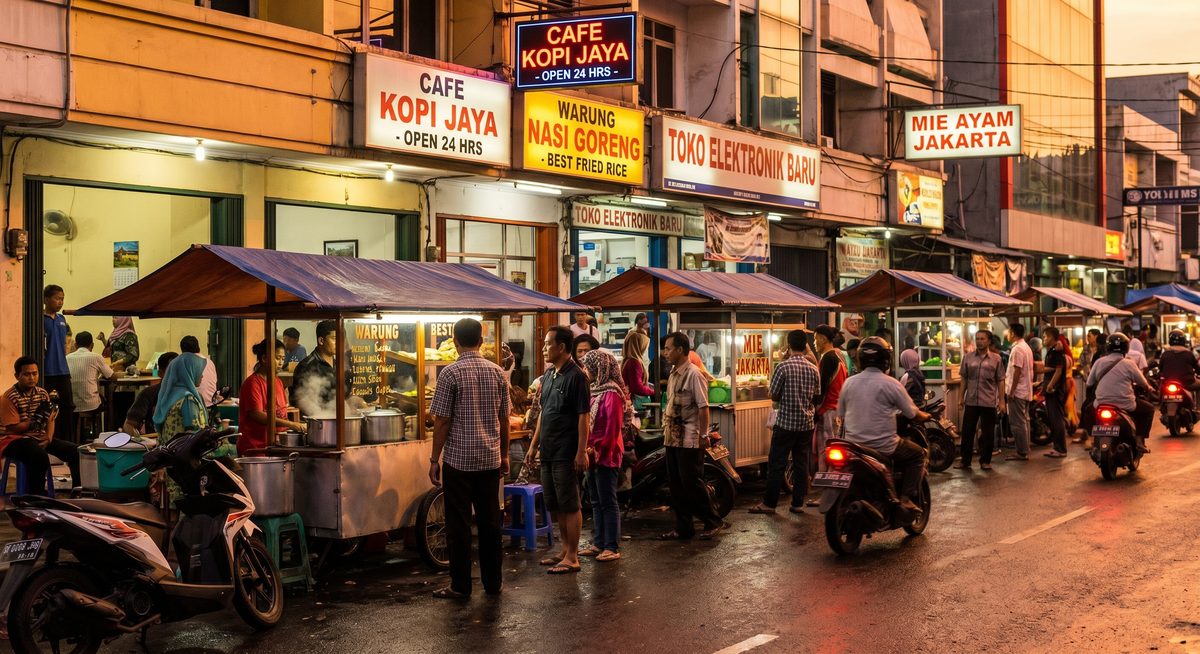
There is a particular moment when learning Indonesian that catches a lot of people off guard. You are reading something, you hit a word you have never studied, and then you sound it out and realise: that is just "presentation". Or "organisation". Or "positive". It was right there the whole time, wearing a slightly different hat.
Indonesian has borrowed a huge number of words from English, particularly since the 1970s when global commerce, technology, and pop culture started pouring in. But because the spelling follows Indonesian pronunciation rules rather than English ones, learners often walk straight past these words without recognising them. Once you understand the system, you get hundreds of words for free.
Why the spelling looks different
Indonesian writes words the way they sound in Indonesian, not the way they look in English. This is actually a feature, not a bug. The orthography is remarkably consistent: once you know the sound system, you can read anything out loud without much guessing. The tradeoff is that borrowed words get respelled to match, which makes them look foreign even when they are not.
The most common changes: a c becomes k when it was making a hard sound in English (so "computer" becomes komputer, "credit" becomes kredit, "crisis" becomes krisis). The combination ph becomes f, so "telephone" is telepon, "pharmacy" is farmasi, "sphere" would be sfer. Double consonants get collapsed: "effect" becomes efek, "official" does not transfer cleanly but "efficient" becomes efisien.
The vowel shifts are where things get interesting. English words ending in a consonant cluster often drop one: "text" would be teks, "test" is tes, "risk" is risiko (with a vowel added to make it pronounceable). Indonesian does not love consonant clusters at the end of syllables, so the language tends to break them up or simplify them.
The suffix swap system
This is the part that actually makes a difference when you are reading. There are several English suffixes that get swapped for Indonesian equivalents in a completely predictable way, and learning these four unlocks a large chunk of the formal and professional vocabulary.
English words ending in -ive become -if in Indonesian. So "active" is aktif, "creative" is kreatif, "negative" is negatif, "positive" is positif, "productive" is produktif, "innovative" is inovatif. This is not a coincidence or a one-off. It is a systematic pattern. If you see any Indonesian word ending in -if, there is a good chance it is a borrowed adjective from an English -ive word.
Words ending in -tion or -sion usually become -si: "presentation" is presentasi, "organisation" is organisasi, "administration" is administrasi, "situation" is situasi, "commission" is komisi, "profession" is profesi. Again, completely regular. You will not always know the root word if the Latinate English version is unfamiliar, but for anything you already know in English, you can usually reconstruct the Indonesian.
English words ending in -ity often become -itas: "university" is universitas, "quality" is kualitas, "activity" is aktivitas, "community" is komunitas, "quantity" is kuantitas, "authority" is otoritas.
And words ending in -ment often become -men or keep a similar shape: "department" is departemen, "management" is manajemen, "government" is pemerintah (that one is native Indonesian, not borrowed). The -ment pattern is less consistent than the others, so do not over-rely on it.
The categories where English borrowing is heaviest
Technology is where you will find the densest concentration of English loanwords, partly because Indonesian had no native words for things that did not exist until recently. Internet is just internet. Email is email. Komputer, monitor, printer, server, software, aplikasi (application), sistem (system). In a tech office in Jakarta, a large proportion of the vocabulary in any given sentence might be English words, even if the grammar is entirely Indonesian.
Business and professional life is similar. Tim is "team", manajer is "manager", presentasi is "presentation", proyek is "project", klien is "client", kontrak is "contract". Meetings are often just called meeting, pronounced roughly as the Indonesian syllable structure allows. If you have read about how Jakarta Indonesians speak in casual settings, you will have noticed that English drops into conversation constantly, especially for anything work-related.
Sport follows a similar pattern. Basket for basketball, tenis for tennis, joging for jogging, futsal for five-a-side football. Football itself is interesting: the Indonesian word is sepak bola (native), but "futsal" is used for the indoor version. Gym is just gym. Fitness is used as a noun and sometimes a verb.
Where it gets confusing
Some words look like English cognates but work differently than you expect. Kondisi (condition) gets used where an English speaker might say "state of affairs" or even "situation" rather than just "condition" in the narrow sense. Aktual does not mean "actual" in the English sense; it usually means "current" or "up to date". Potensial can mean roughly "potential" but is often used to mean "promising" or "capable of doing something" in a slightly broader way than English uses it.
There is also the word handphone, abbreviated as HP and pronounced ha-pe. This is the word Indonesians use for mobile phone, and it is not American English at all. You will hear it constantly and it can take a moment to register the first time. Similarly, motor almost always refers to a motorbike, not a car engine, which trips up learners who go looking for the automotive sense.
Dutch loans add another layer of complexity because some of them entered Indonesian at the same time as English words were arriving, and they overlap in odd ways. The Dutch loanwords in Indonesian are worth learning separately, since they tend to cluster in different domains (administration, infrastructure, certain household items) and the phonetic patterns differ from the English ones.
How to use this when learning
The practical tip is simply to try sounding things out before looking them up. If you hit an unfamiliar Indonesian word in a formal or professional context, say it slowly and see if it resolves into an English word once you apply the suffix and spelling rules. It will not always work, but it works often enough that it is worth the half-second it takes.
For the suffix patterns, I would suggest just learning a handful of examples from each category rather than memorising the rule abstractly. Once you have seen aktif, kreatif, negatif, and positif in the wild, the pattern sticks without much effort. The -si words are probably the most immediately useful since they cover a lot of the vocabulary that turns up in news articles, formal documents, and anything educational.
This is one of the genuinely pleasant surprises of learning Indonesian. For a language often described as easy, it does have genuine complexity in its affix system. But the English loanword layer means that total beginners can read a modern Indonesian news article and understand chunks of it from day one, which does a lot for motivation in the early stages.
If you want to practise spotting these patterns in context, the exercises on bahasa.fun use real Indonesian sentences where you can see the loanwords functioning naturally alongside native vocabulary. And if you are just getting started, our free account gives you access to the beginner levels where most of this vocabulary comes up first. There is also a breakdown of what is covered in each tier on the pricing page.