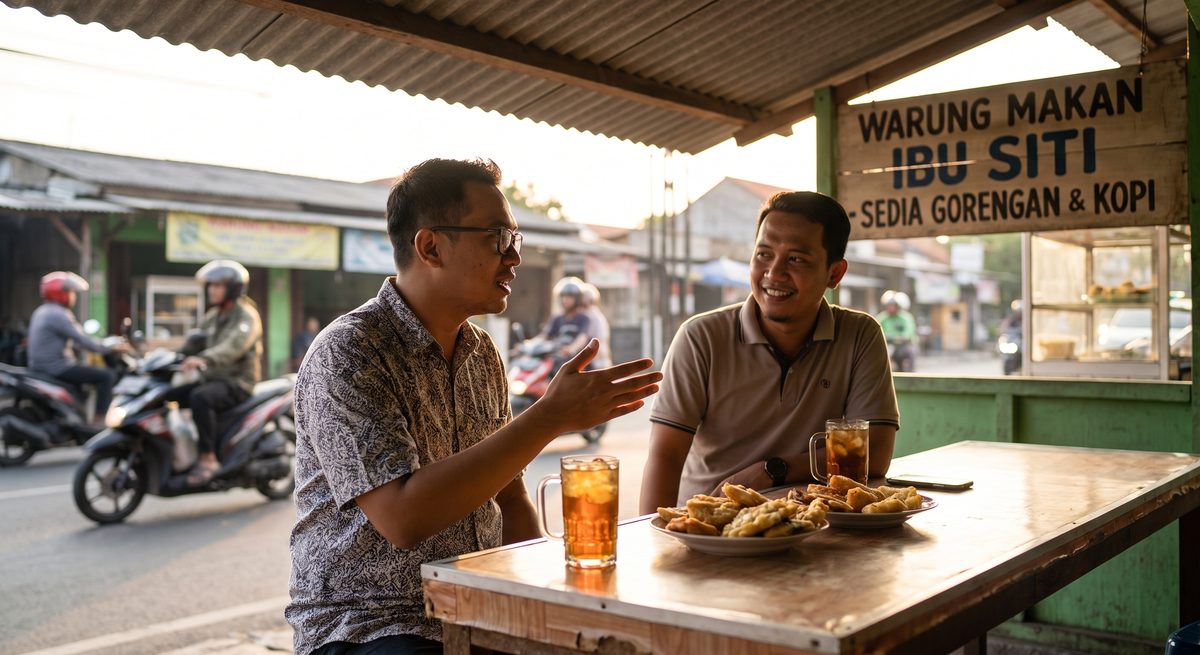
My Indonesian was technically fine for about a year and still sounded like a phrasebook read aloud. Correct words, correct order, nothing obviously wrong. The problem was the glue. I joined every sentence to the next one with dan or tetapi, because those are the words the textbook gives you for "and" and "but", and almost nobody speaks that way. Indonesians run their sentences together with a small set of connectors that most courses either skip or bury in a chapter on formal writing.
Fixing this did more for how natural I sounded than any amount of new vocabulary. You can get a long way with a few hundred words if you can string them together the way people actually do.
Soalnya is the because you will hear
Karena means because. It is correct, it appears in the news, and it is the word every course teaches first. In conversation you will hear soalnya far more often.
The difference is not just formality. Karena tends to sit inside a sentence, linking cause to effect in one breath: Saya tidak datang karena hujan. I didn't come because it was raining. Soalnya usually starts a fresh sentence and adds the reason afterwards, almost as an afterthought. Saya nggak datang. Soalnya hujan. I didn't come. It was raining, you see.
That trailing "you see" is close to the feel of it. Soalnya comes from soal, meaning matter or issue, so the literal shape is something like "the thing is". It softens the reason. It also buys you a second to think, which is why learners take to it so quickly once they notice it.
One warning. Because soalnya explains, it can sound like you are making an excuse. If a friend asks why you missed dinner, soalnya is perfect. If your boss asks why the report is late, the same word makes you sound like a teenager. Use karena there, and be brief about it.
Terus carries whole stories
Listen to two Indonesians telling a story and count how many times terus appears. It will be a lot. The dictionary says continue or straight ahead, and both are true, but as a connector it means "and then".
Tadi aku ke pasar, terus ketemu Rina, terus kita ngopi sampai sore. I went to the market, then I ran into Rina, then we drank coffee until evening. Three clauses, two terus, no dan anywhere. English does the same thing when we talk rather than write, we just do not notice ourselves doing it.
The shortened form trus is what you will hear in Jakarta, and in text messages people write it that way too. There is also habis itu, "after that", which does a similar job with slightly more weight, and abis itu when spoken quickly.
Terus has a second life as a complaint. Said on its own with a flat, slightly impatient tone, terus? means "and? so what?" I have heard this delivered to a market seller mid-negotiation and it is not friendly. Tone carries the whole difference.
Jadi is so, and also a stalling noise
Jadi means become as a verb, and so or therefore as a connector. Motor saya rusak, jadi saya naik ojek. My bike broke down, so I took an ojek.
Its more useful function is the one nobody teaches. Jadi at the start of a sentence works like English "so" when you are about to explain something or restate it more clearly. Jadi begini... is the standard opening for "right, here's the situation". If someone has misunderstood you, jadi maksud saya... is how you climb back out.
Indonesians also use it as pure filler while they gather their thoughts, exactly as English speakers use "so" at the start of an answer. That makes it an easy one for learners to overuse, and I did overuse it, but the failure mode is harmless. You sound like a person thinking rather than a person reciting.
Makanya, and the small satisfaction inside it
Makanya means "that's why", and it usually points backwards at something already said. Aku kurang tidur. Makanya aku ngantuk. I didn't sleep enough. That's why I'm sleepy.
The part that took me a while to hear is that makanya often carries an "I told you so". If you drop your phone in a puddle and a friend says makanya hati-hati, they are not offering fresh advice. They are pointing out that you were warned. It is teasing rather than cruel between friends, but it lands as a mild scolding from a stranger, and it is not something to aim at your landlord.
The formal equivalent, the one for emails and anything written, is oleh karena itu. Four syllables to do one word's work, which is roughly how formal Indonesian tends to go.
Padahal has no clean English match
This is my favourite one, and the hardest to translate. Padahal introduces a fact that clashes with what came before. Dictionaries offer "whereas" or "in fact", which are both stiff and neither quite right.
Dia bilang sudah berangkat, padahal masih di rumah. He said he'd already left, when actually he was still at home. Mahal banget, padahal porsinya kecil. Really expensive, and the portion was tiny.
English handles this with tone of voice and words like "and yet" or "when actually", or often with nothing at all. Indonesian gives it a dedicated word, and once you can use it you get access to a whole register of mild complaint and gossip that was previously closed to you. It is the sound of someone pointing out that reality did not match the advertising.
Padahal can also stand alone at the end of a thought, trailing off, leaving the contradiction hanging. Someone tells you the restaurant shut down and you say padahal enak banget. And it was so good. There is a small note of regret in it that "however" cannot reach.
Gara-gara blames somebody
Gara-gara also means because, but only for bad outcomes. Nothing good ever happens gara-gara anything. Gara-gara macet, aku telat dua jam. Thanks to the traffic, I was two hours late.
You would not say gara-gara hard work I got the job. The word carries fault. Which makes it precise and slightly dangerous. Saying gara-gara kamu, because of you, to someone's face is an accusation, even in a joking tone, so it pays to know that before you deploy it lightly.
Kalau does more than if
Kalau is if, and it works the way you expect: kalau hujan, saya di rumah. If it rains, I'll stay home. Indonesian has no conditional tense to worry about, so the sentence stays flat and simple no matter how hypothetical it gets.
The extra job is topic-setting, closer to "as for". Kalau saya, lebih suka kopi. As for me, I prefer coffee. Kalau di Bali, harganya beda. In Bali, the prices are different. Nothing conditional is happening. Kalau is just flagging what you are about to talk about, which fits how Indonesian likes to put the topic first and comment on it afterwards. If you have read about how Indonesian word order works, this is the same instinct showing up in conversation.
Then there is kalau nggak, "otherwise" or "or else", which is one of the most useful two-word combinations in the language. Berangkat sekarang, kalau nggak kena macet. Leave now, otherwise you'll hit traffic.
The register trap
Nearly every connector here is spoken Indonesian. Soalnya, makanya, gara-gara, terus, and kalau nggak belong in conversation, WhatsApp messages and anything relaxed. Written Indonesian, meaning a formal email, a school essay or a government notice, runs on karena, oleh karena itu, namun, sehingga, kemudian and selanjutnya.
The gap between the two is wider than in English, and it catches learners in both directions. I have written emails full of terus and soalnya that must have read like a text from a fifteen year old. I have also spoken namun out loud in a warung and got the look you would get for saying "nevertheless" over a bowl of soup. The same split runs through the whole language, and it is the same reason tidak and nggak are not interchangeable.
If you only remember one sorting rule: anything with -nya stuck on it, or anything doubled like gara-gara, is leaning casual.
How to actually pick these up
Do not try to learn all of them at once. Take two, soalnya and terus, and use them for a week until they stop feeling deliberate. They cover explaining and narrating, which is most of what casual conversation consists of, and they will change how you sound faster than anything else on this list.
Padahal is worth deliberate practice because there is no English word to hang it on, so it will not arrive by itself. Try to catch one moment a day where something did not match expectations and say it out loud, even to yourself.
The rest are best learned by ambush. Once you know makanya exists you will start hearing it several times a day, usually aimed at someone who has just done something daft, and the meaning will settle without any study. That is how most of these arrived for me. Same thing happens with the small particles like lah, dong and sih, which do a related job at the other end of the sentence.
None of this is grammar you can be wrong about in a way that stops you being understood. Every sentence here works fine with dan and karena. You will just sound like a textbook, which is a slower and more permanent problem than a mistake would be.
You can practise Indonesian with real conversational examples in our app, including the connectors that formal courses skip. It is free to sign up, and if you want the full set of lessons and exercises, have a look at our plans.