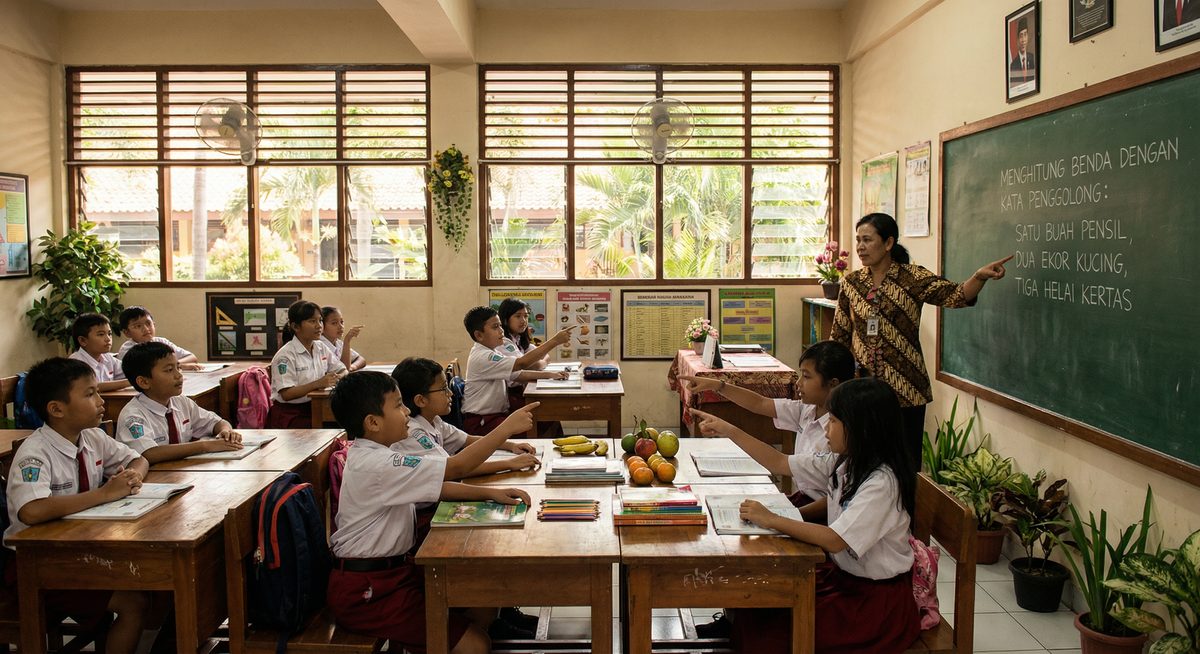
Let me save you some anxiety: Indonesian has classifier words for counting things, and you almost certainly don't need to worry about them yet.
If you've been studying Indonesian from a textbook, you've probably seen phrases like dua ekor kucing (two cats, with 'ekor' as the classifier for animals) and panicked a bit. Another grammar rule to memorise. Another thing to get wrong.
Here's what the textbooks won't tell you. In everyday spoken Indonesian, most people just say dua kucing. No classifier. No pause. No confusion. And nobody thinks twice about it.
So what are classifiers, exactly?
Classifier words (kata bantu bilangan) sit between a number and a noun when you're counting. Different categories of things get different classifiers. Animals get ekor (literally 'tail'). People get orang (literally 'person'). Flat things get lembar (literally 'sheet'). You get the idea.
The pattern is: number + classifier + noun
English has traces of this too. We say 'two sheets of paper' and 'three slices of bread'. Indonesian just has more of these, and grammar books present them as if they apply systematically to nearly everything you count.
And technically, they do. Technically.
The gap between grammar and reality
This is where most learning resources get it wrong. They teach classifiers as a core part of Indonesian that you need for basic communication. Some even suggest that dropping them makes you sound like a beginner.
That framing is backwards.
I've lived in Indonesia, spoken Indonesian daily for years, and I can tell you: classifiers are just not that common in spoken Bahasa. Not in Jakarta. Not in Bali. Not in casual conversation anywhere. People say dua kucing, not dua ekor kucing. They say tiga rumah, not tiga buah rumah. The number goes next to the noun and life carries on.
This isn't slang or lazy speech. It's simply how spoken Indonesian works for most people most of the time.
Where classifiers actually show up
That said, classifiers aren't pointless. They have a home. It's just not in your average conversation at a warung.
Formal writing. Government documents, legal texts, academic papers. If you're reading anything official in Indonesian, classifiers will be everywhere. A planning document won't say lima sekolah (five schools); it'll say lima buah sekolah. This is where knowing them genuinely matters.
News and journalism. Kompas, Tempo, any major publication. Written Indonesian follows the formal grammar, and classifiers are part of that. If you want to read Indonesian news fluently, you need to recognise these words when they appear.
Literature. Novels, short stories, poetry. Written Bahasa Indonesia holds onto grammatical features that spoken language has quietly dropped.
Formal speeches and presentations. A university lecture or business presentation will use classifiers. A chat with your Grab driver will not.
The pattern is clear: classifiers belong to the written and formal register of Indonesian. Once you see it that way, they stop being stressful and start being useful for what they are. A literacy skill, not a survival skill.
The classifiers worth knowing
Even if you won't use these much in speech, they're worth learning for reading and comprehension. Here are the ones that come up most often.
Orang (people)
Tiga orang teman = three friends
Lima orang guru = five teachers
This one actually does pop up in speech more than others, partly because orang also means 'person' on its own. You'll hear dua orang (two people) regularly.
Ekor (animals; literally 'tail')
Satu ekor anjing = one dog
Sepuluh ekor ayam = ten chickens
Works for all animals. Dogs, cats, birds, fish. The 'tail' origin makes enough sense for most of them.
Buah (large objects, buildings, vehicles; literally 'fruit')
Dua buah rumah = two houses
Satu buah mobil = one car
Despite meaning 'fruit', this is the classifier for big things. Houses, cars, mountains. It also doubles as a general-purpose fallback when you can't remember the specific classifier for something (more on that below).
Biji (small round things, seeds, some fruits)
Lima biji jeruk = five oranges
Tiga biji telur = three eggs
Anything roughly spherical or grain-like. Eggs get biji even though they're not particularly round.
Batang (long cylindrical objects; literally 'trunk/stick')
Dua batang rokok = two cigarettes
Satu batang pohon = one tree
Trees, pencils, cigarettes. If it's stick-shaped, batang is your word.
Lembar (flat things, sheets)
Tiga lembar kertas = three sheets of paper
Dua lembar foto = two photos
Paper, photos, fabric, documents. Anything flat and thin.
Potong (slices, cut pieces)
Satu potong roti = one slice of bread
Dua potong kue = two pieces of cake
From the verb memotong (to cut). If it's been sliced, use potong.
The fallback trick
Buah pulls double duty. Beyond its role as the classifier for large objects, it works as a general-purpose fallback. If you're writing something formal and can't remember whether scissors are buah or something else, just use buah. It's the 'thingy' of Indonesian classifiers: slightly imprecise, always understood.
In the rare case you do want to use a classifier in speech, buah will get you through.
When you genuinely don't need them
Beyond the spoken vs. written split, there are situations where classifiers don't apply even in formal contexts.
When you're not counting specific quantities. Ada kucing (there are cats) needs no classifier. Neither does banyak orang (many people).
With question words like 'berapa' (how many), classifiers are optional even in careful speech. Berapa kucing? and Berapa ekor kucing? both work fine.
The general principle: if you're pointing at something or stating a precise number in a formal context, classifiers fit. Otherwise, leave them.
How to actually learn them
Don't memorise classifier-noun pairs like vocabulary lists. That approach is tedious and doesn't stick.
Instead, learn the literal meaning of each classifier and think about the shape or category it describes.
Ekor (tail) → animals
Lembar (sheet) → flat things
Batang (trunk) → long things
Biji (seed) → small round things
Buah (fruit) → big things / default
Once you internalise the logic, you can make reasonable guesses when you encounter new ones in text. Will you always be right? No. But the system is logical enough that your guesses will make sense.
The honest summary
Indonesian classifiers are real, they follow patterns that make sense, and they're worth understanding. But they belong primarily to written and formal Indonesian. In everyday conversation, Indonesians themselves rarely bother with them.
If you're learning Indonesian to speak it, don't let classifiers slow you down. Say dua kucing and move on. If you're learning to read Indonesian news, literature, or formal documents, then yes, spend some time with classifiers. They'll be all over the page.
Knowing them won't make you sound more fluent in conversation. But it will make you a better reader, and it'll stop you being confused when formal texts are suddenly full of words like ekor and buah that don't seem to add anything.
That's the honest version. Most resources oversell classifiers as essential for speech because the grammar says they should be. The grammar is right. The people just don't care.
Want to practise reading Indonesian with classifiers in context? Our app includes exercises that show you how classifiers work in formal writing, so you can recognise them when they matter.
Related: If you're more interested in how spoken Indonesian actually works, have a look at Indonesian particle words like 'lah' and 'dong'. Those are the ones you'll actually hear in every conversation.