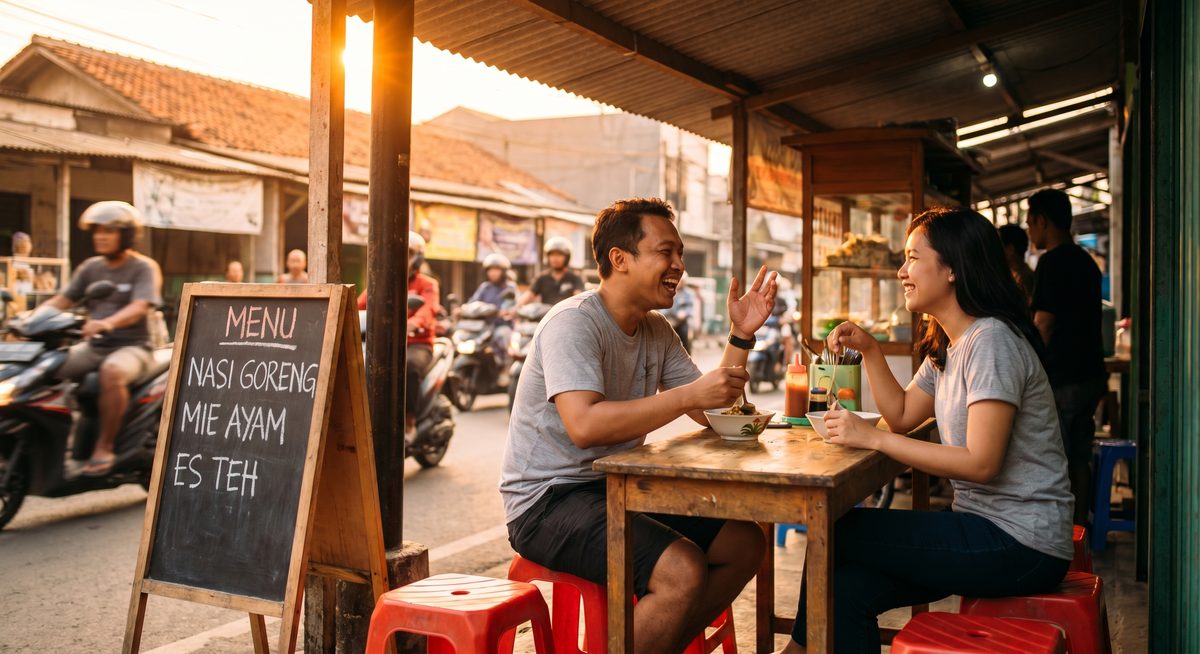
I once spent about a week thinking kan was three different words. Sometimes my friend Reza tacked it onto the end of a sentence like a question. Sometimes it appeared in the middle of one, doing some kind of "no, but" job. Sometimes it sat at the end of a verb like a tail. I kept asking him "wait, is that the same word?" and he kept saying "kind of?" which is the worst possible answer when you're trying to learn a language.
It turns out kan really is doing several jobs that happen to share the same three letters. They aren't related in any deep grammatical way. Indonesian just has a habit of recycling sounds. Kan can be a tag question particle, a shortened version of bukan, what's left over from akan, and a suffix that completely changes what a verb does. Each one shows up in a different position in the sentence, which is the only thing that saves you from going insane.
The tag question: kan as "right?"
This is the version you'll hear most often in casual speech. Stick kan at the end of a sentence and you've turned it into a tag question, the equivalent of "right?" or "isn't it?" in English.
Kamu sudah makan, kan? You've eaten, right?
Dia orang Bali, kan? She's Balinese, isn't she?
Murah, kan? Cheap, right?
The function is checking in with the listener. You think you know the answer, you're just confirming. It's also a way of inviting agreement without sounding pushy about it.
What makes kan particularly useful is that it can also drop into the middle of a sentence, where it shifts from "right?" to something closer to "you know" or "obviously, but". Saya kan sudah bilang means "I told you already, didn't I", with that slightly exasperated tone of someone who's said it before. Dia kan masih kecil means "she's still little, you know", offered as a reminder.
This middle-of-the-sentence kan is harder to use correctly because the placement carries meaning. It usually goes right after the subject. Drop it in too late and the sentence sounds wrong, even if every word is technically there.
Kan as a shortened bukan
Bukan means "no" or "not", but specifically for nouns and pronouns. (For verbs and adjectives you'd use tidak, which I wrote about in the post on tidak versus nggak.) Dia bukan dokter. He's not a doctor. Itu bukan punya saya. That's not mine.
In quick speech, bukan often gets clipped to just kan. Especially in tag questions. "She's a doctor, isn't she?" becomes Dia dokter, kan?, where kan is doing the work of both "isn't" and the tag question particle at once. The full version, Dia dokter, bukan?, is grammatically fine but I almost never hear it outside of more careful speech.
Here's where it gets confusing: tag-question kan and reduced-bukan kan sound identical and sit in the same position. Most of the time you don't need to distinguish them. The meaning lands either way. Indonesian speakers don't really separate them in their heads.
The 'kan from akan
This one is less common in casual speech but you'll see it in writing or hear it in slightly older or more formal contexts. Akan is the formal future marker (I went into this a bit in the post on mau, where I argued mau has mostly taken over its job in spoken Indonesian). Sometimes akan gets shortened to 'kan, written with an apostrophe in careful texts and without one in messages.
Saya 'kan datang nanti. I'll come later.
Hujan 'kan turun. It's going to rain.
You don't really need to use this version yourself. Mau or just plain context will cover almost any future situation in everyday speech. But it's worth recognising when you see it written, because otherwise you'll wonder why the tag question is sitting in the middle of the sentence with no comma in front of it.
The -kan suffix that changes verbs
This is the kan that has nothing to do with any of the above, and the one that got me really confused for a while. As a suffix glued onto the end of a verb, -kan turns the verb into a different verb. Sometimes it makes it transitive. Sometimes it adds a "for someone else" sense. Sometimes it does both, depending on the verb you start with.
Buka means "open". Bukakan pintunya means "open the door for me". The action is being done on behalf of someone.
Beli means "buy". Belikan saya kopi means "buy me a coffee", with "me" as the beneficiary.
Tidur means "sleep". Tidurkan anak itu means "put that child to sleep", which has gone from intransitive (just sleeping) to causative (making someone else sleep).
You'll often see -kan paired with the me- prefix on the front of a verb, giving you words like menjelaskan (to explain), menggunakan (to use), menyatakan (to declare). These are the textbook verbs, the ones you'd write in an email or read in a newspaper. In conversation people often drop the me- and keep the -kan, so menjelaskan becomes jelasin, with -in being the Jakarta slang version of -kan, which is a whole other story.
The good news is the suffix is attached to a verb, so positionally it's nothing like the standalone kan that floats at the end of a sentence. You won't actually confuse them in real text. They just share a spelling.
How to actually keep these straight
Position does most of the work. End of the sentence, after a comma or a pause? That's the tag-question or reduced-bukan kan. Glued to the end of a verb with no space? That's the suffix. Standalone before a verb, especially in writing? Probably the shortened akan.
You don't need to consciously parse this every time. After a few weeks of listening you'll just know which is which, the same way English speakers don't think about whether "right" means correct, or the direction, or "okay-let's-go". Context handles it.
What's worth practising is using tag-question kan yourself. It's an easy way to sound more natural and to soften statements that might otherwise come across as flat. Bagus, kan? is a much friendlier sentence than just Bagus. You're including the other person, asking them to share the view.
The middle-of-sentence kan takes longer to get right. I still misuse it sometimes, mostly by putting it in places where it sounds slightly defensive when I just meant casual. If in doubt, leave it out. Tag-question kan at the end of the sentence is the safer way to dip your toes in.
Where I still trip up
The one that still catches me is when kan shows up in the middle of a fast sentence and I parse it as a tag question, then get confused when the sentence keeps going. Dia kan sudah pergi ke Bandung minggu lalu. I want to break that into "she, right?" then "she's already gone to Bandung last week", which makes no sense. The kan there is the "you know" version, slotted between subject and verb. The sentence means "she's already gone to Bandung last week, you know".
Slowing down helps. So does just listening to a lot of casual Indonesian and getting your ear used to where these little particles slot in. Reading Indonesian with context is more useful for this than memorising rules, because the cadence and the way native speakers chain sentences tells you where the breaks are even when the punctuation doesn't.
If you want to drill the patterns where kan shows up, our contextual exercises include a lot of the casual register where these particles live. You won't find this stuff in formal textbooks. It lives in messages, in conversations, in the bits of the language that get cut from the curriculum because they don't fit neatly into a grammar rule.
Most of what I learned about kan came from getting it wrong with friends and being gently corrected, which an app can't replicate. The closest substitute is constant exposure to natural Indonesian in context, which is the gap most textbooks leave. Our plans include enough reading material that you'll see kan in the wild dozens of times a week. After a few hundred encounters it stops feeling like a puzzle and starts feeling like a comma.
If particles in general are your thing, the post on lah, dong, sih, and kok covers the other four little words that shape the tone of Indonesian sentences. Kan probably should have been in there, honestly. I just didn't realise at the time how much work it was doing.