The first Indonesian word that made me laugh out loud was rumah sakit. Literally: sick house. That's the word for hospital. No Latin root, no clever coinage, no need to dress it up. Sick people go there. It's a house. Done.
The second one was mata hari. Eye of day. That's the sun.
I remember sitting on a kerb in Sanur, watching the sky go peach and thinking: who looks at the sun and decides to call it the eye of the day? Whoever they were, I wanted to be friends with them.
The pattern is just two words doing one job
Indonesian has a deep habit of building new vocabulary by jamming two existing words together. No glue, no special marker, no compound stress like German. You just put one word next to another and the pair takes on a meaning of its own.
Some of them are wonderfully literal:
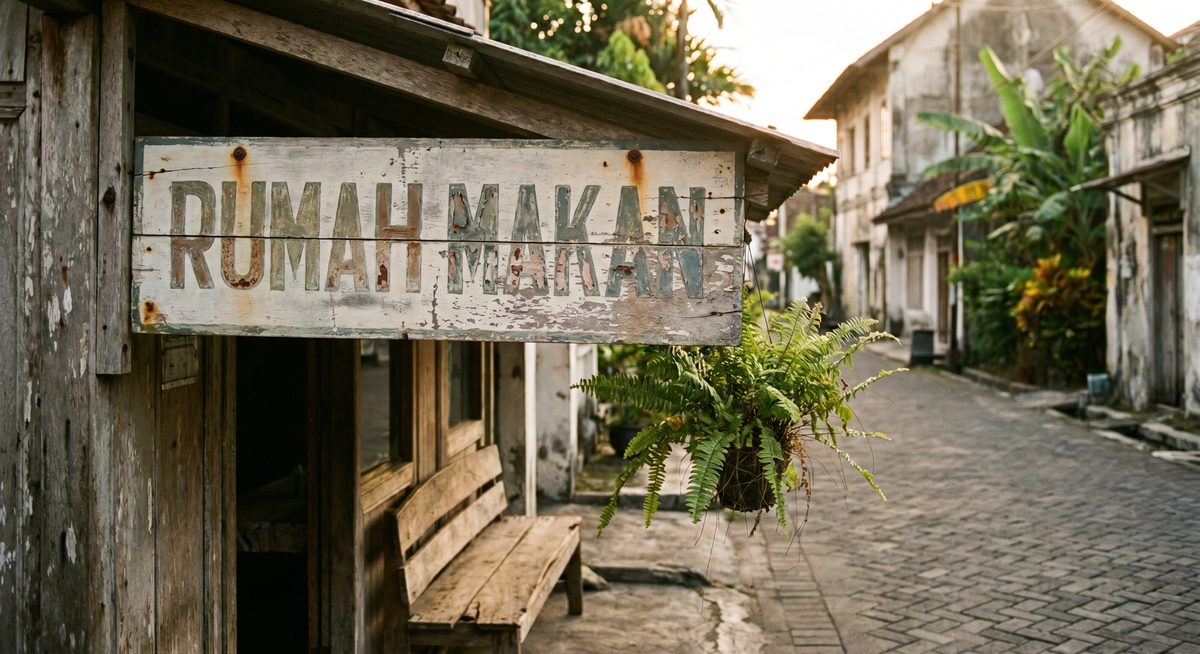
rumah makan, eating house, restaurant.
kamar mandi, bathing room, bathroom.
meja tulis, writing table, desk.
kapal terbang, flying ship, aeroplane.
kereta api, fire carriage, train. (This one's a hand-me-down from the steam era and Indonesia kept it.)
You can sometimes guess these on a slow second reading even if you've never seen them before. Once you know rumah is house and sakit is sick, rumah sakit jiwa, a sick soul house, suggests itself pretty quickly. It's a psychiatric hospital. Indonesian respects your ability to do basic arithmetic on its vocabulary.
This is a different game from the prefix-and-suffix system, which welds bits onto a single root to make new words. Compounds keep both halves visible. You can see the joints.
Where it stops being literal and starts being good
Then there are the ones that aren't trying to be obvious. They're little poems with a definition attached.
buah hati, fruit of the heart, a beloved child.
buah pikiran, fruit of thinking, an idea.
buah tangan, fruit of the hand, a souvenir or a small gift you bring back from somewhere.
anak emas, gold child, the favourite, the teacher's pet.
ibu jari, mother of fingers, the thumb.
ibu kota, mother of cities, the capital.
You don't actually need to know these to function in Indonesia. Tas ini buah tangan dari Bandung, this bag is a gift from Bandung, is perfectly understandable if you only know the words. But knowing them gives you a slightly different relationship with the language. You stop translating word for word and start tasting how the language thinks.
Indonesian does a lot of this with body parts, by the way. The ankle is mata kaki, the eye of the foot. A water spring is mata air, the eye of water. Currency is mata uang, the eye of money. A school subject is mata pelajaran, the eye of a lesson. Mata apparently means many more things than just the round wet thing on your face.
The compounds that quietly carry an attitude
Some compounds turn into idioms and start meaning something fairly different from the two halves.
Kaki tangan, foot-and-hand, sounds like it might be a yoga pose. It actually means a henchman, an accomplice, somebody's lackey. Useful when reading about corruption cases in the news, which in Indonesia is most days.
Panjang tangan, long-handed, means a thief. The hand that reaches into places it shouldn't.
Ringan tangan, light-handed, can mean two things depending on who you ask: quick to help, or quick to hit someone. Same compound, two opposite social meanings. You have to read context.
Tangan kanan, right hand, mostly maps onto the English version. The trusted second-in-command. Probably borrowed.
Besar kepala, big-headed, is arrogant. The same image English uses, so it lands easily.
Keras kepala, hard-headed, is stubborn. Also intuitive.
These are the ones that catch beginners off guard. If you take them word by word you get nonsense. If you let them sit as one unit, they're often more vivid than the English equivalent. I'd rather be told someone is panjang tangan than that they're a thief. The first sentence does more.
The bit nobody warns you about: spelling
Some compounds are written as one word, some as two. There isn't always a clean rule and you'll see disagreement online.
Olahraga, sport, was originally olah raga, body exercise. Now it's solid.
Matahari, sun, often turns up as one word too, especially as a brand name. (There's a department store called Matahari, which is how I first saw it.)
Rumah sakit stays as two words. Almost always.
Sapu tangan, sweeping hand, meaning handkerchief, is two words.
Kerja sama, work together, meaning cooperation, is two words officially, but you'll see kerjasama constantly in WhatsApp groups, on banners, in print.
Don't get precious about it. Native speakers don't. The official spelling rules from Pusat Bahasa say one thing and the real world says whatever it fancies. If you're writing for an exam, follow the rules. If you're writing a message to a friend, do whatever they do.
Why this is useful for learners specifically
Compound words give you a lot of vocabulary for very little effort. When you learn rumah, kamar, meja, and buah as basic words, you've actually unlocked a fairly long list of compounds without doing extra work. Knowing buah alone gets you:
buah tangan, souvenir.
buah hati, sweetheart or child.
buah pikiran, idea.
buah bibir, fruit of the lips, the talk of the town.
buah dada, fruit of the chest, a fairly direct word for breast.
I'm not telling you to memorise these as a list. The list will fade in a week. What I'd say is: when you meet a new word in the wild, pause and check whether it's a compound. If it is, learn both halves properly. You'll get the compound for free plus a small constellation of related ones.
This is also a reason real reading practice beats flashcards in my experience. Compounds make sense only in context. Buah dada on a flashcard looks like a fruit. Buah dada in a sentence about anatomy clearly is not.
A handful of practical compounds worth stealing
If you want to walk away from this post with usable vocabulary rather than just appreciation, here are the ones I use almost weekly:
rumah makan, restaurant (often interchangeable with warung makan for the smaller ones).
kamar mandi, bathroom. Important everywhere.
kamar tidur, sleeping room, bedroom.
tempat tidur, sleeping place, bed.
ibu kota, capital city.
kepala sekolah, head of school, headteacher.
tanda tangan, sign of the hand, signature.
kartu nama, name card, business card.
sepeda motor, motor bicycle, motorbike. (The thing you'll spend half your trip dodging.)
orang tua, old person, parents.
That last one is a small lesson on its own. Orang tua, in the singular, just means an old person. In context, especially when paired with a possessive, it means parents. Orang tua saya means my parents. Not my old person. Indonesian is full of these context shifts and it stops feeling weird once you've sat with the language for a few months.
The pattern doesn't always work
I want to be honest. Not every Indonesian word is built this way and you'll sometimes try to compound-decode something that just happens to be a single word with no internal logic. Bunga is flower, also interest as in bank interest. That's a polysemy, not a compound. Tinggi is tall and high, but setinggi-tingginya isn't two separate words mashed together, it's a different mechanism related to reduplication.
Also, plenty of compounds have drifted so far that the original meanings are nearly gone. Tetangga, neighbour, looks like it could be a compound but actually traces back to tangga, ladder or step. The connection is faint at best and most speakers don't think about it. You don't need to either.
So treat compound-spotting as a tool, not a rule. When it helps, use it. When it doesn't, move on. The danger of getting too keen with this is the same as getting too keen with false friends: you decide what a word means before you've actually heard a native speaker use it.
What I'd do if I were starting over
If I were back at week one, I'd keep a small notebook of compounds I came across, with the two halves and the joint meaning side by side. Not for memorisation. For pattern recognition. After a couple of months you start to feel the shapes, the way buah, mata, orang, and anak show up over and over as the first half of something else.
You can also practise Indonesian with material that puts these in context rather than flat word lists. Compounds want sentences around them. They want a menu, a sign, a conversation. Drilling kaki tangan in isolation teaches you nothing useful. Hearing it in a news headline about a politician's circle teaches you everything.
If you want a structured route through this, our lessons drip-feed compounds in context rather than dumping them as glossary entries. And the paid plans get you the dialogue-style practice where compounds actually live.
One last thing
Indonesian's habit of building from existing pieces is part of why it feels approachable even when it's strange. Nothing is hidden. You can almost always see how a word was made. The language is, in a quiet way, generous with you. It hands you the components and trusts you to put them together.
It also means once you've got a few hundred basic words, you've actually got a much bigger vocabulary than you realise. You just haven't stitched it together yet.
The eye of the day is the sun. The fruit of the heart is your child. The sick house is the hospital. Once you start noticing, you'll see it everywhere.