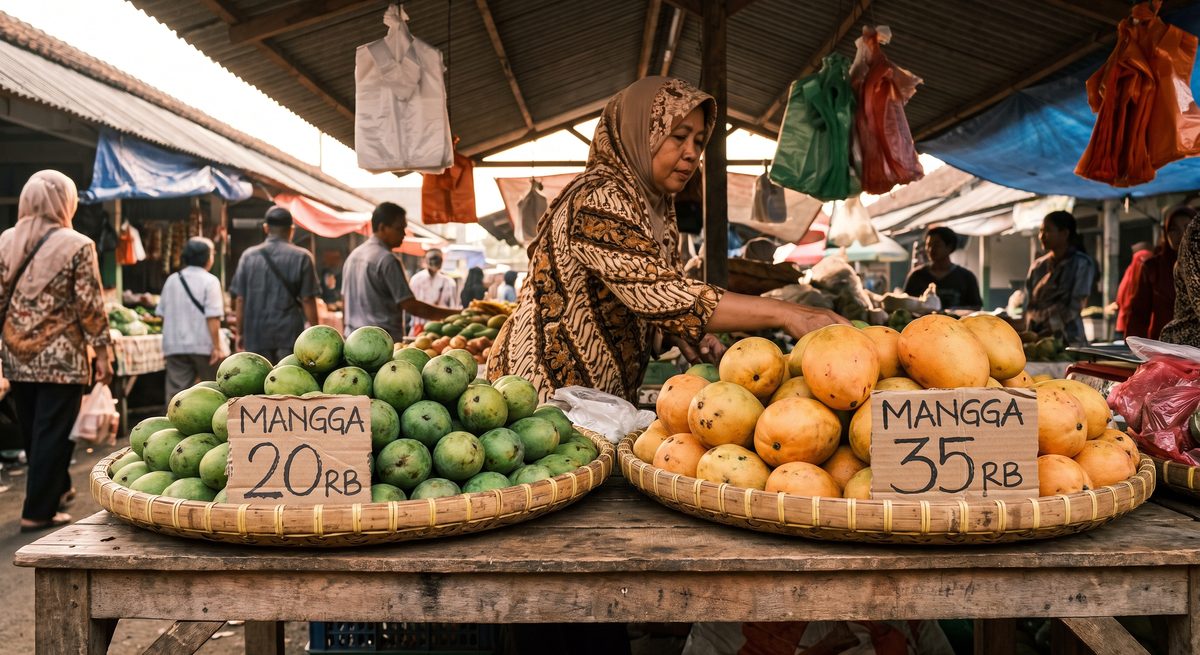
A vendor in Pasar Baru once quoted me two prices for two baskets of mangoes and I understood every word of the sentence she used to justify the gap: yang ini lebih manis. This one is sweeter. What stopped me was what wasn't there. No -er on the end of the adjective, no irregular form to memorise, no agreement with anything. She had taken the plain word for sweet and put one extra word in front of it.
That is the whole comparative system in Indonesian. You never modify the adjective. You add lebih for more, paling for most, and se- for the same. Three words and you can compare anything. I remember feeling smug about this for roughly a week, until I heard someone use paling to mean "probably not much" and realised the tidy version I had learned was only the first layer.
Lebih and the missing comparison
Lebih goes in front of the adjective and means "more".
Mahal means expensive. Lebih mahal means more expensive.
Cepat means fast. Lebih cepat means faster.
Enak means tasty. Lebih enak means tastier.
To say what you are comparing against, you add daripada.
Jakarta lebih panas daripada Bandung. Jakarta is hotter than Bandung.
Naik kereta lebih murah daripada naik pesawat. Taking the train is cheaper than flying.
In speech, almost nobody says the full daripada. They say dari. Jakarta lebih panas dari Bandung. Textbooks and school teachers will tell you this is sloppy, because dari is supposed to mean "from" and daripada is supposed to be reserved for comparisons. In practice the shortened form is everywhere, including in print, and no one will misunderstand you. Use daripada when you're writing something formal and dari when you're talking, and you'll sound about right in both.
The more useful habit is dropping the second half altogether. Indonesian is comfortable leaving the comparison implied in a way English often isn't.
Ada yang lebih besar? Do you have a bigger one? (Bigger than the one in my hand, obviously.)
Coba yang lebih murah. Try a cheaper one.
Besok lebih baik. Tomorrow is better.
This shows up constantly when shopping. You almost never need to name the thing you're comparing to, because it's sitting on the table in front of you.
Paling, and the ter- that shadows it
For superlatives, swap lebih for paling.
Ini yang paling enak. This is the tastiest one.
Dia paling pintar di kelas. She's the cleverest in the class.
Jalan ini paling cepat. This road is the fastest.
Then there's the other superlative: the prefix ter-. Terbaik, terbesar, tercepat, termurah. It means the same thing as paling, and learners usually want a rule for choosing between them. The rule is roughly this: paling is the spoken default, ter- is what you see in writing, headlines, advertising and anything trying to sound official. Hotel terbaik di Bali is a marketing line. Hotel yang paling bagus di Bali is what your friend says when you ask them where to stay.
Ter- is also not fully productive. It attaches happily to short, common adjectives and gets uncomfortable elsewhere. Terpanas exists but sounds strained in conversation. Terenak gets used online and still makes some Indonesians wince. If you're not sure whether a ter- form is a real word, use paling, which works with absolutely everything.
One thing to keep straight: this superlative ter- is a different animal from the ter- that marks accidental or completed actions, as in tertidur (fell asleep without meaning to) or terbuka (open, having been opened). Same prefix, different jobs, and context does all the disambiguating. I went through the full set of those in the piece on ber-, ter- and me-, and the accidental one is far more common in speech than the superlative one.
Se- for saying two things match
To say something is as tall as, as expensive as, as good as, stick se- on the front of the adjective.
Setinggi means as tall as. Rumahnya setinggi pohon itu. His house is as tall as that tree.
Semahal means as expensive as. Nggak semahal yang saya kira. Not as expensive as I thought.
Sebagus means as good as. Kualitasnya sebagus yang asli. The quality is as good as the original.
The se- here comes from sama, meaning same, which does a lot of quiet work in Indonesian generally. Worth reading up on if you haven't, because sama has taken over the jobs of several other words in everyday speech and this is only one of them.
There's a longer form too: sama ...-nya dengan. Harganya sama mahalnya dengan yang di toko sebelah. The price is just as expensive as the one in the shop next door. It's clunky, it's more formal, and you can go a long time without needing it. But you'll see it in written Indonesian and it helps to recognise the shape.
My favourite use of se- is the exasperated one. Semahal itu? That expensive? Sejauh itu? That far? The itu points at a fact just mentioned, and the whole phrase does the work of a raised eyebrow.
Going the other direction
For "less", you have kurang. Kurang enak means less tasty, or not very tasty. Kurang jelas means not very clear.
What's interesting is how much softer kurang is than the direct negative. Saying tidak enak about someone's cooking is a verdict. Saying kurang enak is a gentle hedge that everyone understands to mean the same thing. Indonesians use kurang to avoid flat contradiction all the time: saya kurang tahu literally means "I know less", but it functions as "I'm not really sure", and it's what people say instead of admitting outright ignorance. Related territory to what I wrote about in the piece on tidak and nggak, where the choice of negative carries as much social information as grammatical.
You can also negate the se- forms: tidak setinggi (not as tall as), nggak semahal (not as expensive as). This is more common than saying kurang tinggi daripada, which sounds translated.
Makin, and the more X the more Y
Makin (or semakin, which is the same word with a prefix and slightly more formal) means "increasingly".
Makin mahal. Getting more expensive.
Bahasa Indonesianya makin bagus. Your Indonesian is getting better.
Doubled up, it gives you the "the more, the more" pattern that English needs a whole construction for.
Makin lama makin bagus. The longer it goes, the better it gets.
Semakin banyak orang, semakin ramai. The more people, the livelier it is.
This one is worth drilling because it comes up in ordinary conversation far more than its slightly literary feel suggests. Traffic, prices, the weather, someone's health, your own progress with the language: all of these get described with makin constantly.
The bit that catches people out
Here's the one I promised. In casual speech, paling often has nothing to do with superlatives. It means something closer to "at most" or "probably only".
Paling juga dia telat. He'll probably just be late, that's all.
Paling lima menit. Five minutes at the most.
Paling dia lupa. He most likely just forgot.
You can see how it got there. "The most it could be is five minutes" collapses into "five minutes at most", and from there into a general marker of dismissive prediction. The first time someone answers your worried question with ah, paling nggak apa-apa, the superlative reading gives you nothing useful. It means "it's probably fine".
The other one to know is mending or mendingan, which is the spoken cousin of lebih baik. It means "better off" or "rather".
Mendingan naik ojek. Better to take an ojek.
Daripada nunggu, mending jalan kaki. Rather than waiting, we might as well walk.
That second example shows daripada doing its other job. It doesn't only mean "than" in comparisons, it also means "rather than" at the start of a clause. Once you notice this you'll hear the daripada ... mending pairing everywhere, especially from anyone stuck in Jakarta traffic weighing up options.
What this actually costs you to learn
Compared with most of Indonesian grammar, this is a cheap area. There are no irregular comparatives to memorise, nothing agrees with anything, and the word order barely changes. If you learn lebih, paling, daripada, se- and kurang, you can express every comparison you'll need on your first day in the country.
The expensive part is the register. Knowing that ter- belongs on a billboard and paling belongs in a conversation, that kurang is doing politeness work rather than arithmetic, that paling in casual speech has drifted away from its dictionary meaning entirely: none of that comes from a grammar table. It comes from hearing the words used by people who aren't thinking about them. Which is the annoying answer, but it's the honest one.
If you want to practise Indonesian with sentences that sound like the ones people actually say, that's roughly what we built the app for. You can sign up and work through it for free, and our plans cover the full set of exercises if you want to go further.