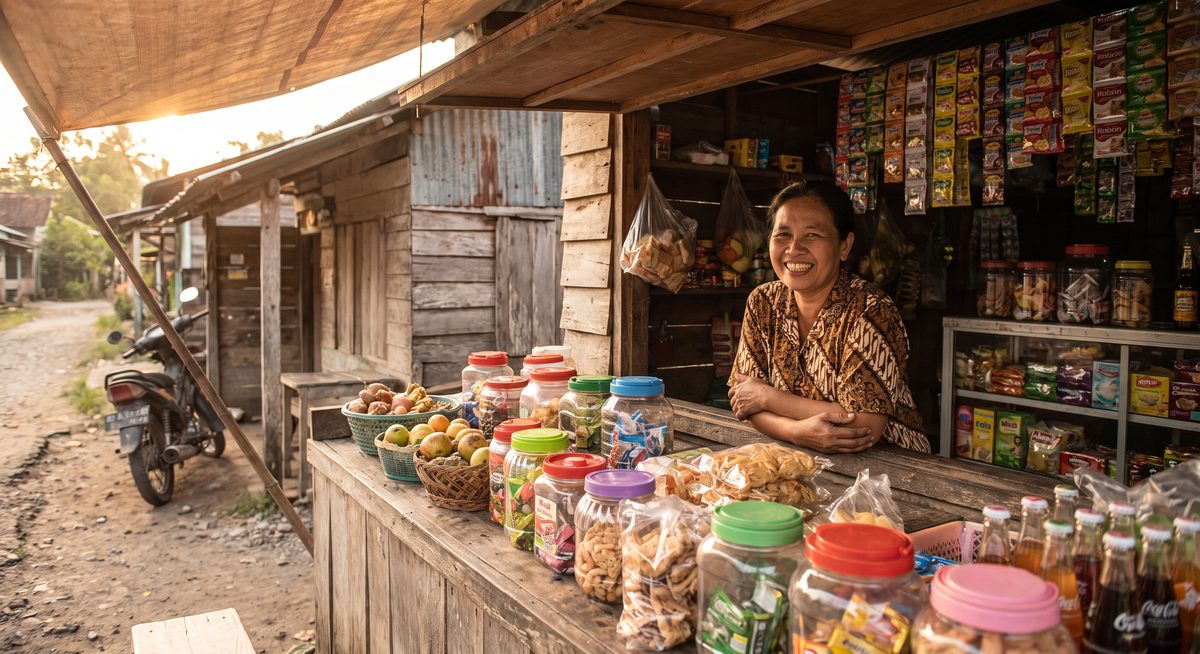
The first thing I said at a warung in Gili Air, before I had much Indonesian at all, was "ada Bintang dingin?" The shopkeeper pointed at the fridge. Transaction done. I didn't know it then, but I'd just used one of the most useful words in the language.
Ada means "there is" or "there are." It also means "is there?" or "do you have?" It indicates location. It shows up in one of the most common casual greetings in Indonesian. It is, in a fairly literal sense, everywhere.
The basic use: existence
At its most straightforward, ada tells you something exists or is present.
Ada orang di sana. There's someone over there. Ada masalah. There's a problem. Tidak ada parkir. There's no parking.
The negative is tidak ada, which means "there isn't any" or "there's none." In normal speech you'll hear it shortened to nggak ada or just gak ada. If you ask a shopkeeper for something and they say gak ada, they don't have it. You need nothing more complicated than that to get through a market.
Asking if something is available
This is where English speakers usually have to adjust. Instead of "do you have...?", Indonesian typically asks whether something exists. "Ada [item]?" is a complete question.
Ada kopi? Do you have coffee? Ada WiFi? Is there WiFi? Ada kamar kosong? Is there a room free?
It works the same whether you're asking about a product, an amenity, or a service. Ada AC? Is there air conditioning? Ada ATM dekat sini? Is there an ATM near here? The word doesn't care about what you're asking about, which makes it a very efficient building block once you've got it.
Ada for location
Indonesian also uses ada to place things in space. Instead of "where is," you'll often hear ada di mana?, which translates roughly as "where does this exist?" It sounds odd in English but is natural in Indonesian.
Toilet ada di mana? Where is the toilet? Dia ada di mana? Where is he? Ibu ada di dapur. Mum is in the kitchen.
This trips people up because they expect a different verb for location. But ada handles it cleanly, and once you recognise it you'll stop wondering why you can't find "is" or "are" where you'd expect them.
Ada versus punya
Punya means "to own" or "to possess." Ada covers availability and presence. In practice the line blurs, but there's a distinction worth keeping in mind.
Saya punya motor. I own a motorbike. That's possession. Ada motor? Is there a motorbike? That's asking whether one is available or accessible.
The same pattern you'll see in bisa versus boleh applies here: two words that look nearly interchangeable but carry different shades. If you want to ask whether someone has a document on them right now, ada is usually more natural than punya. Ada KTP-nya? Do you have your ID? - that's the phrasing you'd hear at a hotel check-in or a government counter, not punya KTP-nya?
I got this wrong repeatedly early on. I kept asking hotel receptionists "punya kamar?" (do you personally own a room?), when "ada kamar kosong?" was clearly what I meant. People understood, but it sounded like an odd question. Mau has a similar issue where the textbook definition only covers part of what the word does.
Ada apa
Ada apa? literally asks "there is what?" and functions as two different things depending on context. Between friends it's just "what's up?" - genuinely casual, said in passing. But when something has clearly happened, the same phrase becomes a real question: what's going on?
Tone makes the difference. The words don't change. You'll pick this up quickly because the contexts are usually obvious, but it's worth knowing that ada apa isn't just a greeting.
There's also ada-ada aja, which uses reduplication to mean something like "you're always pulling something" or "of course that happened." It's the phrase you say when someone does something predictably chaotic. Mildly exasperated, occasionally affectionate.
The negation question
Tidak ada is correct and formal. Nggak ada is what you hear in most conversations. The formal and informal negation split runs through a lot of Indonesian, and ada is no exception. In eastern Indonesia you might also hear nda ada or ndak ada, with a regional flavour of the same negation.
If you hear someone say "ada gak?", they're asking "is there any?" in a compressed form. The gak at the end turns the statement into a yes/no question, and it's the kind of shorthand that turns up constantly in casual speech. Getting comfortable with these compressions is what makes you sound less like you're reading from a government pamphlet.
Why it matters early
You can navigate a serious amount of Indonesian daily life on ada [thing]? plus understanding ada versus nggak ada in response. It's probably the first exchange that feels genuinely communicative rather than just word-matching, because it's transactional and immediate. Someone either has something or they don't, and the word tells you.
Once you've got that working, the location usage tends to click naturally - it's the same word, pointing at where something is rather than whether it exists. The casual greeting usage comes later and mostly through exposure.
If you want to practise Indonesian in context, ada appears constantly across different exercise types precisely because it's so frequent. Seeing it in varied sentences is probably the fastest way to stop second-guessing which meaning applies. Start for free and you'll notice it turning up before long.
There's no single word in English that maps cleanly onto everything ada does, which is part of why it takes a while to internalise. But once it clicks, it genuinely does feel like a word that was doing a lot of work all along and you just didn't notice.